Chapter 28 · Part 06
Why Does Russia Fear Empty Space?
Plains, strategic depth, access to the sea and memories of invasion.
Great plains, distance, maritime access and memories of invasion help explain Russian strategic culture—without turning geography into a justification for political choices.
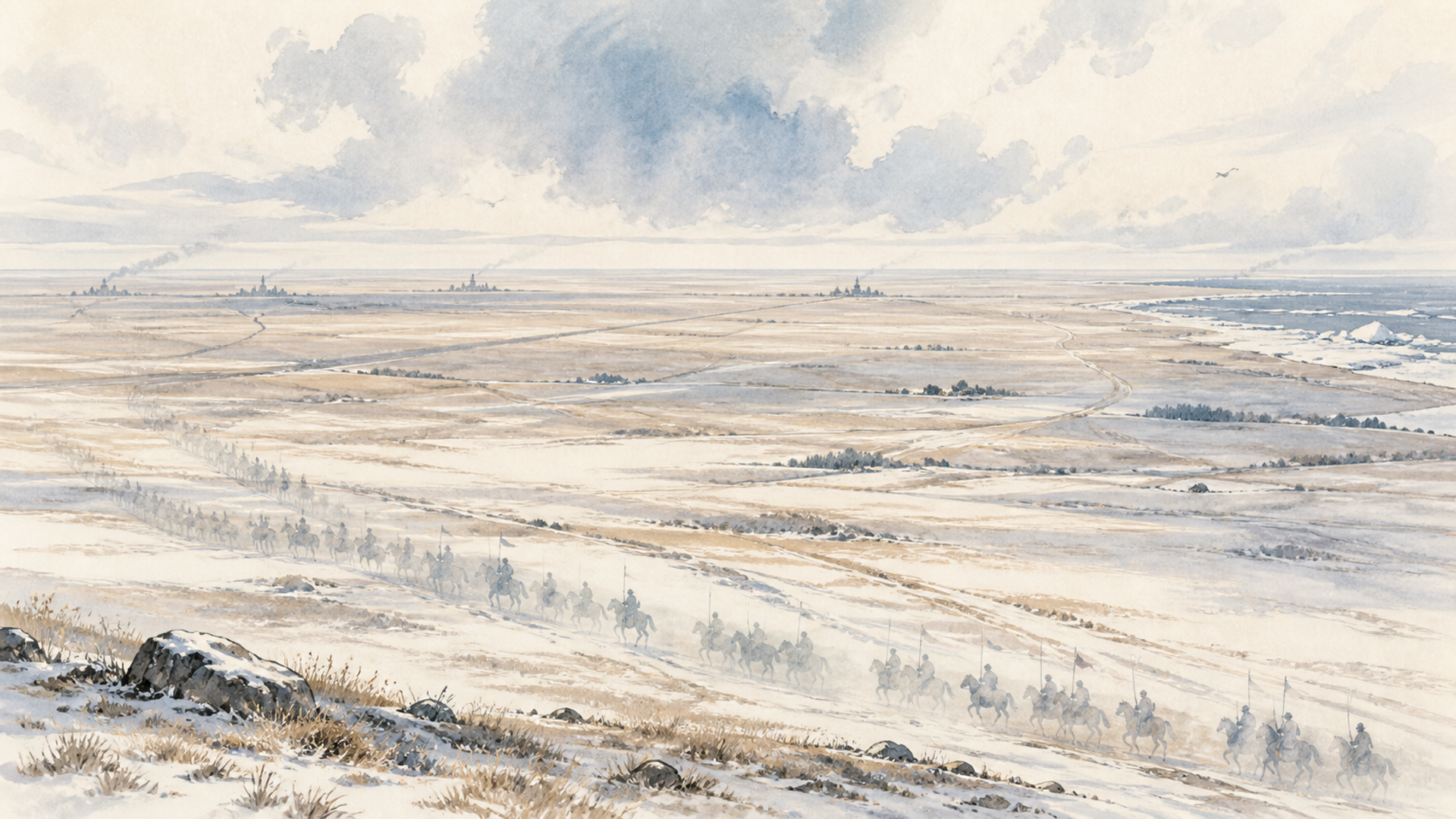
Drive east from Berlin and you cross political borders, languages and different histories, but for long stretches you do not meet the natural barrier that western Europeans often associate with security. There is no mountain chain comparable to the Alps closing the road. A broad belt of lowlands extends from northern Germany through Poland and Belarus into European Russia. It is not perfectly flat, of course, and rivers, marshes and forests have often mattered enormously in war. Yet compared with many parts of the planet, Russia’s political heartland has no obvious natural wall to the west.
On a map this seems almost banal. In Russian historical memory, however, it overlaps with invasions and wars that left deep scars: Napoleon’s advance to Moscow in 1812, Germany’s invasion during the First World War and, above all, Operation Barbarossa in 1941, when Nazi Germany and its allies attacked the Soviet Union across an immense front. The Second World War cost the USSR tens of millions of military and civilian lives. It is hard to overstate how deeply that trauma shaped Soviet strategic culture and, in part, the Russian culture that followed it.
This produces a seductive geopolitical explanation: the plain supposedly condemns Russia to seek territory and buffer states because only distance can protect it. There is truth in the intuition, but turn it into a law of nature and explanation becomes justification. Geography helps explain why Russian leaders may value strategic depth. It does not by itself explain a particular policy, much less make the invasion of a neighbour inevitable. The countries between Russia and western Europe are not empty spaces on someone else’s map. They are societies with their own memories, interests and right to choose their future. Geopolitics becomes most dangerous precisely where two ideas of security overlap on the same territory.
When distance becomes a weapon
Napoleon entered Russia in 1812 with a vast force drawn not only from France but from across Napoleonic Europe. The campaign is often compressed into a sentence: “The Russian winter defeated him.” Winter contributed to the final catastrophe, but the story is much more interesting. The Grande Armée began to erode well before the famous snow. Distances were immense and roads difficult; people and horses required prodigious quantities of food and fodder. Disease, desertion, fighting and supply failures steadily reduced the force. Russian armies long avoided the decisive battle Napoleon wanted, retreating inland and denying him a swift political victory.
After the bloody battle of Borodino, the French reached Moscow without obtaining what Napoleon expected. Tsar Alexander I did not ask for peace. Much of Moscow burnt, and the occupying army found no strategic decision there. Retreat turned a campaign already in trouble into disaster. Cold, hunger, Russian attacks and logistical collapse completed the destruction.
The lesson is not that Russia cannot be conquered. Its history contains occupations, defeats and territorial losses. The lesson is that space can alter the balance between attacker and defender. Every hundred kilometres an army advances adds a hundred kilometres over which food, ammunition, reinforcements and information must travel. A defender able to withdraw without immediately losing the means to fight possesses something a small state does not: depth.
The same mechanism appeared in a more terrible form in 1941. Germany’s attack on the Soviet Union initially made astonishing advances, captured vast territory and inflicted appalling losses. The USSR nevertheless moved part of its industry eastwards, mobilised new forces and continued fighting. Distance, climate and logistics burdened Germany, but snow did not win that war either. Soviet resistance and mobilisation, German operational decisions, industrial production, Allied aid and many other factors mattered. Geography imposed costs; political and military systems turned those costs into history.
The empire that expands to feel less exposed
Modern Russia grew from a comparatively small core and expanded over centuries towards the Baltic and Black Seas, through the Caucasus and Central Asia, across Siberia to the Pacific. Calling all of this a search for security would be far too simple. As with other empires, resources, trade, prestige, dynastic opportunities, rivalry and the central state’s appetite for territory and people all mattered.
Security and expansion nevertheless reinforced one another in a paradoxical way. If a frontier feels vulnerable, move it farther away. Once you take more territory, however, you possess an even longer frontier to defend. Seek another buffer and the process begins again. Many empires have discovered that the search for a “finally secure” frontier can become endless. The problem is that the land serving as your buffer is somebody else’s home.
After the Second World War, the Soviet Union built a system of allied states and communist regimes across eastern Europe. To Moscow, friendly governments between the Soviet border and Germany could be understood through the trauma of 1941. To many Poles, Czechs, Hungarians, Balts and others, the same system meant Soviet domination, constrained sovereignty and, in several cases, military repression of attempts at political autonomy. One strip of land could be described as strategic depth from one side and lost freedom from the other. Maps of security quickly become moral and political maps.
When the Soviet Union collapsed in 1991, Moscow lost not only its ideological empire in eastern Europe. Fourteen former Soviet republics became independent states alongside the Russian Federation. For many Russians this was an immense economic and identity shock. For many citizens of the new states it was the recovery or creation of national sovereignty. The same transformation carried opposite memories.
NATO, neighbours and the problem of two fears
After the Cold War, countries across central and eastern Europe sought NATO membership. Poland, the Czech Republic and Hungary joined in 1999. Seven more states entered in 2004, including Estonia, Latvia and Lithuania, which had been Soviet republics. The alliance continued to expand. After Russia’s full-scale invasion of Ukraine in 2022, Finland and Sweden abandoned decades of military non-alignment and joined in 2023 and 2024 respectively, bringing NATO to thirty-two members.
Russian governments, especially under Vladimir Putin, have long presented NATO enlargement as a growing threat and evidence that the West disregarded Moscow’s security interests. That perception is real and must be taken seriously if we want to understand Russian decisions. It is also only half the story. Poland, the Baltic states and their neighbours did not enter the alliance because somebody slid them across a board. They actively sought western guarantees, partly because memories of Russian and Soviet power made them fear another period in a grey zone.
A measure one side regards as defensive may look threatening to another, which responds with measures the first side then regards as threatening. This is often called a security dilemma. Even that useful idea must not become an alibi that erases political responsibility.
Russia annexed Crimea in 2014, an act widely regarded internationally as illegal, while war began in the Donbas. On 24 February 2022, the Russian Federation launched a full-scale invasion of Ukraine. The United Nations General Assembly described the action as aggression in violation of the UN Charter and demanded that Russia withdraw from Ukrainian territory. In 2026, the war continues to bring death, injury and destruction. Russian authorities have offered shifting arguments and objectives, including security claims linked to NATO. Ukraine and the large majority of states voting in the UN General Assembly have rejected the notion that those claims legitimise invasion.
Our central rule is indispensable here. The eastern European plain is real. Memories of invasion are real. NATO enlargement is real. So are neighbouring states’ sovereignty, their memories of Russian rule, ideology, domestic politics, leaders’ ambitions and choices that could have been different. “Russia invaded because it has no mountains” is not geopolitics. It is caricature.
Ukraine is not space between two powers
Buffer is a convenient word for strategic map-makers and a dangerous one for those who live inside it. Ukraine is the clearest example. Its territory lies between Russia, central Europe and the Black Sea, but reducing it to a strip meant to separate Moscow from NATO erases both its political history and its citizens’ agency.
When the Soviet Union dissolved in 1991, Ukrainian independence won an overwhelming majority in a national referendum, with a majority in every administrative region. Ukrainian politics in later decades was often divided and contradictory, with deep ties both to Russia and Europe; it did not follow an inevitable path towards one camp.
That makes the crisis of 2014 particularly instructive. The Maidan protests, President Viktor Yanukovych’s flight, Russia’s annexation of Crimea and the Donbas war were interpreted radically differently. Moscow described political change in Kyiv as a western-backed coup and threat. Many Ukrainians saw the fall of a government that had lost legitimacy after repressing protest and abandoning an association agreement with the European Union. Whatever one’s interpretation of Ukraine’s internal crisis, the great majority of states did not recognise the annexation, and the UN affirmed Ukraine’s territorial integrity.
The war expanded in 2022 with Russia’s attack on several fronts. If geography were destiny, we could stop at a great power seeking strategic depth. The consequences reveal the limit of that explanation. The attack drove Finland and Sweden into NATO, enlarging the alliance and creating a long direct NATO–Russia frontier through Finland. A policy justified partly in the language of security can produce the opposite of its declared result. Other actors react. Geopolitics is not chess played by one hand.
The “warm-water port” myth and the real question of access
Another familiar phrase says Russia has always sought a “warm-water port”. Again, a useful intuition hides inside an oversimplification. Russia has important ports on several seas. Murmansk remains operational at very high latitude under the influence of North Atlantic currents. Vladivostok opens to the Pacific; Saint Petersburg to the Baltic.
The strategic issue is not simply finding water that does not freeze, but where a port leads. Ships leaving the Black Sea pass through the Bosporus and Dardanelles, straits controlled by Turkey and governed by the Montreux Convention. Baltic access to the Atlantic runs through straits bordered by European and NATO countries. Pacific routes and bases sit in a region shaped by maritime powers such as the United States and Japan. Russia has enormous coastlines, but not always free and direct access to open oceans.
This helps explain the historical importance of Crimea and Sevastopol, home of the Black Sea Fleet. It neither explains away nor justifies the 2014 annexation, but clarifies why the peninsula’s strategic value greatly exceeds its area. As with Gibraltar and Suez, a place may matter for what it opens onto.
European and Asian at once
Looking only westward distorts Russia’s geography. Most of its population lives in the European part, but most of its territory stretches beyond the Urals across Siberia to the Pacific. It contains vast energy and mineral resources that have supported Russia’s economy and international influence.
Oil and gas are not simply commodities. They require pipelines, railways, ports and contracts tying distant fields to particular markets. For decades, much Russian gas sold in Europe travelled through networks crossing Ukraine, Belarus, the Baltic and Black Seas in different configurations. Every route embodied engineering and politics together.
As relations with the West deteriorated, especially after 2022, Moscow tried to direct more energy trade towards Asia. Turning an arrow on a map is far easier than turning a pipeline. Fields, pipes and plants designed for one market cannot always serve another quickly. New infrastructure to China takes years and investment, while the alternative buyer gains bargaining power. Owning a resource does not mean owning every way of selling it.
Siberia reveals distance’s double face. It offers depth, resources and room for industry far from western borders; it also imposes immense costs of transport and maintenance. Many cities exist because state and economy built connections through difficult climates. Russia is powerful partly because it is huge, and expends enormous effort because it is huge. Both statements are true.
Space also costs its owner
Being the world’s largest country by area means vast resources, strategic depth and extraordinary environmental variety. It also means maintaining infrastructure across immense distances, joining remote regions, defending long borders and administering eleven time zones. Space can protect and isolate.
The Trans-Siberian Railway, begun in the late nineteenth century and continuously developed since, is a monument to that problem. Linking Moscow with the Far East was more than transport policy. It made a vast part of the empire more governable and defensible. Railways, oil and gas pipelines, roads and ports remain tools by which Russia converts distance into economic power. Every one also creates a node that must be maintained and protected.
This chapter speaks of “empty space” not because these lands are empty, but because Russian strategy has often feared what lies immediately beyond its control. That fear grows from real historical experience, then passes through ideology and political choice. Treat it as destiny and other actors disappear. Ignore it entirely and an important part of Moscow’s worldview disappears.
Next we cross Eurasia to a power with an almost opposite problem. China possesses an enormous continental hinterland, but contemporary growth has made it increasingly dependent on the sea: on routes bringing energy and materials to its coasts and carrying goods out to the world. Off that coast lies an island where history, identity, military power and a crucial part of global technology converge. The plain showed why one power might fear what lies before it. The sea will show why another fears that somebody might close the door.