Chapter 27 · Part 06
Why Is the United States So Powerful?
The best geography is not enough, but it helps enormously.
Oceans, rivers, farmland and a continental market offer enormous advantages, but they become global power only through industry, institutions, immigration, victories in war, the dollar, alliances and technology.
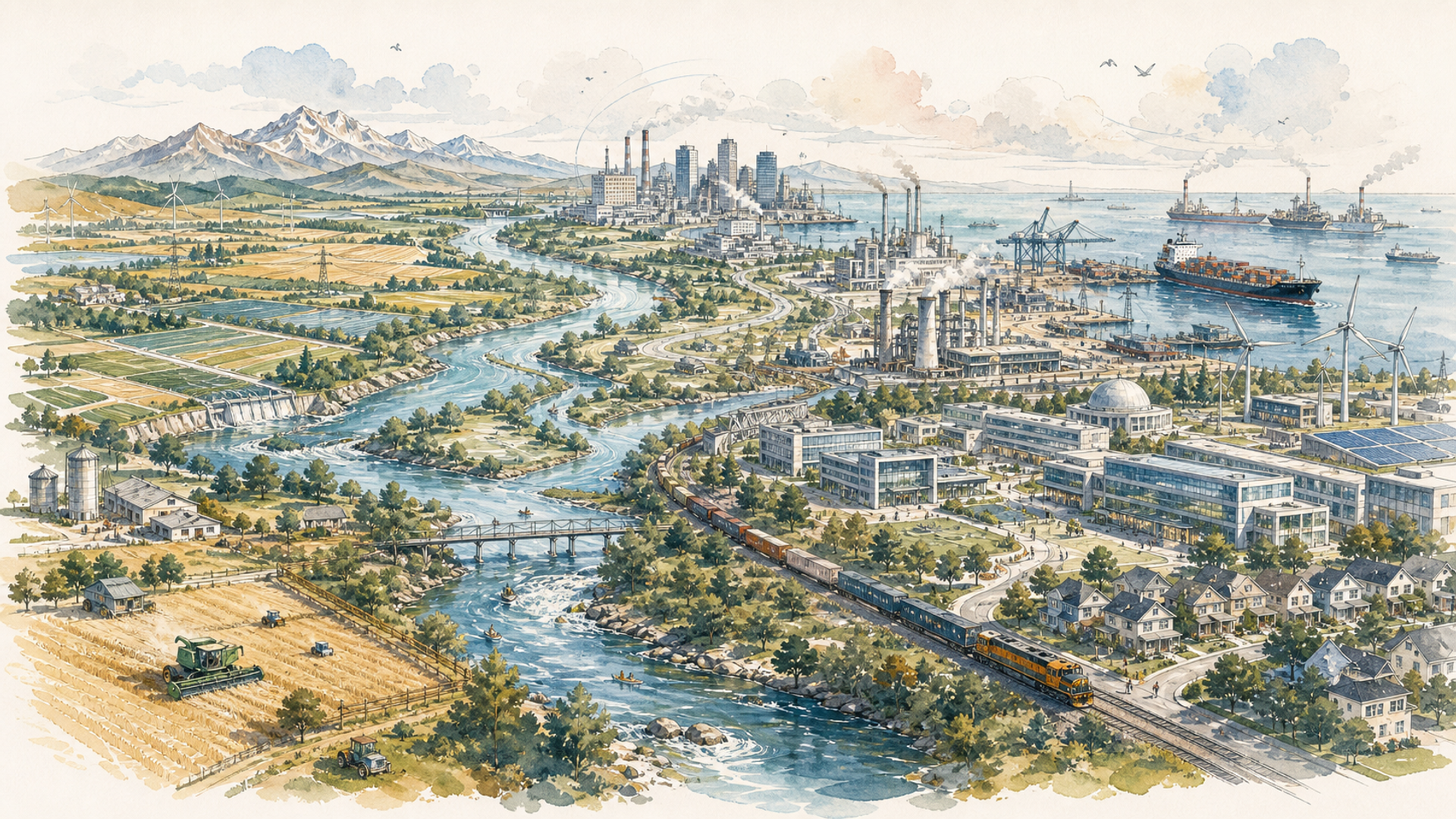
If you look at the United States on a physical map before learning a single date from its history, it is difficult not to feel a certain geopolitical envy. To the east lies the Atlantic, and to the west the Pacific: two vast oceans that, for much of modern history, made it extremely costly for a major Eurasian power to land an army on American soil. For long stretches to the north and south, there are no impassable mountain ranges dividing the country into separate compartments. At its centre lies one of the planet’s largest temperate agricultural regions, together with a river system that converges on the Mississippi and the Gulf of Mexico. If someone were to design a geographical foundation favourable to the growth of a great power, they might devise something rather like this.
And this is precisely where we must resist the explanation that is too elegant. The United States did not become a superpower because it ‘had good geography’, as though being dealt a fortunate hand were enough. Millions of people inhabited that land before the United States existed. Westward expansion proceeded through purchases and treaties, but also through wars, expulsions, broken agreements and the destruction of Indigenous societies. An enormous part of the country’s present territory was incorporated after the war with Mexico. For decades, the agricultural wealth of the South was bound to a system of slavery. Natural resources became power only through infrastructure, capital, immigration, institutions and political decisions, while American growth was accompanied by internal conflicts so deep that they culminated in civil war. Geography provided exceptional possibilities. Human beings decided how to exploit them, often with terrible consequences for other human beings.
The river that built a market
Imagine that you are a farmer in Ohio at the beginning of the nineteenth century. You can grow immense quantities of grain, but your harvest has value only if you can deliver it to someone who wants to buy it. Before the railways, hauling tonnes of goods along muddy roads for hundreds of kilometres might cost more than the produce itself was worth. A navigable river changes the equation. The Ohio flows into the Mississippi, and the Mississippi runs down to New Orleans. Grain, timber and other goods from the interior can therefore move towards a major port with a relative ease that many parts of the world did not enjoy.
This is why New Orleans mattered so much to the young American republic. When Thomas Jefferson bought Louisiana from Napoleon’s France in 1803, roughly doubling the size of the United States at the time, he was not merely buying an immense expanse of land. He was securing access to the Mississippi and its mouth. Napoleon, for his part, needed money for war in Europe and had seen a decisive part of France’s Caribbean ambitions collapse after the Haitian Revolution. What looks like an astonishing property deal was in fact the meeting point of river geography, an anti-slavery revolution, European war and continental ambition.
The Mississippi–Missouri system was not the only natural advantage. The Great Lakes form an enormous inland waterway; the Atlantic coast offers numerous ports; and broad plains allow mechanised farming and the relatively straightforward construction of railways and roads. Yet the value of all these features rose when they were connected. The Erie Canal, opened in 1825, linked the Great Lakes region with the Hudson River and New York. Railways completed the stitching together of the continent. In little more than a century, extremely distant territories were integrated into an enormous internal market in which people, capital and goods could move on a scale unavailable to most European states.
That market was also protected by an unusual geographical circumstance: once it had consolidated control of the continent, the United States had no power along its land borders comparable to the great rivals that European states faced only a few hundred kilometres away. Canada and Mexico had their own histories and interests, of course, but North America did not resemble Europe, where France, Germany, Russia, Austria and other states had spent centuries fearing that an enemy army might appear across the frontier. The United States could devote an enormous share of its energy to internal growth without continually living under the same continental military pressure.
A continent conquered, not found empty
When this expansion is told through maps, it is easy to make the western territories look like blank spaces simply waiting to be filled. They were not. Dozens of Indigenous nations lived on those lands, with political, economic and cultural systems of their own. American expansion involved wars and treaties, but also forced removals such as the one remembered as the Trail of Tears. More than a thousand Cherokee died on the journey west in the late 1830s, and thousands more are estimated to have died in the detention camps or from the consequences of forced removal and resettlement. Epidemics that began with European contact had devastated many Native populations long before the United States reached the Pacific; subsequent American expansion took still more land and autonomy from them.
Nor was growth towards the south-west remotely inevitable. After the annexation of Texas, the Mexican–American War of 1846–48 ended with Mexico ceding a vast territory to the United States. It encompassed present-day California, Nevada and Utah, as well as parts of Arizona, New Mexico, Colorado, Oklahoma, Kansas and Wyoming. The California Gold Rush then accelerated migration, investment and connections with the Pacific. In 1869, the transcontinental railway made it possible to cross the country at a speed that the previous generation would have considered extraordinary. This history matters because it corrects a characteristic temptation in geopolitics: confusing an outcome with a necessity. Looking at the United States today, with coasts on two oceans and a contiguous territory, we might imagine that this shape was ‘destined’ to exist. It was not. It is the product of decisions, wars, negotiations, violence and opportunity. Geography offered a continent rich in possibilities; politics determined who would control them.
Even possession of the territory did not guarantee stability. Conflict over slavery and the relationship between the federal government and the states culminated in the Civil War of 1861–65, the deadliest conflict in United States history. The Union emerged victorious, slavery was abolished and the federal government grew stronger, but the legal end of slavery did not produce equality: segregation, discrimination and racial violence continued to mark American society for generations. American power therefore developed alongside profound internal contradictions. This matters because powerful states are not perfectly coherent organisms; they can project strength abroad while fiercely contesting the meaning of citizenship at home.
The factory that came late to the war—and then changed its outcome
By the end of the nineteenth century, the United States was already an industrial economy of immense proportions. It possessed coal, iron, oil and farmland, a rapidly growing population fuelled by great waves of immigration, and an internal market capable of supporting mass production. Figures such as Andrew Carnegie in steel, John D. Rockefeller in oil and, later, Henry Ford in motor manufacturing symbolise an enormously productive industrial capitalism that was also marked by concentrations of wealth, harsh working conditions and social conflict.
The two world wars then transformed the relationship between this economic power and the rest of the world. The United States entered the First World War only in 1917, after nearly three years of fighting in Europe, and its military and financial contribution helped the Allies in the final phase. But it was above all the Second World War that transformed the scale of American power for good. The United States entered the conflict directly after Japan attacked Pearl Harbor in December 1941. Drawing on its industrial capacity, it produced immense quantities of ships, aircraft, lorries, ammunition and other matériel not only for its own armed forces but for its allies as well. The phrase ‘arsenal of democracy’ was not mere rhetoric: the ability to turn a civilian economy into a wartime production machine became one of the conflict’s decisive strategic assets.
Meanwhile, geography continued its quiet work. The United States suffered a devastating attack at Pearl Harbor and fought ferociously in the Pacific, but its continental territory did not experience the industrial destruction inflicted on Europe, the Soviet Union, China and Japan. By 1945, many of the Old World’s leading industrial powers lay physically devastated; the United States, despite heavy loss of life, possessed a productive capacity that was intact and greatly enlarged. This was not simply ‘geographical luck’. It was the combination of distance, oceans, naval power, alliances and a continental industrial base that no enemy managed to strike on a comparable scale.
When the dollar becomes a road
At the end of the war, Washington did something that distinguishes American power from that of many earlier empires: it helped to build international institutions in which other countries could participate. The Bretton Woods system, the United Nations, the International Monetary Fund, the World Bank and, later, the GATT arose in different settings and pursued different aims, but together they helped create an economic and political order in which the United States occupied a central position. The Marshall Plan aided the reconstruction of western Europe; NATO tied American security to that of European allies. In the Pacific, agreements with Japan, South Korea and other partners built another strategic network.
The dollar became the leading currency for international reserves and transactions. This does not mean that Washington can simply ‘print money for free’, a popular but misleading formula. It does mean, however, that an enormous share of global trade, debt and financial reserves uses the American currency and passes through institutions connected to the United States financial system. This advantage rests on trust, the scale and liquidity of its markets, the rule of law and economic strength; it is not a magical property of the banknote. Precisely because the system is so widely used, access to the American financial market and dollar-denominated infrastructure can also become an instrument of pressure through sanctions.
There is a profound difference here from the power of a classic territorial empire. Rome had to garrison its provinces physically. The United States can exert influence through military bases and fleets, but also through technological standards, finance, universities, companies, multilateral institutions and alliances in which other states choose to cooperate because they gain security or economic benefits from doing so. Naturally, those relationships are not free of conflict: allies and the United States quarrel over military spending, trade, wars and political priorities. An alliance network is not an empire commanded by Washington. But the fact that the United States can operate alongside dozens of partners greatly expands its capacity compared with that of a power forced to do everything alone.
The American navy is another fundamental part of the picture. Two oceans protect the country, but they can be turned from moats into motorways only if you have ships, bases, logistics and allies. A large navy allows the United States to move forces on a global scale and helps secure trade routes on which the world economy also depends. Once again, geography supplies the ocean; centuries of investment turn it into power.
The advantage of attracting people and ideas
There is one final element that is difficult to draw on a physical map: the ability to attract people. From the nineteenth century onwards, the United States received enormous migration flows from Europe, Latin America, Asia and many other regions. Immigrants were often met with suspicion, discrimination and restrictive laws; yet, over the long term, they contributed decisively to the growth of the population, industry, research and entrepreneurship. The American nuclear programme during the Second World War offers an almost paradoxical example. Many of the scientists who contributed to the Manhattan Project had been born in Europe, and some had fled the very regimes the United States was fighting. Enrico Fermi came to the United States after Fascist Italy’s racial laws had placed his Jewish wife Laura in danger; other physicists came from Hungary, Germany and elsewhere in Europe. A power is measured not only by the minerals beneath its soil, but also by its ability to create a place where expertise arriving from elsewhere can generate new ideas.
After the war, research universities, public funding, military laboratories and private companies fostered fields such as aerospace, computing, biotechnology and the Internet. Silicon Valley did not arise simply because California had pleasant weather: it was the product of universities, defence contracts, venture capital, skilled immigration, an entrepreneurial culture and a series of choices that reinforced one another. Here too, success creates a loop: if a place offers opportunities, it attracts people; those people create businesses and knowledge; that increases the opportunities and attracts still more people.
The power of a system that others have an interest in using
One of the most interesting differences between the United States and many empires of the past is that part of its power does not require direct obedience. An airline buys American aircraft because it considers them suited to its needs; a researcher tries to enter an American university because they believe it will give them opportunities; a government holds dollars because it judges the markets in which they can be invested to be liquid and reliable; a country joins an alliance because it considers the protection it receives worth the obligations it assumes. Washington also exerts pressure and coercion and uses military force, of course, as every great power does. But to confuse the entire American system with an empire issuing orders to subordinate provinces is to miss an important part of the mechanism.
Economists speak of network effects: a system can become more useful precisely because many people already use it. The English language is a cultural example; the dollar a financial one; technical standards and digital platforms offer others. Once universities, businesses, investors and governments have organised themselves around an ecosystem, replacing it requires a sufficiently strong reason to offset the costs of change. This does not make primacy eternal. Sterling played a far larger international role when the British Empire stood at the centre of world trade, and gradually lost it as economics, war and finance changed. But it explains why power transitions are often slower than charts of gross domestic product might suggest.
Then there is cultural power, a form that is difficult to measure but impossible to ignore. Film, music, universities, brands, sport and technology platforms have given the United States a presence in the daily lives of billions of people. Joseph Nye popularised the phrase soft power to describe the ability to gain influence through attraction and legitimacy rather than coercion alone. It is a useful concept provided it does not become a magic formula: a Hollywood film does not win a war, and cultural popularity can coexist with strong opposition to American foreign policy. But a power that attracts students, talent, investment and attention possesses a resource that no iron mine can produce by itself.
The size of the internal market matters in this respect too. A company that succeeds in growing in the United States can begin with a base of hundreds of millions of relatively affluent consumers, a common currency and an integrated federal system. In sectors with strong economies of scale, that size helps companies emerge that can then expand into the rest of the world. It is no guarantee of innovation and can even encourage troubling concentrations of economic power; but it is another example of political geography and institutions transforming quantity—people and territory—into capacity.
A superpower is not all-powerful
Having come this far, it would be easy to fall into the opposite error and imagine the United States as a machine destined to dominate. Recent history offers ample evidence to the contrary. Military superiority did not deliver the hoped-for objectives in Vietnam. In Afghanistan, after twenty years of war, the government supported by Washington collapsed rapidly in 2021 when international forces withdrew. The 2003 invasion of Iraq removed Saddam Hussein’s regime but produced regional and domestic consequences far more complex than its architects had imagined. Power makes many things possible; it does not guarantee that they will produce the desired result.
There are also domestic problems that no ocean can solve: political polarisation, inequality, infrastructure that must be maintained, public debt, social tensions, and industrial and technological competition. China’s rise has narrowed the economic gap between the United States and its principal contemporary strategic rival. Technologies that were once close to an American monopoly are spreading. Allies may have different interests. Even the dollar retains its role not by eternal decree, but because millions of actors continue to find it useful and reliable. This is perhaps the most interesting point. The United States is powerful because it has layered many different advantages: favourable geography, a continental market, resources, a large population, industrial capacity, institutions that have been relatively stable over the long term, immigration, technology, finance, a navy and alliances. None of these elements, taken alone, explains the outcome. Together they form a network of advantages that reinforce one another.
In the next chapter, we shall look at something close to the inverse image: a country just as vast, immensely rich in resources and capable of generating enormous military power, but whose strategic history has been marked by a recurrent sense of vulnerability. Where the United States has oceans, Russia has plains stretching across much of its territory. Where America could expand until it consolidated relatively secure frontiers, Russia spent centuries building security by pushing its control ever farther from its political heartland. The question, however, will remain the same: how much of this history is written in geography, and how much arises from the choices of the people who look at it?