Chapter 22 · Part 05
Why Does Peace Fail?
Economic crisis, revisionism and the Second World War.
Versailles, economic crisis, fascism, Nazism and Japanese imperialism combine in another global conflict, shifting the centre of power from Europe towards the United States and the Soviet Union.
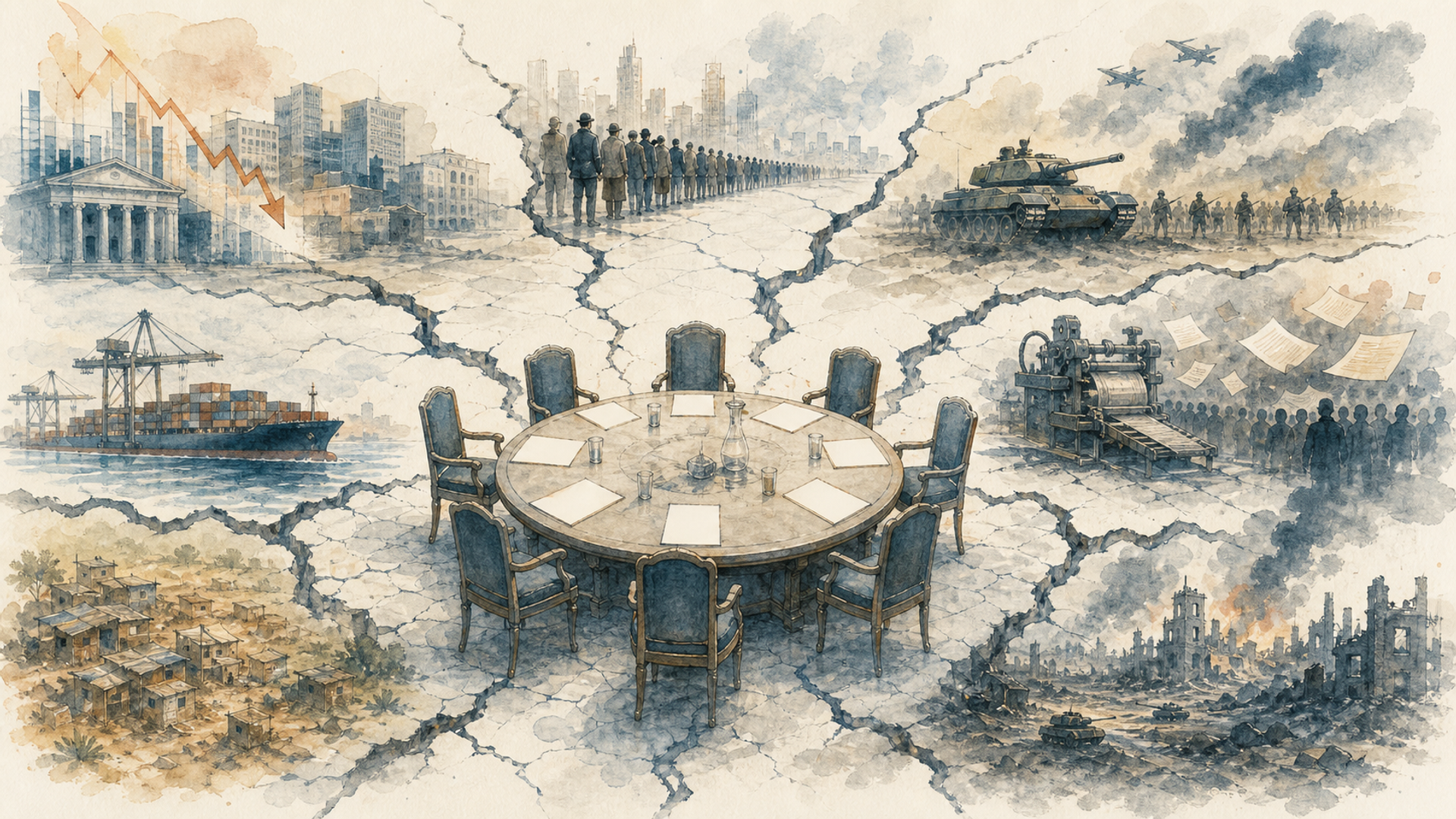
In photographs of some great Western cities in 1929, the future already seems to have arrived. Cars, cinemas, radio, skyscrapers, electric advertisements. After the slaughter of the First World War, the 1920s brought consumption, music, new freedoms and a sense of modernity back to parts of society. Had you looked only at certain streets in New York, Paris or Berlin, you might have convinced yourself that the world had learnt its lesson. Then American finance collapsed, the crisis crossed the Atlantic, unemployment soared and millions discovered how fragile the international economic system could be. Here too, however, we must resist a simple fable: ‘the Great Depression arrived, therefore Hitler arrived’. Many countries suffered terrible crises without becoming Nazi dictatorships. The Depression changed the conditions of politics; people, parties and institutions then responded in different ways.
To understand why the peace of the 1920s and 1930s failed, we must hold at least four stories together: an incomplete international order, profound economic crises, authoritarian and revisionist ideologies, and a growing belief among certain powers that force could change the rules without meeting a sufficiently strong response.
Hitler does not ‘simply win an election’
Adolf Hitler and the Nazi Party offer a perfect example of the danger of squeezing history into one sentence. You sometimes hear that ‘the Germans elected Hitler’. The Nazi Party did win enormous electoral support and became the largest party in the Reichstag, but Hitler never won an absolute majority on his own in a free national election. President Paul von Hindenburg appointed him chancellor in January 1933 amid political crisis, manoeuvring by conservative elites and the disastrous calculation of men who thought they could control him.
After his appointment, the regime rapidly destroyed democratic space. The Reichstag fire was used to suspend fundamental freedoms; political opponents were arrested; the Enabling Act allowed the government to legislate without parliament; trade unions and parties were eliminated. A fragile democracy did not turn into a dictatorship in a single instant, but through a sequence of steps, each making the next easier. Nazism was not merely a wish to ‘revise Versailles’. At its centre were a radical racist ideology, antisemitism, anti-communism and a project to conquer Lebensraum—living space—above all in the east. To reduce the Second World War to a German reaction against reparations is to ignore the ideology that led to persecution, a war of annihilation and the Holocaust.
Benito Mussolini had ruled Italy since 1922. Fascism had built a dictatorship, crushed opponents and promoted an aggressive nationalism that culminated, among other things, in the conquest of Ethiopia in 1935–36. The aggression exposed the weakness of the League of Nations: sanctions were imposed, but they were not effective enough to stop the war. Revisionist powers drew a dangerous lesson. International rules existed, but enforcing them depended on whether governments were truly willing to take risks in their defence. In Asia, Japan had occupied Manchuria in 1931, and war with China became a full-scale conflict in 1937. Japanese imperialism had its own motives: resources, security, prestige, ideology and regional domination. The Second World War therefore did not begin everywhere on the same day. For millions of Chinese people, the great war was already real before Europe’s September 1939.
That global perspective prevents us from treating the conflict as a German story with supporting actors elsewhere. In 1941, Germany’s invasion of the Soviet Union and Japan’s attack on Pearl Harbor bound different theatres together into a genuinely planetary war.
Appeasement: cowardice or a tragic choice?
The word appeasement has become almost a political insult. It is associated above all with the Munich Agreement of 1938, when Britain and France accepted Germany’s annexation of the Sudetenland—areas of Czechoslovakia with a large German-speaking population—in an attempt to avoid another European war. Hitler occupied the remaining Czech lands in March 1939, showing that his ambitions went beyond bringing German populations together. In hindsight, Munich can look like an absurd surrender. Yet those deciding in 1938 still carried the fresh memory of the First World War. European societies had lost a generation; British and French armed forces doubted their readiness; many voters desperately wanted to avoid another massacre. This does not make appeasement ‘right’. It helps us understand why rational governments may take decisions that later seem incomprehensible.
Geopolitics is full of this problem: you must decide before you know how the story ends. React too early and you may provoke the war you hope to avoid; wait too long and you may strengthen the person preparing it.
In August 1939, Nazi Germany and the Soviet Union signed the Molotov–Ribbentrop Pact, formally a non-aggression agreement accompanied by secret protocols dividing spheres of influence in eastern Europe. Days later, on 1 September, Germany invaded Poland. Britain and France declared war. On 17 September, the Soviet Union also invaded Poland from the east. The pact is startling because Nazism and Soviet communism were declared ideological enemies. But states can cooperate temporarily even when they loathe one another if an agreement serves their immediate interests. Hitler reduced the risk of fighting on two fronts straight away; Stalin gained time and expanded the area under his control. Two years later, Hitler broke the pact by invading the Soviet Union. It is a vital lesson about alliances: they do not always describe friendship. Sometimes they describe no more than a temporary overlap of interests.
The Second World War was fought by armies, industries and empires, but it was also a war against civilians on a terrifying scale. Strategic bombing destroyed cities. Occupations and reprisals produced massacres. In Europe, the Nazi regime and its collaborators systematically persecuted and murdered approximately six million Jews in the Holocaust, alongside millions of other victims of persecution, forced labour and policies of annihilation. On the eastern front, the Nazis conceived their war against the Soviet Union as an ideological and racial struggle, not as an ordinary conventional war. This is not a moral footnote to add after the tanks and borders. It changes the nature of the conflict itself, and helps explain part of the order built after 1945. The language of human rights, war-crimes trials, the Genocide Convention and efforts to create stronger international institutions all arose in part from the knowledge of what a modern state could do when it turned bureaucracy, technology and power towards the systematic persecution of whole categories of people.
Two powers emerge from the ruins
By 1945, much of Europe and Asia lay devastated. Germany had been defeated and occupied. Japan surrendered after a long Pacific war, conventional bombing and the atomic bombs dropped on Hiroshima and Nagasaki, while the Soviet Union entered the war against Japan in August 1945. Nuclear weapons opened an entirely new age: technology now allowed human beings to destroy a whole city with a single bomb and would soon let them threaten destruction on a far larger scale. Europe’s old powers had won or lost, but all were weakened. The United States emerged with immense industrial, financial and military capacity. The Soviet Union had suffered appalling human and material losses, but the Red Army occupied much of eastern Europe and the country had become a military superpower. The centre of the international system had shifted.
There was a paradox. After the First World War, the victors had tried to build a new order and failed to prevent another catastrophe. In 1945 they would try again, this time with different institutions, a much deeper American presence and a clear awareness that economics, security and international politics could not be treated as separate compartments. The UN, International Monetary Fund, World Bank, GATT, Marshall Plan and NATO: names that now feel like part of the scenery would all appear within a few years. Not because the world had suddenly become altruistic, but because the victorious powers wanted a system that protected their interests, supported reconstruction and reduced the risk of repeating earlier mistakes.
When millions lose their jobs and savings, income is not the only casualty. Faith in the system changes too. Parties that recently seemed extreme can present themselves as the only people prepared to ‘do something’, while parliamentary governments appear paralysed by crisis and fragile coalitions. In Germany, mass unemployment and the collapse of confidence in Weimar institutions gave the Nazis far more favourable ground. Their success also depended on propaganda, organisation, political violence, antisemitism already present in society, fear of communism and choices made by conservative elites. In other countries struck by the Depression, democratic institutions survived or changed without turning Nazi. Economic crisis is therefore a multiplier: it can make an authoritarian turn more likely without deciding which turn will occur.
The Holocaust did not begin with the gas chambers
After Hitler became chancellor in 1933, the persecution of Jews advanced in stages: exclusion from jobs and professions, boycotts, racial laws, public violence, confiscation and deportation. The Nuremberg Laws of 1935 stripped German Jews of fundamental rights; Kristallnacht in 1938 marked an overt escalation of violence. During the war, as it occupied vast territories in eastern Europe, the Nazi regime radicalised persecution into systematic extermination. Mass shootings by the Einsatzgruppen, ghettos, deportations and killing centres formed part of a process organised by state institutions and supported by collaborators in several countries.
Understanding the stages matters because it stops us imagining that a society moves from normality to genocide overnight. Language, exclusion, classification and dehumanisation come first. Power then finds more and more tools for turning those categories into violence. In the Pacific, the geography was almost the opposite of the European front: not a long line of trenches between neighbouring countries, but vast oceans, archipelagos and scattered bases. Japan sought an imperial system able to secure resources and strategic depth in eastern and south-eastern Asia. Its December 1941 attack on Pearl Harbor aimed to damage the United States Pacific Fleet and buy time to consolidate its conquests.
The United States responded with a colossal logistical war: aircraft carriers, submarines, convoys, bases and an island-hopping advance. Some tiny islands became objectives simply because they offered useful airfields or harbours. Once again, a point could be worth far more than anything it contained. The war ended after devastating bombing, the Soviet entry into the war against Japan and the American use of atomic bombs on Hiroshima and Nagasaki. Historians still debate the relative weight of these factors in Japan’s decision to surrender and the alternatives available to the United States. Good history should not pretend that a complex controversy has one uncontested answer.
1945 creates both a taboo and a temptation
Nuclear weapons were at once a military innovation and a moral rupture. The United States remained the sole nuclear power for only a few years; the Soviet Union tested its own bomb in 1949. From then on, the technology that had helped end the Pacific war became the technology that made another war between superpowers potentially suicidal. Here lies the post-war paradox: states would build ever more destructive arsenals precisely in an attempt not to use them. And while the world tried to prevent another global conflict, it also had to decide what to do with war criminals, refugees, destroyed cities, colonies, and a Germany and Japan that had to be rebuilt. The year 1945 was not an ending. It was a building site.
Knowing what happened in 1939, it is hard to look at the 1920s without seeing a road leading inevitably to Hitler. But the future was not written for those living then. Weimar Germany was fragile, but it had parties, elections, a vibrant urban culture and periods of recovery. The Locarno Treaties of 1925 and Germany’s entry into the League of Nations in 1926 seemed to point towards normalisation. Reparations were restructured through international plans and effectively suspended in 1932. That possibility makes the collapse even more important to understand. Versailles fuelled resentment and gave radicals a powerful symbol, but did not automatically turn millions into Nazis. The Great Depression, beginning after the 1929 financial crash, hit Germany hard, producing mass unemployment and discrediting already weakened democratic parties. The Nazis converted fear, anti-communism, antisemitism, ultranationalism and promises of order into political support. In January 1933, conservative elites who believed they could control Hitler arranged his appointment as chancellor. It was a catastrophic mistake.
But the world war was already under way in Asia
An exclusively European narrative risks starting the Second World War in 1939 and forgetting that large-scale war had already erupted in Asia. Japan occupied Manchuria in 1931 and launched full-scale war against China in 1937, accompanied by atrocities including the Nanjing Massacre. Japanese expansion pursued security, resources and regional supremacy, and was sustained by an increasingly militarised political system. American sanctions and an oil embargo intensified pressure on Japan, which depended heavily on imported energy. The December 1941 attack on Pearl Harbor brought the United States directly into the war; almost simultaneously, Japan attacked British, Dutch and American possessions across the Asia-Pacific. The European and Asian conflicts became fully joined as one global war.
No account of the Second World War is acceptable if it treats the Holocaust as a side note. The Nazi regime persecuted Jews from the beginning, progressively stripping them of rights and property; during the war, persecution became systematic murder. Six million Jews were killed by the Nazis and their collaborators. Millions of other victims—Roma and Sinti, disabled people, Soviet prisoners of war, political opponents, Polish and Soviet civilians, people persecuted for their sexual orientation and other groups—were subjected to killing, deportation and repression. Nazism conceived the war in the east as a racial and colonial war as well as a military one. That is essential to understanding why violence reached such extremes. It was not an accidental consequence of conventional war: ideology and military aims were intertwined.
In 1945, nobody wanted simply to rebuild 1919
When Germany and Japan were defeated, the human and material toll was horrifying: destroyed cities, tens of millions dead, refugees, genocide, atomic bombs on Hiroshima and Nagasaki, ruined economies. But the new order would differ from 1919 for a simple reason. The United States did not retreat from European politics as it had after the First World War, and the Soviet Union occupied much of eastern Europe. The challenge was not merely to ‘make peace’, but to design an economic and security system that would prevent both another depression and another war between great powers. Institutions we still use were born from that urgency: the United Nations, International Monetary Fund, World Bank, a new trading system and, soon afterwards, NATO and European integration. The modern world is full of structures built by people who had just seen what happens when the international order collapses.