Chapter 21 · Part 05
How Can an Assassination Redraw the Planet?
The First World War and the collapse of empires.
Sarajevo is the spark, not the explanation. Alliances, nationalism, imperial rivalries and industrial mobilisation turn a local crisis into a war that brings down four empires.
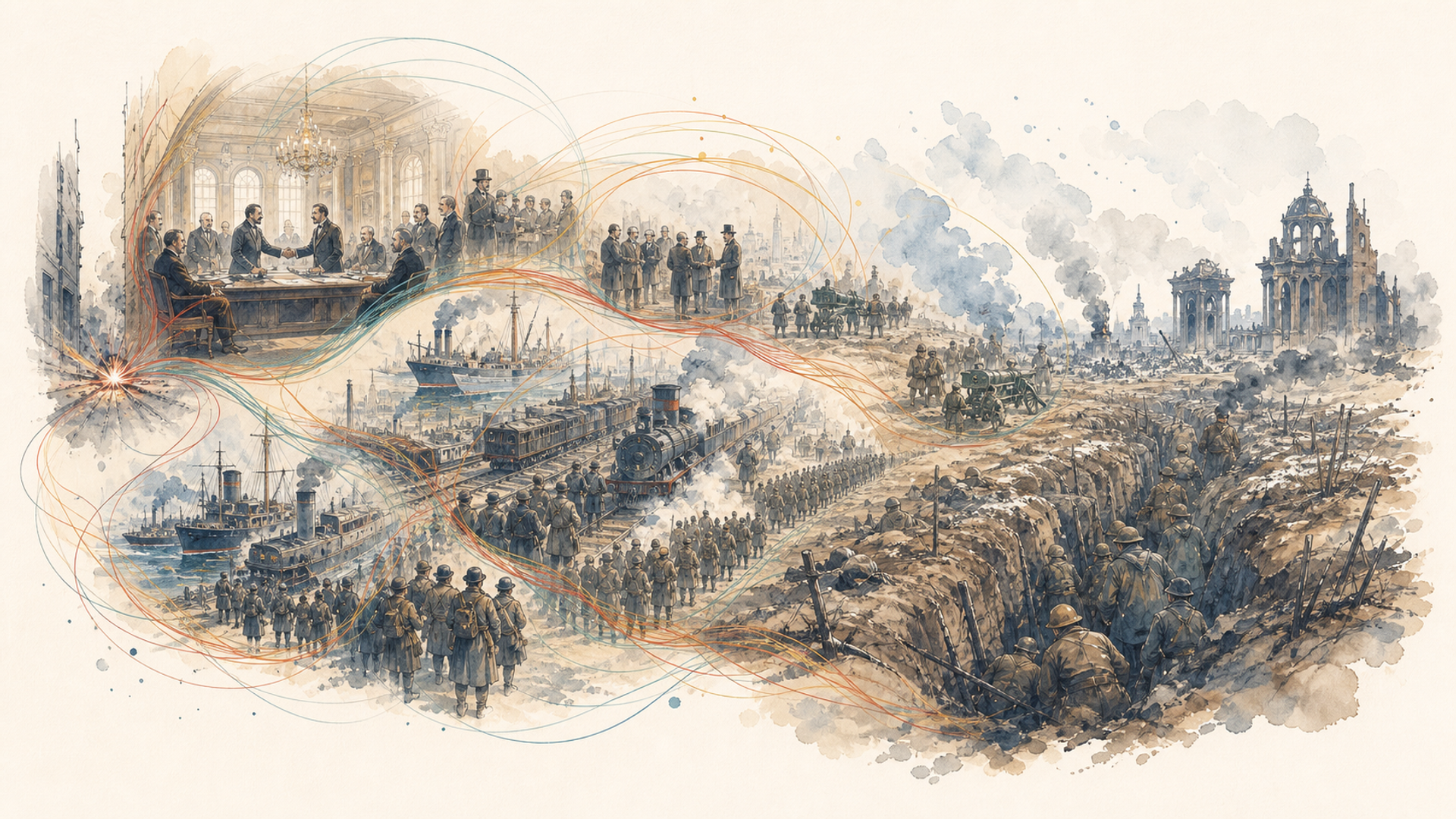
On the morning of 28 June 1914, Archduke Franz Ferdinand, heir to the throne of the Austro-Hungarian Empire, was travelling through Sarajevo by car with his wife Sophie. The visit was already fraught: Bosnia and Herzegovina had been annexed by Austria-Hungary only a few years earlier, and Serbian and South Slav nationalism was stirring the region. A group of young conspirators had decided to strike at the archduke. The first attempt failed. A bomb bounced away and injured other people. One might have thought the day would end there. Then came one of those coincidences that seem to have been written by an overambitious novelist. Later, the archduke’s driver took a wrong turning. As the car slowed to manoeuvre, Gavrilo Princip, one of the conspirators, suddenly found himself only a few metres from his target. He fired. Franz Ferdinand and Sophie died. A month later, Europe was at war.
It is such a cinematic story that it risks teaching us the wrong lesson. A young man fires two shots and the First World War begins. But if two pistol shots were enough to produce a world war, history would be full of world wars. The assassination was the spark. What interests us far more is why there was so much combustible material around it.
A local crisis inside a nervous system
The Europe of 1914 was not simply divided into two teams waiting for the starting whistle. There were alliances, understandings, military plans and diplomatic commitments, but every government retained room for choice. That is precisely why the so-called July Crisis is so instructive: a succession of decisions turned the assassination into a continental and then a global war. Austria-Hungary saw Serbia not merely as an irritating little neighbour, but as a pole of attraction for Slav nationalisms that could threaten the cohesion of a multinational empire. Germany assured Vienna of its strong support. Russia regarded itself as Serbia’s protector and feared losing influence in the Balkans. France was allied with Russia and viewed German power with growing concern. Britain had increasingly close relations with France and Russia and, when Germany invaded neutral Belgium as part of its plan against France, entered the war.
Told quickly, it sounds like a line of dominoes. Austria attacks Serbia, Russia enters, Germany enters, France enters, Britain enters. But dominoes do not have foreign ministries, generals, parliaments and sovereigns. People do. Military mobilisation created enormous pressures — because railway plans involved moving millions of men to rigid timetables — but it did not erase politics. No railway track declared war on its own.
Here a technology from Chapter 17 returns: the railway. European armies had become enormous. Mobilisation meant calling up reservists, clothing and arming them, and carrying them to the front at great speed. A railway network could move numbers of men that would have been unimaginable in Napoleon’s time, but it also made planning more rigid. If you picture thousands of trains already assigned to precise stations, timetables and units, you can see why halting or reversing a mobilisation was not perceived as simply pressing a button. This is a fine example of our recurring theme: a technology that increases power simultaneously creates a new dependency. Railways enable the state to mobilise more rapidly; for that very reason, governments fear that an adversary who mobilises first may gain a decisive advantage. Speed and fear feed one another.
Many European leaders also thought that, if war broke out, it would be relatively brief. Not all were naive, and not all shared the same optimism, but recent military campaigns had encouraged the idea that a major offensive could settle the conflict quickly. What happened was almost the opposite.
The industrial machine discovers the trench
On the Western Front, after the initial manoeuvres of 1914, the armies encountered a terrible problem. New weapons made defence highly effective: machine guns, artillery, barbed wire and modern rifles could mow down troops advancing in the open. But the command systems, tactics and technologies needed to break through those defences had not yet matured. The result was a long belt of trenches stretching from the North Sea towards Switzerland, and a war of attrition in which gaining a few kilometres could cost a horrifying number of lives. Industrial war consumes everything: steel, coal, explosives, food, uniforms, horses, locomotives, medicines. To sustain the front, entire economies were reorganised. Factories changed production, women entered industrial sectors in greater numbers, states controlled prices and supplies, and propaganda became a central function. The distinction between ‘front line’ and ‘home front’ began to grow less clear.
And the war was not only European. Empires brought with them territories and populations from other continents. Colonial soldiers fought far from home; military campaigns unfolded in Africa and the Middle East; Japan, allied with Britain, occupied German possessions in Asia and the Pacific; the Ottoman Empire entered the conflict and opened new fronts. Calling it a ‘European war’ conceals the imperial system that made it global. When the Ottoman Empire entered the war on the side of the Central Powers, the Middle East became one of its decisive theatres. Even during the conflict, the Entente powers were discussing how they might divide influence and territory in the event of victory. The secret Sykes–Picot Agreement of 1916 between Britain and France has become almost a symbol for all modern Middle Eastern borders.
Here, too, caution is needed. It is not correct to say that two diplomats, Mark Sykes and François Georges-Picot, simply drew ‘today’s countries’ with a ruler. The subsequent settlement resulted from several agreements, promises in tension with one another, conferences, wars, mandates, national movements and local decisions. But the episode clearly reveals an imperial habit: discussing the political future of distant territories without giving the people who lived there equivalent power at the table. During the same period, the British government was corresponding with Sharif Hussein of Mecca about an Arab revolt against the Ottomans, and in 1917 it issued the Balfour Declaration, supporting the establishment in Palestine of a ‘national home for the Jewish people’, while adding conditions regarding the rights of existing non-Jewish communities. These diplomatic strands were not identical, and their implications would be contested for decades. For now, the point is to see how a war can layer different promises over the same territory.
Four empires end almost at once
By 1918, the world that had begun the war four years earlier no longer existed. The German Empire had been defeated. Austria-Hungary was disintegrating. The Ottoman Empire was collapsing. The Russian Empire had already fallen in the revolution of 1917, and the Bolsheviks had seized power, opening a civil war and the road to the future Soviet Union. It is difficult to overstate how greatly this changed the map. Poland, Czechoslovakia and the Kingdom of Serbs, Croats and Slovenes — the future nucleus of Yugoslavia — emerged from lands that had previously belonged to empires. In Eastern and Central Europe, however, the idea of making state and nation coincide perfectly collided with a far less orderly reality: different populations lived intermingled. Whatever line you drew, someone risked finding themselves on the ‘wrong side’.
US president Woodrow Wilson made the principle of self-determination famous, but its application was selective and inconsistent. The victorious powers had colonial empires that they had no intention of dissolving immediately, and many non-European peoples discovered that the language of self-determination had very tangible political limits. The Treaty of Versailles of 1919 imposed territorial losses, military restrictions, reparations and controversial responsibility for the damage caused by the war on Germany. For many Germans, it became the symbol of a humiliation. Yet it would be a mistake to leap directly from Versailles to Hitler with an arrow: treaty → Nazism → Second World War. Between those points lie twenty years of politics, revolutions, attempts at cooperation, economic recovery, financial crises, propaganda, choices by elites and international decisions.
Versailles did not make 1939 inevitable. It did, however, create problems and resentments that revisionist movements could exploit. Moreover, the League of Nations system, founded on the idea of making security more collective, began with obvious limitations: the United States did not join, although Wilson had been one of its principal advocates; other powers joined, withdrew from or defied the system. There was another, less visible legacy. After four years of total war, millions of people had died, entire regions had been devastated, and societies accustomed to a centuries-old political order found themselves in new states. Peace was not simply the end of the fighting. It was the difficult construction of new rules in a world full of debts, traumas, minorities, revolutions and incompatible expectations.
And then, scarcely a decade later, an economic crisis would arrive that was capable of crossing oceans and bringing down governments. In Germany, a radical political movement would turn resentment, racism and fear into power. In Italy, Fascism was already in government. Japan continued its expansion in Asia. Peace would not fail because of a single clause written at Versailles: it would fail because many different cracks would ultimately meet.
A world war also produces a genocide
One of the fundamental tragedies of the twentieth century occurred within the collapse of the Ottoman Empire. Beginning in 1915, the Young Turk government systematically deported and killed Ottoman Armenians; historians and numerous states recognise these events as the Armenian genocide. Other Christian communities in the empire also suffered persecution and massacres. The war gave the government a climate of emergency and secrecy in which it could treat a civilian population as an internal threat. This is an important precedent for understanding a terrible feature of the modern state: the same administrative capacity that makes it possible to conduct censuses and mobilise people can be used to identify, deport and destroy. We do not have to wait for the Second World War to see industrial violence directed against civilians.
Britain used its naval superiority to impose a blockade on the Central Powers, restricting access to raw materials and food. Germany responded with submarine warfare, seeking to cut off British supplies. Submarines turned the Atlantic into an invisible battlefield and contributed to tensions with the United States, especially when ships carrying American citizens were struck. In 1917, Germany resumed unrestricted submarine warfare on a large scale, calculating that it could bring Britain to its knees before American intervention became decisive. The calculation failed. The United States entered the war in April 1917, and its economic and military capacity progressively strengthened the Entente. It is another example of a decision based on time: Berlin tried to win before the new power could turn distant resources into soldiers on the European front.
In 1918, as the war approached its end, an influenza pandemic killed millions of people around the world. It is often called the ‘Spanish flu’, not because it necessarily originated in Spain, but partly because the Spanish press — in a neutral country — could report it more freely than the censored press of many belligerent nations. Crowded troops, military transport and global movements of people helped create favourable conditions for its spread. It is the same lesson as that of medieval networks and the plague, but on a planet with much faster ships and railways. The war ended in November 1918. For many families, however, death continued to arrive not from the front but from a virus. This made the world that had to build peace even more fragile: debts, veterans, refugees, revolutions, disputed territories and a pandemic in their midst.
Sarajevo was the spark, not the petrol
Alliances made the crisis more dangerous, but here again we must not imagine automatic machinery. The Triple Entente and the Triple Alliance were not computer programs that compelled every government to press a button. Actual leaders, with incomplete information and particular fears, made decisions during the so-called July Crisis. Vienna chose to use the assassination to strike Serbia; Berlin offered Austria-Hungary strong support; Russia mobilised; Germany declared war on Russia and France and invaded Belgium, bringing Britain into the conflict as well. The structure made the conflagration possible; decisions set it alight.
One fascinating and disturbing aspect of 1914 is the relationship between mobilisation and diplomacy. Mass armies had extraordinarily complex railway plans. Millions of soldiers had to be called up, equipped and transported according to precise timetables. Once a general mobilisation had begun, stopping or modifying it could be difficult and risky. Leaders feared that waiting would allow the adversary to complete its deployment first. This does not mean that ‘railway timetables caused the war’, another overly simple slogan. It means that technology and military planning altered political incentives. If you believe that whoever mobilises first gains an enormous advantage, a diplomatic crisis becomes a race against time. The railway that integrates the national market in peacetime can accelerate the chain of decisions in wartime.
The German plan for fighting France and Russia envisaged initially concentrating most forces in the west and attempting to defeat France rapidly before slower Russian mobilisation became fully effective. The invasion of Belgium, deemed necessary according to the operational logic adopted, turned a Franco-German war into a violation of Belgian neutrality that contributed to Britain’s entry. A military plan does not determine politics, but it can make some choices far more costly once the machine has begun to move.
Industry makes war larger than armies
In 1914, many governments imagined a relatively brief war. Instead, they found themselves in an industrial conflict of attrition. Artillery, machine guns, barbed wire, trenches, railways and mass production turned the Western Front into a system in which attacking was appallingly costly. Technology did not always favour offence or defence in the same way, and tactics and weapons changed during the conflict; but the result was a colossal demand for men and materials. At that point, war no longer concerned soldiers alone. Governments controlled production, imposed rationing, borrowed, taxed, mobilised women into industry, and regulated transport and propaganda. Civilians became part of the war machine. The British naval blockade sought to weaken the German economy; German submarine warfare aimed to break British maritime supply lines and contributed to the United States entering the war in 1917.
The colonial empires also took part. Soldiers and labourers from India, Africa, the Caribbean and the dominions fought or supported the European war effort. The conflict is called ‘world’ not only because the great European powers possessed colonies, but because fighting, resources and consequences genuinely involved several continents. By the end of the war, the German, Austro-Hungarian, Ottoman and Russian empires had collapsed or been radically transformed. New states appeared in Central and Eastern Europe; Ottoman territories in the Middle East were assigned as mandates to France and Britain under the League of Nations; the Russian Revolution had brought the Bolsheviks to power and would lead to the birth of the Soviet Union.
The principle of self-determination, also associated with the rhetoric of US president Woodrow Wilson, became immensely powerful but was applied selectively. Even in Europe it was all but impossible to create ethnically homogeneous states without leaving large minorities beyond their borders; in the colonies, many populations discovered that the promise of self-determination did not necessarily mean independence. The victorious powers retained enormous empires. The contemporary Middle East was not ‘invented in a room’ by two diplomats, as the myth of Sykes–Picot sometimes suggests. The secret Franco-British agreement of 1916 was important, but later borders arose from war, mandates, negotiations, revolts, local interests and decisions taken in the years that followed. Here again, our task is to resist the elegant but false explanation. Modern lines have a colonial and imperial history, but that history is more intricate than a ruler on a map.
The war ends; the causes of the next one do not
The Treaty of Versailles imposed territorial losses, military limits, reparations and the controversial clause attributing responsibility for war damage to Germany and its allies. It was perceived by a great many Germans as humiliating and became a political weapon for nationalists and Nazis. But it would be wrong to say that Versailles automatically ‘caused Hitler’. The Weimar Republic also experienced periods of relative stability; reparations were modified; German democracy collapsed through a combination of economic crisis, political violence, institutional weaknesses, choices by elites and Nazi strategy. The lesson of 1914–18 is more disturbing: an international system can enter a war not because everyone wants exactly the same outcome, but because many actors simultaneously seek security, prestige or advantage and interpret one another’s moves as threats. When that happens within a network of alliances, military plans and nationalisms, a local crisis can become global.