Chapter 10 · Part 03
Who Invented Globalisation?
The Silk Roads, the Indian Ocean and premodern networks.
Long before multinational companies, Eurasia and Africa were already connected by networks of merchants, ports and cities. Goods, religions, technologies and diseases travelled from node to node.
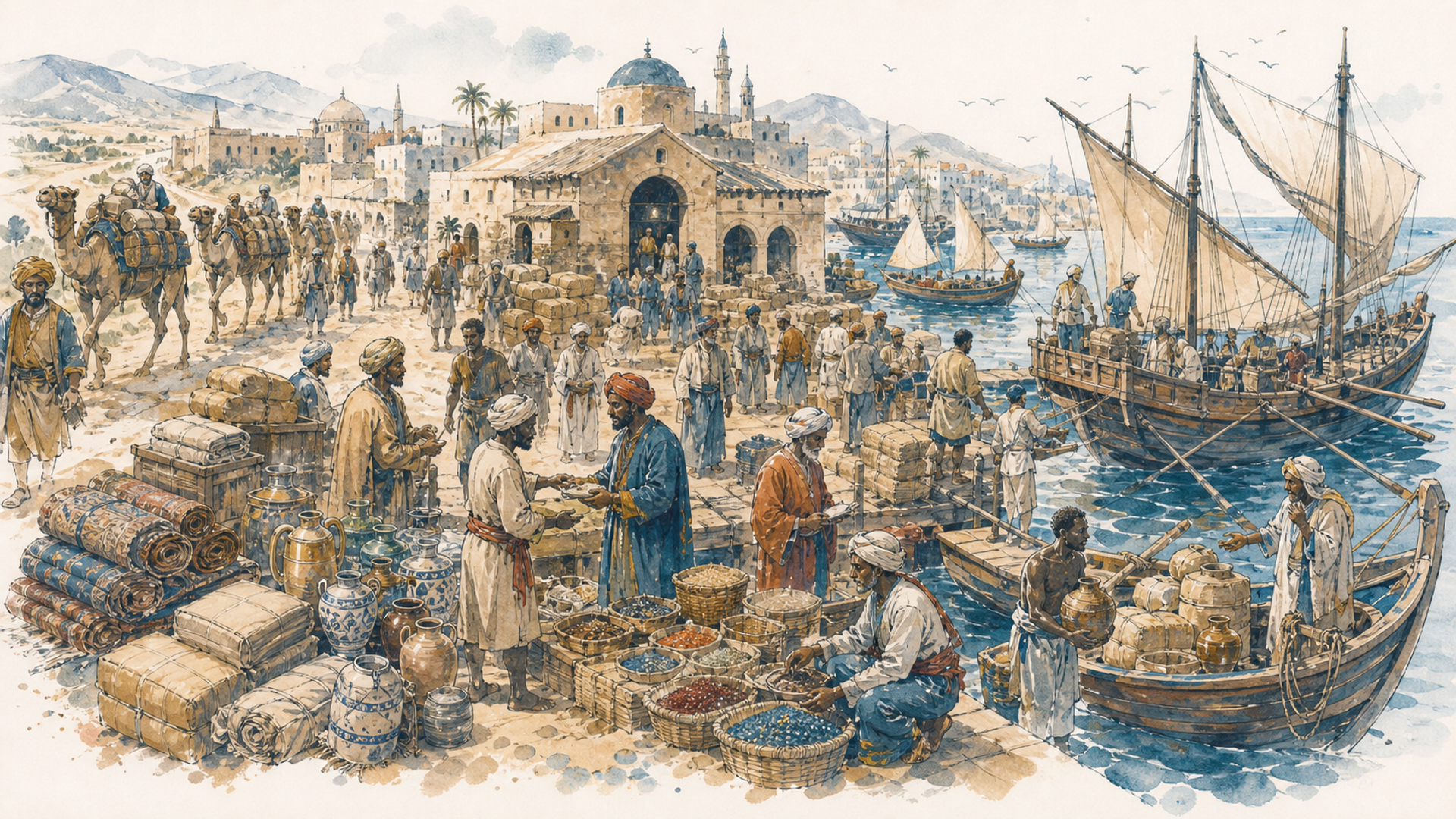
When we say “globalisation”, our minds readily turn to containers, smartphones, intercontinental flights and companies selling the same product in a hundred countries. But imagine stepping into a market in Samarkand a thousand years ago. You might find fabrics from distant regions, spices that had crossed seas, coins bearing inscriptions you could not read and merchants able to move from one language to another. At an inn, you might meet travellers bound for China, India, Persia or the Mediterranean. There is no internet, yet the world is already connected by networks of astonishing complexity. The difference is speed. Today, a message crosses an ocean in a fraction of a second; then, a piece of news might take months. But slow connection does not mean no connection. Goods, ideas, religions, technologies and diseases still managed to travel enormous distances, often without a single person making the entire journey.
The Silk Road was not a road
The name “Silk Road” is convenient, but somewhat misleading. There was no single ancient motorway running from Rome to China, complete with signs and service stations. There was, rather, a network of overland and maritime routes connecting cities, oases, kingdoms and ports. Silk was one of the prestigious goods that travelled along these networks, but it was certainly not the only one, nor was it always the most important. A merchant might buy a product in Central Asia and resell it to someone else without the slightest intention of reaching the Mediterranean. The goods passed from hand to hand. Each intermediary added costs, information and risks. It was like a relay race in which no runner saw the whole course.
This structure explains something interesting: two civilisations could exchange goods without having regular direct contact. A Chinese object might reach the Roman world after passing through many hands. Whoever bought it at the western end of the network might have only vague or fanciful ideas about where it came from. Ancient globalisation, then, did not produce uniform global knowledge. It connected markets faster than it connected minds.
The overland routes of Central Asia depended on places where people and animals could stop, drink, rest and trade. Oases were not merely green spots in the desert: they were nodes. Cities such as Samarkand prospered because they occupied favourable positions within wider networks. Think of an oasis as an ancient router. It did not necessarily produce everything that passed through it, but it allowed the flow to continue. If a war closes off a region, if an empire makes a road safer or if a new route becomes worthwhile, the value of the node changes. It is the same principle we saw with maritime straits, applied to land. Networks reward places capable of connecting different segments.
This connectivity had enormous cultural consequences. Buddhism, born in South Asia, spread towards Central Asia and China partly through the journeys of monks and merchants. Texts, images and religious practices were translated and adapted. They did not arrive as intact packages: they changed as they passed through different cultures. When we speak of premodern trade between East and West, the overland Silk Roads almost always take centre stage. Yet the maritime routes of the Indian Ocean were fundamental and, for bulky goods, often far more efficient. For centuries, sailors and merchants had connected the coasts of East Africa, the Arabian Peninsula, the Persian Gulf, India, South-East Asia and southern China. The monsoons provided a relatively predictable seasonal rhythm: winds that changed direction over the course of the year and could be used to plan outward and return journeys.
Imagine that you are a merchant arriving at an Indian port, knowing that the favourable wind for your return will not blow for several months. You have no choice but to stay. During that time, you live among local people, learn words, make agreements and perhaps start a family or a religious community. Trade thus creates multicultural settlements without any emperor ever planning them. The Swahili cities of East Africa, the ports of the Arabian Peninsula and India, and the centres of South-East Asia belonged to commercial worlds in which Africa and Asia were connected long before the Portuguese arrived. This is an important correction to the story often told in Europe: Vasco da Gama did not “create” Indian Ocean trade. He entered a system that was already old and sophisticated.
When politics makes a route safer
Trade networks thrive when risk falls. If every hundred kilometres brings another army, a different tax or a band of raiders, the cost of trade rises. When a great power establishes a degree of stability across a wide area, exchange can grow. Despite the violence of its conquests, the Mongol Empire linked vast parts of Eurasia in the thirteenth and fourteenth centuries under regimes that, during certain periods, made it easier for merchants, officials and travellers to move. Famous journeys such as Marco Polo’s emerged from this context, although his account should not make us forget the many Asian and Muslim travellers who crossed equally extensive networks.
Ibn Battuta, born in Tangier in the fourteenth century, spent decades travelling through North Africa, the Middle East, East Africa, Central Asia, India and other regions. His experiences reveal an immense Islamic world in which an educated traveller could find shared institutions, communities and religious points of reference across thousands of kilometres. These stories matter because they destroy the idea of isolated continents waiting to be “discovered”. People had been travelling, trading and learning about one another — incompletely, of course — for a very long time. A merchant carrying cloth can also carry a word. A monk carrying a text can carry an artistic technique. An army crossing a region can carry new weapons. A ship carrying spices can carry numbers, instruments or navigational knowledge.
Paper, invented in China, gradually spread westwards through Asian and Islamic networks before becoming increasingly important in Europe. Techniques connected with the production of gunpowder followed complex routes across Eurasia. The numeral system that Europeans often call “Arabic” has Indian roots and reached Europe through scholars and texts from the Islamic world. This is one of the most beautiful things about the history of inventions: rarely does one civilisation create the entire chain by itself. An idea is born, translated, improved, combined with another, adapted to a local problem and then travels again. Human knowledge is as woven as geopolitics.
The networks that carry wealth also carry organisms. The most terrible example is the fourteenth-century plague, the pandemic often called the Black Death. The bacterium Yersinia pestis spread through networks of movement and trade, causing devastating mortality in Europe, the Middle East and North Africa, with effects in other parts of Eurasia as well. The details of its origins and precise trajectories are still being researched, but the principle is clear: connection also increases the possibility that a pathogen will travel. Trading cities, precisely because they receive people and goods from far away, can become gateways for epidemics.
If you lived through the COVID-19 pandemic, the mechanism will be familiar. An efficient global network rapidly spreads both what we want and what we do not want. In the Middle Ages, everything happened far more slowly, but the trade-off was already the same.
Globalisation is not a line that always rises
It is important not to imagine the history of connection as one of continuous growth. Networks expand and contract. Wars, epidemics, political collapses and climate change can make a route too dangerous or too costly. A falling empire may fragment a commercial space; a new state may protect it. A technology may suddenly make an alternative route worthwhile. Globalisation is therefore reversible. Even today, when companies and governments talk about reshoring, friend-shoring or supply-chain security, they are doing something ancient: reassessing the balance between efficiency and risk. At this point, an almost inevitable question appears. If a commodity travels thousands of kilometres, passes through many hands and reaches Europe exceedingly rare and expensive, how much can it be worth? And if its value is immense, how much would you be willing to risk to reach the place where it is produced directly?
This is how a scent can change geopolitics. Pepper, cinnamon, cloves, nutmeg: today, you can find them in a supermarket for a few euros. For centuries, some of these products were valuable enough to fuel voyages, monopolies and wars. In the thirteenth and fourteenth centuries, Mongol expansion brought enormous parts of Eurasia under politically connected dominions. The term Pax Mongolica is used to describe a period in which travel and trade along certain routes could benefit from greater protection and integration, although speaking of “peace” may sound paradoxical after extraordinarily violent conquests. Merchants, diplomats, craftspeople and religious figures travelled remarkable distances. Marco Polo is merely the most famous of them in Europe; the world was full of travellers who were less thoroughly transformed into legend.
The dark side of connection appears in the fourteenth-century plague. The spread of Yersinia pestis was aided by networks moving people and goods, and it devastated populations in Eurasia and North Africa. Scholars continue to reconstruct its precise routes and local dynamics, but the general lesson is firm: a network that accelerates trade can also accelerate something no one wants to trade. In the fourteenth century, the Moroccan traveller Ibn Battuta covered extraordinary distances through North Africa, the Middle East, East Africa, Central Asia, India and beyond. His journey reveals the existence of a vast space connected by religion, law, languages of culture, trade routes and networks of hospitality.
It was not a single empire. It was something different: politically separate regions sufficiently connected for an educated man to find recognisable communities, judges, merchants and institutions thousands of kilometres from home. This is globalisation in its most useful sense: not a world government, but a density of connections that makes what happens far away relevant to you.
Networks can shrink
After seeing centuries of connection, we might think that globalisation always moves forwards. Yet networks can fragment. Empires collapse, wars make certain routes dangerous, epidemics reduce populations, governments impose barriers. The world of 1914 was highly integrated in trade and finance; just a few years later, war had shattered an enormous share of those relationships. Even in the twenty-first century, pandemics, conflicts and strategic rivalries have reminded us that interdependence is an institutional choice as well as a technological possibility. Globalisation is not a destination. It is a state of the network that human beings can expand, reduce or reorganise.
Between the Middle Ages and the early modern period, cities on the Swahili coast such as Kilwa, Mombasa and Malindi were embedded in Indian Ocean networks. Gold from the interior of southern Africa, ivory and other goods reached ports from which they departed for Arabia, Persia and India; ceramics and Asian products arrived in the opposite direction. The Swahili language itself contains a history of encounters, with a Bantu foundation and numerous loanwords derived from commercial and cultural contact. The coastal cities were Muslim and participated in a far larger maritime world. This dismantles a persistent image: continents as sealed blocks that only begin to “connect” with European exploration. The connections already existed; what changes from the sixteenth century onwards is who manages to control a growing share of them, and how directly the different oceans are linked.
In 1453, the Ottomans conquered Constantinople. It is often said that this “closed the Silk Road” and forced Europeans to seek a sea route. This, too, is a simplification: trade between Europe and Asia did not cease, and Venetian merchants continued doing business in the Ottoman world. But political control of the routes, costs and rivalries changed the incentives. The Portuguese and Spanish already had reasons to explore the Atlantic; finding more direct access to the riches of Asia increased the potential reward. Great turning points rarely begin because one door closes completely. They often begin because one door becomes costly enough to make building another seem worthwhile.
Samarkand: when a city has value because it lies between other cities
If a city becomes accustomed to selling textiles to a distant market or importing a good it does not produce, it becomes sensitive to events beyond its control. A war in Central Asia can raise the price of a commodity in the Mediterranean; a political change at a port can divert a route; an epidemic can simultaneously reduce demand, production and transport capacity. This is not yet the world of modern supply chains, but the principle is already present: connection increases possibilities and also increases dependencies. This is why globalisation is never merely a story of openness. Every network prospers only while enough actors find it worthwhile to maintain and while the cost of risk remains bearable.
The Silk Roads were not a road from Beijing to Rome
The name “Silk Road” suggests an ancient motorway with a beginning and an end. It would be far more accurate to picture a network: routes that change, divide and cross oases, passes and cities, connecting with maritime routes and regional trading systems. Very few merchants travelled the entire distance between China and the Mediterranean. Goods passed from hand to hand; every intermediary added costs, information and local products. A piece of cloth could travel much farther than the person who first sold it. Chinese silk reached the Roman world, but horses, glass, metals, fabrics, spices, fruit, techniques and ideas also travelled along those routes. Sogdians, Persians, peoples of the steppe, Central Asian communities and many others acted as intermediaries. To speak simply of “trade between China and Rome” erases precisely what makes the network interesting: the world in between was not empty space, but full of societies that lived through connection.
One episode often presented as the symbolic origin of China’s opening towards Central Asia concerns Zhang Qian, sent by the Han emperor Wudi in the second century BCE on a diplomatic mission to seek allies against the Xiongnu. He was captured, remained away for years and eventually returned with valuable information about the western regions. The curious thing is that a mission launched for strategic reasons helped to broaden knowledge of territories and networks that would sustain trade. Geopolitics and commerce rarely occupy separate compartments. If we look at history from a European point of view, the arrival of the Portuguese in the Indian Ocean at the end of the fifteenth century can seem like the beginning of global trade. From the perspective of Calicut, Aden, Malacca or Kilwa, however, they appeared as new participants in a much older system. For centuries, Arab, Persian, Indian, African and Asian merchants had used the monsoons to travel between ports, creating diasporic communities in which languages, religions and commercial practices mingled.
The Swahili cities of East Africa traded African products with Arabia, India and places beyond; ceramics and other objects of Asian origin discovered by archaeologists demonstrate the depth of these connections. In South-East Asia, straits and ports prospered because of their position between the Indian Ocean and the South China Sea. When Islam spread along many of these networks, it travelled not only through territorial conquest but also with merchants and urban communities. This was a form of globalisation without containers, the internet or modern multinational companies. It was slower and more expensive, and involved a much smaller share of world production; most people still consumed mainly what was produced relatively nearby. Yet the consequences of some exchanges could cross continents.
The plague had enormous demographic, economic and social consequences, but they differed from region to region. In parts of Europe, labour scarcity altered relationships between landowners and workers; elsewhere, different institutions and conditions produced different outcomes. Once again, a biological catastrophe interacts with existing political structures: the same shock does not automatically produce the same society.
The Mongols and the paradox of imperial security
In the thirteenth century, the Mongol conquests devastated many populations, but the subsequent integration of enormous territories under Mongol rule helped, in certain periods, to facilitate the movement of merchants, diplomats and knowledge across Eurasia. The so-called Pax Mongolica was not an age of peace in the modern sense, and the term can conceal violence and wars; rather, it describes the fact that certain routes became relatively more integrated and protected within spaces controlled by connected powers. Marco Polo is the most famous European traveller associated with this world, but his publishing success risks making us forget thousands of others. Ibn Battuta, born in Tangier in the fourteenth century, travelled across an enormous part of the Islamic world and beyond, from Africa to India and Asia. Chinese Buddhist monks had journeyed to India centuries earlier in search of texts. Franciscan diplomats reached the Mongol courts. Merchants who left no autobiographies built family networks across ports and oases.
Globalisation, in short, has no inventor. It has accelerations. Every new transport technology, every great empire, every language of trade and every institution capable of reducing risk makes a network a little denser. When we reach Atlantic crossings, steam, the telegraph and the container, the scale will change enormously. But the fundamental logic — distant people becoming dependent on a shared network — existed long before the word we now use to describe it.