Chapter 11 · Part 03
Why Could a Spice Be Worth a Fortune?
Scarcity, distance and control of trade routes.
Value also depends on how rare, desirable and difficult to transport a commodity is. Spices, silk and salt show why controlling a trade route can be worth almost as much as controlling a mine.
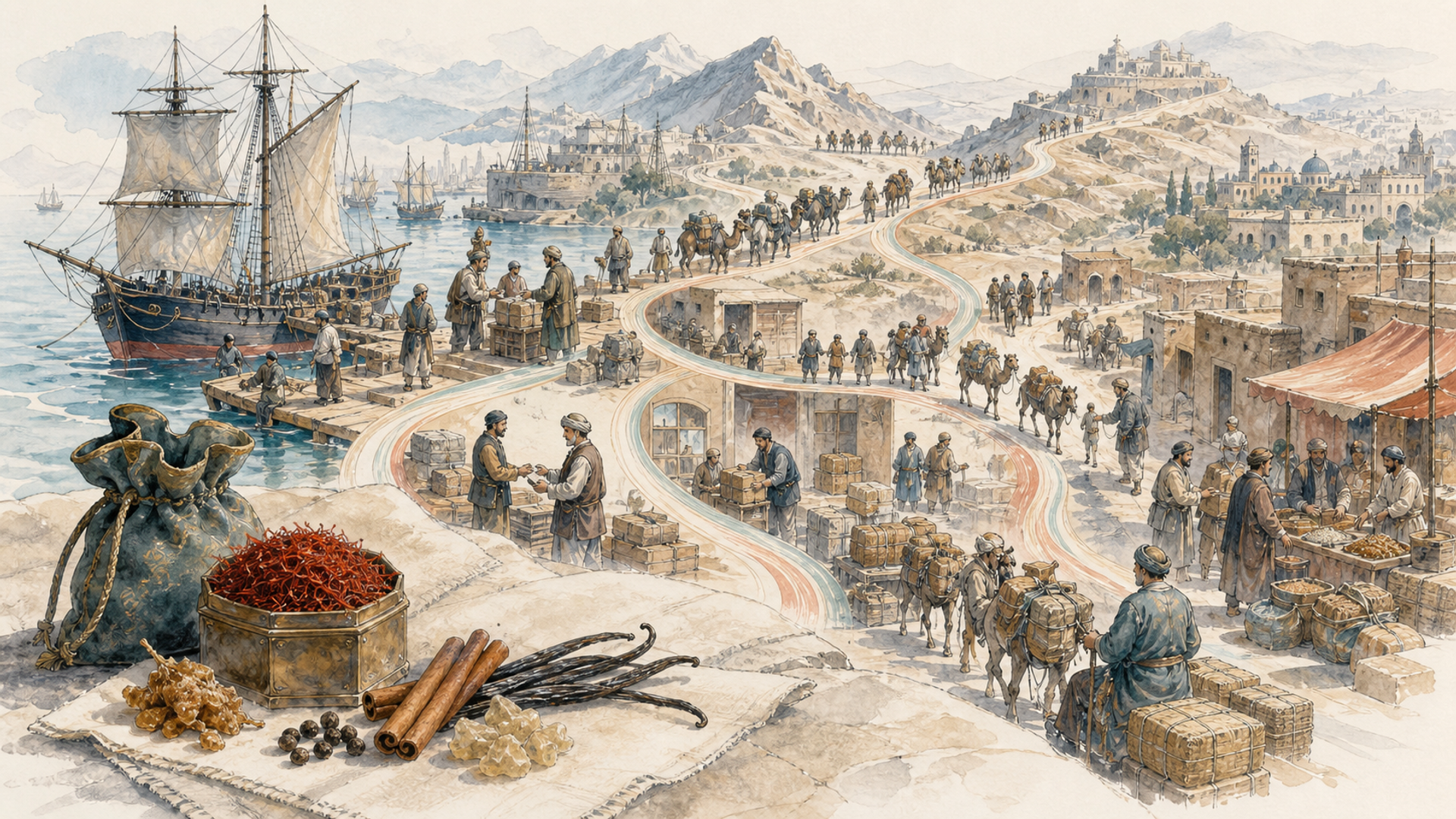
Open a kitchen cupboard and pick up a jar of pepper. Today, it is one of the least geopolitical objects you could imagine. It costs little, comes ready-packaged and you probably do not even know which port it passed through. Yet for long periods of European history, Asian spices were luxury goods desirable enough to cross continents, generate enormous margins and drive merchants and states to seek new routes. The interesting point is not to declare, with a touch of theatre, that “pepper was worth its weight in gold” everywhere and at all times — it was not. Its value changed constantly. It is much more useful to understand how distance creates value.
Something becomes precious along the way
Black pepper thrives in the humid tropical climates of South Asia. To a producer near the growing region, it is not necessarily a mysterious commodity. But carry it by sea to the Persian Gulf or the Red Sea, transfer it to another merchant, transport it across the Mediterranean, add taxes, risks, losses, storage costs and every intermediary’s profit, and the price changes. Pepper’s scarcity in Europe was not one of its natural properties. It was the result of the geography of production and the commercial chain. This is a simple but extraordinarily powerful economic idea. An object can be worth a great deal in one place and very little in another. Trade arises from precisely that difference. Whoever manages to connect the two places makes money.
This is one reason cities such as Venice prospered through Mediterranean trade in goods supplied by eastern networks. Venice did not control pepper plantations in India, but it occupied a privileged position in a chain connecting European markets with merchants in the eastern Mediterranean. One curious episode captures the prestige of spices rather well. When Alaric and the Visigoths threatened Rome in the early fifth century, some ancient sources report that their ransom demands included a large quantity of pepper. To us, the detail seems almost absurd: imagine an army demanding mountains of cooking spice alongside precious metals.
The precise quantity and context should be treated with caution because we depend on ancient sources, but the appearance of pepper in accounts of this kind reminds us that it was not merely a seasoning. It was a prestigious, portable, high-value product. Many spices also had culinary, medicinal and ritual uses. There is no need to repeat the old legend that medieval Europeans used spices mainly to disguise the taste of rotten meat: an expensive spice would have been a rather peculiar way to rescue food that had already gone bad. Spices were desired because people enjoyed them, because they signalled social distinction and because they belonged to the period’s medical and culinary practices.
The islands worth fighting a war over
The story becomes even more remarkable with nutmeg and cloves. For a long time, some of these spices were produced commercially in extremely small areas of the Moluccan archipelago, in present-day Indonesia. This concentrated their value enormously. If a commodity sought after in Europe grows on only a few distant islands, controlling those islands brings you close to a monopoly. That is exactly what European powers such as Portugal and the Netherlands tried to achieve in the early modern period, forcing their way into pre-existing Asian networks. The Dutch East India Company, or VOC, was not simply a private company in the modern sense. Founded in 1602 with powers granted by the Dutch state, it could, under certain conditions, wage war, conclude treaties and administer territories. The pursuit of commercial profit and political force fused into something new: a company that could behave almost like a state.
Here, the thread of our story becomes perfectly clear. A spice leads to a route. The route leads to a port. The port requires protection. Protection requires armed ships. Armed ships lead to bases. Bases lead to territory and administration. A kitchen ingredient ends up woven into the construction of an empire.
For a European merchant, the prospect of reaching Asian markets directly was irresistible. Every intermediary removed promised greater margins. Yet between Western Europe and South Asia lay continents, powers, deserts and an enormous ocean. This was one source of the impetus behind Portuguese oceanic exploration. It was not the only motive: religion, prestige, political competition and geographical curiosity all mattered. But direct access to the trading networks of Africa and Asia was central. When Vasco da Gama reached India by sea in 1498, he did not arrive in an isolated land. He reached ports that had participated in sophisticated international trade for centuries. The Portuguese quickly discovered that they were newcomers to a system in which Arab, Persian and Indian merchants, among others, were firmly established. Their advantage did not lie in any natural commercial superiority. They sought to build power through armed ships, fortifications and control of strategic passages.
Price is a map of power
If you look at prices as though they were a map, you can almost see geography. A product costs little where it is abundant; its price rises when it must cross dangerous spaces, changes when a war closes a route and falls when technology makes transport more efficient. We still experience this. Oil prices rise when conflict threatens a production or transit area. Container costs increase when a route is disrupted. An electronic component becomes precious when a factory shuts down. We have not ceased to depend on geography; we have replaced some spices with semiconductors, natural gas and batteries.
Modern markets are, of course, infinitely more complex. There are futures, stockpiles, insurance, alternative sources and global logistics systems. Yet the underlying question is identical: how much does it cost to move something from where it exists to where you want it? In the late fifteenth and sixteenth centuries, this question led Europeans to invest ever more heavily in oceanic navigation. Wanting pepper was not enough. They had to know where to go, build ships capable of long voyages, determine their position and understand winds and currents. At this point, the story changes tone. Until now, globalisation had been a network made up chiefly of many intermediaries. Now some European monarchies attempted to establish direct and permanent maritime connections with Asia and, almost simultaneously, came into contact with the Americas.
This was no sudden triumph of “European genius”. It was the result of knowledge accumulated over centuries: the compass developed in Asia; astronomy and mathematics refined in several traditions; Mediterranean cartography; sailors’ experience; shipbuilding techniques. The great transformation occurred when these elements were combined with capital and with states willing to finance extremely risky voyages.
The Spice Islands are tiny
Nutmeg and cloves originally came from very limited geographical areas of the Indonesian archipelago. This created a natural monopoly before anyone tried to create a political one. If the whole world wants a product that grows well on only a few islands, those islands suddenly become more important than their size would suggest. In the seventeenth century, the Dutch East India Company sought to impose strict control over nutmeg production and trade in the Banda Islands. Its attempt to enforce a monopoly involved extreme violence, deportations and the destruction of local communities. This case shows how far the logic of commodity control can go when prices are high and scarcity is exceptional. A kitchen spice can therefore help finance fleets, companies and wars. Economic value does not depend on an object’s physical size.
If you know that a harvest has failed in one port and no one else knows it yet, you possess something that may be worth money. Information travelled slowly in premodern trade, so family networks, letters, agents and reputation were strategic resources. Commercial cities developed institutions to reduce uncertainty: contracts, insurance, credit and mercantile courts. A shipwreck could ruin a single investor; spreading the risk among several people made it possible to finance larger voyages. When we come to the Dutch and British joint-stock companies, we shall see that the real innovation was not merely the ship. It was the financial capacity to raise capital and distribute risk on a new scale.
The search for direct access to spices helped drive European navigators down the African coast and then into the Indian Ocean. It was not the only motive — religion, prestige, gold and political rivalries all played a part — but the desire to bypass commercial intermediaries was extremely powerful. This is a wonderful reversal: for centuries, geography had made spices expensive; that very cost provided the incentive to invest in technologies and routes capable of changing economic geography. When a route is too expensive, human beings do not always simply pay. Sometimes they try to invent another one. The point is not to retell the familiar story of the “great explorers”, but to understand how people actually learn to cross an ocean when no one can tell them with certainty what they will find on the other side.
Value also comes from distance
If you walk into a supermarket today and buy pepper, cinnamon or nutmeg, you are spending a few euros on products that, for centuries, travelled through extraordinarily long commercial chains. It is easy to assume that their historic prices reflected an irrational taste for luxury. That was partly true: spices were status symbols, and some were associated with medicinal properties that we would assess far more cautiously today. But their value above all illustrates a simple economic rule: when a commodity is desired, produced in very few places and costly to transport, every stage of the chain adds profit and risk.
Nutmeg is an almost perfect example because, for a long time, it came from a tiny part of the planet: the Banda Islands, in present-day Indonesia. Cloves originated in the northern Moluccas. Before a European consumer ever saw these spices, they might have passed through local merchants, South-East Asian ports, Indian Ocean traders, Middle Eastern intermediaries and Mediterranean networks. There was no single “spice merchant” who set out from London and returned with a full sack. There was a chain. Each link required knowledge, protection and trust. You needed to know when the monsoons blew, which port accepted a particular currency, who ruled a strait, what taxes a city demanded, where piracy was a risk and which merchant could be trusted. The price incorporated all of this. Distance was not simply a matter of kilometres: it was the cost of uncertainty.
Fifteenth-century Europeans were not the first to desire Asian spices, nor did they “invent” the spice trade. What changed was the possibility of reaching Indian Ocean markets directly by sea, sailing around Africa. When Vasco da Gama arrived in India in 1498, Portugal hoped, among other things, to enter an extremely profitable trade while bypassing some of the intermediaries connecting Asia and the Mediterranean. It is important not to turn this history into a fable in which “the Ottomans close the Silk Road and Columbus sets sail”. The Ottoman conquest of Constantinople in 1453 did not sever Eurasian trade, and exploration had many motives: the search for trade routes, political rivalry, religion, nautical knowledge, the availability of capital and personal ambition. But the desire for more direct access to Asian markets was undoubtedly a powerful force.
Once they had found the route, however, the Portuguese discovered something we should now expect: the Indian Ocean was not empty. There were merchants, states, fleets and rules. To secure a privileged position, Portugal combined trade with violence, seeking to control ports and strategic passages such as Goa, Malacca and Hormuz. The aim was not to conquer all of Asia — an impossible undertaking for a relatively small European kingdom — but to insert itself into the network’s nodes and tax or otherwise shape its flows.
Nutmeg and the dark side of monopoly
In the seventeenth century, it was primarily the Dutch, through the Dutch East India Company, or VOC, who sought much more aggressive control over the spices of the Banda Islands. The story is brutal. To impose its nutmeg monopoly, the VOC used coercion, deportation and extreme violence; in 1621, forces led by Jan Pieterszoon Coen killed, expelled or enslaved an enormous share of the Bandanese population. Behind the elegant porcelain, Amsterdam’s markets and shareholders’ profits lay a geography of monopoly built with weapons. The most famous curiosity comes several decades later. In the 1667 Treaty of Breda, which ended the Second Anglo-Dutch War, the Dutch consolidated their control of Run, one of the Banda Islands, while the English retained New Netherland, including New Amsterdam, which later became New York. To say that “the Dutch traded Manhattan for nutmeg” is an excessively theatrical simplification: the treaty settled a war and numerous claims. Yet the comparison remains memorable because it shows how strategically valuable a small spice-producing island could appear in the seventeenth century.
Then the monopoly vanished. Seedlings and seeds were transferred elsewhere, new production areas developed and supply increased. The commodity had not lost its fragrance; it had lost its scarcity. This is an economic lesson that applies to oil, diamonds, technologies and patents: what makes a resource valuable is not only its usefulness, but how difficult it is for others to obtain it elsewhere. Spices interest us not because the modern world depends on cinnamon, but because they teach us to see value chains. A raw material is produced in one place, transported through nodes, processed, financed, insured and sold. Whoever controls a link that is difficult to replace can extract returns far greater than the commodity’s physical size might suggest.
In the twentieth century, this logic shifted to energy. An oilfield has value because the world builds engines, industries and military systems that depend on oil. In the twenty-first century, the same question applies to critical minerals, semiconductors and industrial components. When everyone wants something that only a few can produce, the geography of production becomes geopolitics. Spices are therefore an excellent starting point because they make the mechanism visible in its simplest form. They are not necessary for survival, yet the combination of desire, rarity and distance was powerful enough to drive states to finance ocean voyages, private companies to maintain armies and entire communities to be overwhelmed by the pursuit of monopoly. Sometimes the things that change the world are surprisingly small: a seed, a grain, a dried fruit weighing only a few grams but worth enough to launch a fleet.
When the price tells the story of everything that can go wrong
A high price tells us not only how much someone desires a commodity, but also how many obstacles lie between the people who produce it and those who want to buy it. Before modern transport, every stage added risk. A ship might sink, a cargo might be seized, an intermediary might fail, a war might close a port or a storm might cause months of delay. Spices were ideal for long-distance trade because they concentrated a great deal of value in very little weight and kept relatively well. Transporting a bulky, inexpensive commodity thousands of kilometres was often not worth the journey; carrying a sack of pepper or nutmeg, by contrast, could justify enormous risks.
This also helps to put a popular myth into perspective: Europeans did not seek new ocean routes simply because “the Ottomans had closed the Silk Road”. Trade between the Mediterranean and Asia continued after the Ottoman conquest of Constantinople and involved complex networks of Muslim, Christian, Jewish and other intermediaries. For the Portuguese and other Europeans, the broader challenge was that reaching the sources of Asian goods directly could cut out intermediaries, circumvent rivals and secure a larger share of the profits. The search for maritime routes was therefore a commercial and geopolitical strategy, not a mechanical response to a door that had suddenly been closed.
When new regions began to cultivate the same spices and monopolies weakened, prices changed. This is the final point: scarcity is not always an eternal property of nature. It can be produced by geography, knowledge, monopoly, technology or politics, and it can disappear when any one of those conditions changes. We shall later apply the same reasoning we use for seventeenth-century nutmeg to oil, rare earth elements and semiconductors.