Chapter 09 · Part 02
Why Do Millions of Strangers Feel Part of the Same World?
Religion, culture, law and shared identity.
Empires are not held together by armies and taxes alone. Beliefs, rules, languages and identities allow people who will never meet to imagine themselves as part of the same order.
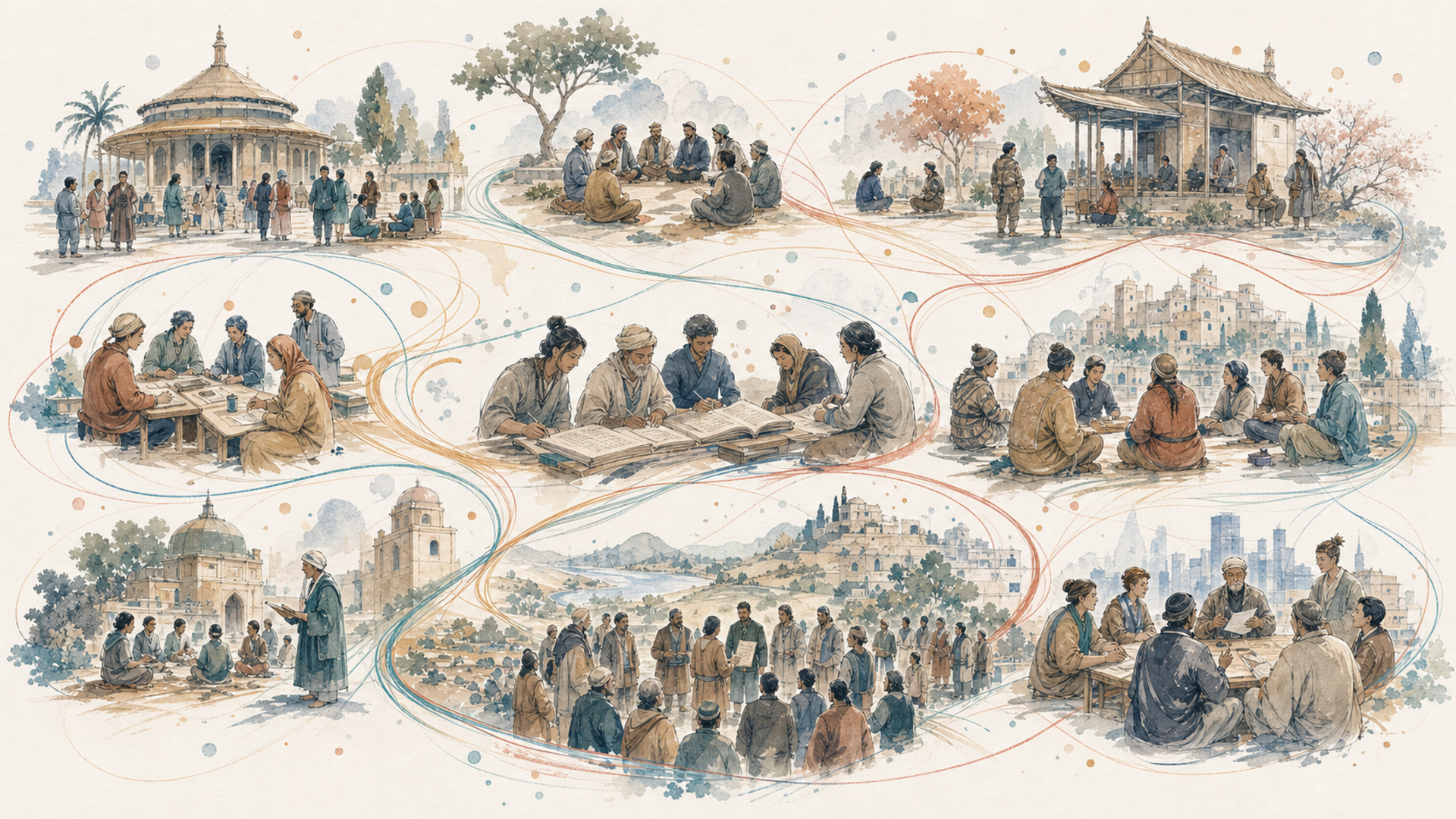
Imagine walking into a vast city where you know no one. You have never met the magistrate who enforces the law, the soldier who guards the frontier or the merchant who sells you something. Yet you behave as though you share common ground: a coin is worth something, a contract must be honoured, certain days are sacred and certain authorities have the right to give orders. How can millions of strangers live within the same system without knowing one another personally? The most obvious answer is force. A state can punish those who disobey. But force alone is extraordinarily expensive. If everyone followed a rule only because a soldier threatened them, there would have to be a soldier standing behind every person. Political systems that endure need something more efficient: they must persuade enough people that at least part of the established order is legitimate, natural, useful or sacred.
Societies also live by invisible things
A border exists physically only in certain places: as a wall, a fence or a checkpoint. Along most of its length, it is a convention. Money may be paper, metal or numbers in a database, but it works because millions of people share expectations about its value. A law is not a force of nature: it exists because institutions and citizens recognise and enforce it. This does not mean that ‘everything is invented’ and therefore unreal. On the contrary, some of the most powerful things in human life exist precisely because they are shared. A religion can organise calendars, marriages, moral rules and communities spanning continents. A political identity can persuade people who have never met to pay taxes for common services or risk their lives in war. Empires have always had to operate on this invisible level.
At the height of the Roman Empire, millions of people lived under the same power without speaking the same language or worshipping the same gods. Rome did not always try to eliminate local religions; it often absorbed or tolerated them, provided they did not threaten the political order. Provincial elites could adopt elements of Roman culture while preserving local traditions. Over time, citizenship became an immensely powerful instrument. Being Roman did not necessarily mean having been born in the city of Rome. It could become a legal status shared by people who lived very far apart. When Emperor Caracalla extended citizenship to most of the empire’s free men in AD 212, Roman political identity had long since outgrown the geographical place where it began. It was a remarkable transformation: a city became a political idea.
But identities do not replace everything that came before them. A person could simultaneously feel that they belonged to their city, their family and their religion, and that they were a Roman citizen. Human identities overlap. When they come into conflict, politics becomes more difficult. The great universal religions added another kind of community. In very different ways, Buddhism, Christianity and Islam created networks that crossed kingdoms, languages and frontiers. Buddhism began in South Asia and spread along trade routes into Central Asia, China and beyond. Christianity began in a province of the Roman Empire and, after centuries of intermittent persecution and growth, became a religion favoured by imperial power in the fourth century and eventually the empire’s dominant faith. Islam, born in the Arabian Peninsula in the seventh century, spread rapidly through a combination of political conquest, trade, migration and religious activity, creating communities from the Mediterranean to Asia.
It would be wrong to reduce this spread to the claim that ‘religion followed the army’. Merchants, monks, pilgrims, families and scholars were just as important. Faiths often crossed borders that empires proved unable to hold. This created a new geography. Two people separated by thousands of kilometres could feel part of the same religious community, sharing rituals, texts and rules even though they lived under different rulers.
The language of power
Language is another essential instrument. An administration needs to communicate; an army must understand its orders; officials must be able to read documents. Empires can govern in a dominant language while allowing many others to be used in daily life. In the Achaemenid Empire, for example, Aramaic was widely used as an administrative language in an otherwise multilingual setting. In the Roman Empire, Latin predominated across much of the west, while Greek remained extremely strong in the east. In China, the written tradition provided administrative continuity across differences in spoken language. A common language reduces the cost of cooperation. But it can also become a source of conflict when a state tries to impose it upon people who regard their own language as an essential part of their identity. This tension would erupt in the age of nationalism, when schools, print and national languages helped turn millions of people into French, Italian or German citizens, or members of other national projects.
You do not need to love every member of a society in order to cooperate with them. It is enough to expect common rules to exist. If you sell something to a stranger, what matters is knowing that the contract will be valid. If you travel, you want to know which authority controls a road. If you lend money, you want a system that recognises the debt. Law creates predictability. Empires that manage to establish relatively stable rules make trade and everyday life easier. This does not mean that the law is the same for everyone: nearly every historical society has had profound differences in status. But even an unequal law can serve as a technology of coordination if people know which rule applies.
Here we encounter a slightly uncomfortable truth: order and justice are not the same thing. A system can be highly ordered and profoundly unjust. The Roman Empire could guarantee roads and contracts while depending heavily on slavery. Modern colonial empires would build infrastructure and administrations while denying political rights to the colonised. Understanding how a system works does not mean approving of it. Shared identities can create solidarity, but they can also draw a line between ‘us’ and ‘them’. A ruler can use religion, ethnicity or culture to legitimise a war. A political movement can turn linguistic differences into territorial claims. An empire can present conquest as a civilising mission.
We must therefore treat identities with care. They are not superficial fictions that rulers can invent at will, but neither are they eternal, immutable blocks. They change over time, overlap and are reinterpreted. Whenever you hear that two peoples have ‘always hated each other’, be wary. Many conflicts presented as ancient have modern causes, while long periods of coexistence are erased from the story told afterwards. Collective memory selects particular episodes, heroes and wounds; politics can reactivate them.
The empire may fall, but the idea can remain
One of the most fascinating features of history is that empires die while some of their cultural networks survive. The Western Roman Empire disappeared, but Latin continued to influence languages, law and religion. Islamic empires changed dynasties and borders, yet Arabic and Islam continued to connect distant societies. Chinese dynasties fell and were replaced, but the idea of a unified Chinese political order survived centuries of transformation. Culture therefore moves at a different speed from politics. A frontier can be changed by a treaty; a language or religion does not disappear with a signature. This difference would become crucial when European empires drew new colonial borders across regions with pre-existing identities, and when decolonisation later produced states that had to build a sense of shared belonging within inherited boundaries.
So far, we have assembled the ingredients of large societies: surpluses, cities, administration, empires, communications and shared identities. Now we can add the network that brings those societies into contact with one another. Globalisation did not begin with the Internet, or even with Columbus. Long before the modern age, merchants crossed deserts and oceans, monks travelled between kingdoms, and coins and technologies passed from hand to hand. No one controlled the entire network, and almost no one travelled its full length from beginning to end. Connections worked in segments, like a relay. We carry one form of shared cooperation in our pockets without giving it a thought: money. A coin or banknote has value because other people agree that it does. You do not have to know the baker personally, be related to them or share their religion. You merely need enough trust in the same system of exchange.
Coins minted by ancient states made taxation, trade and the payment of armies easier, although complex economies already existed before them and barter was not simply ‘replaced’ by money in a single moment. What makes this geopolitically interesting is that a common currency creates an economic space. An empire that pays its soldiers and collects taxes in the same coin can link distant regions through a material network as well as a political one. In the contemporary world, this logic will become immense: trust in the dollar, the euro or a banking system can generate power across borders. Imagined communities do not live by flags alone; they also live by bookkeeping.
Buddhism, Christianity and Islam demonstrate something that ancient local cults often did not do in quite the same way: they can build communities that cross political and ethnic boundaries. Buddhism travelled along the networks of Central and East Asia; Christianity arose within the Roman Empire and then survived its western half; Islam spread through conquest, trade, migration, institutions and conversion across vast regions. This created a new geography of belonging. A person could be the subject of a ruler, an inhabitant of a city and a member of a religious community extending far beyond the political territory. Identities do not neatly replace one another: they overlap.
And precisely because they overlap, they can cooperate or come into tension. An empire can use religion to legitimise itself; a religious community can offer solidarity against political power; depending on the system, minorities may be protected, tolerated, taxed differently or persecuted.
A common language does not mean a uniform people
Empires often use one or more administrative languages to coordinate different territories. Aramaic played an important role in the Achaemenid Empire; Greek spread enormously after Alexander; Latin became central in the West under Rome; written Chinese provided administrative continuity across different dynasties. But the language of the state and the language spoken around the kitchen table are not the same thing. A person might write documents in Latin and speak a local language; trade in a lingua franca and pray in another tongue. When we come to the modern nation-state, we shall see governments deliberately attempt to reduce this variety through schooling, the army and linguistic standardisation. For now, it is enough to observe that diversity was the normal condition of a great many large political systems.
To say that an identity is ‘constructed’ is not to say that it is fake. A standard language, an origin myth, a religion or a nation can be produced over centuries of history and nevertheless become intensely real in emotional terms to those who belong to it. People are willing to pay taxes, help strangers and even die for communities that exist above all because millions of people simultaneously believe in their importance. This is one of culture’s most astonishing powers: it extends the reach of trust and obligation beyond the family and the village. It is also one of the most dangerous sources of conflict when ‘us’ is constructed through the absolute exclusion of ‘them’.
Flag, anthem, currency, calendar, public holiday, oath: modern states are full of them, but the idea is far older. Societies use rituals to turn something abstract — a political or religious order — into an experience that can be seen and repeated. When thousands of people celebrate the same festival or recognise the same symbol, they do not need to know one another personally to know that others are doing the same. Ritual synchronises a community. This may seem merely decorative beside taxes and armies, but it is not. A power that must compel every person every day is extraordinarily expensive. If enough people regard the system as legitimate, they will often obey without a soldier having to be present.
Identities change without disappearing
A Sicilian in 1700 might have felt attached to their village, the Catholic faith, a dynasty and Mediterranean networks without possessing the Italian national identity of the twentieth century. This does not mean they had no identity; they had other identities, organised differently. The same person can also have several forms of belonging at once. Being Catalan and Spanish, Kurdish and a Turkish citizen, Muslim and French, European and Italian are not logically impossible combinations. They become sources of conflict when institutions and political movements present them as incompatible. The geopolitics of identity does not arise simply because people ‘are different’. It arises from the way in which differences and forms of belonging are politically organised.
Imagine living in a medieval city and meeting people who have come from thousands of kilometres away, who pray in the same liturgical language as you, know similar stories and arrange their calendar around the same religious events. Even without a common state, you suddenly possess a mental map larger than the place where you were born. The pilgrimage to Mecca is a powerful example. For centuries, Muslims from far-flung regions of Africa, Asia and the Mediterranean have met along the routes of the hajj. The pilgrimage did not erase linguistic, ethnic or political differences, but it made tangible the idea of belonging to a religious community that transcended the borders of kingdoms and empires.
Something similar, in different forms, happens with Christian, Buddhist, Hindu and other holy places. Religions produce geographies that do not coincide with those of states: centres, peripheries, routes, calendars and shared memories. These invisible maps can outlive vanished empires. One of the traps of the present is to project our idea of nationality backwards into the past. An inhabitant of Europe or Asia centuries ago might simultaneously have felt part of a village, a city, a religious community, a guild, a dynasty or a language group without needing to choose a single dominant label.
We do something similar today. You can feel Italian, European, from the Marche, a supporter of a football club, a member of a profession and part of a family without any one of these identities necessarily erasing the others. Conflict begins when politics decides that a distinction must become exclusive: ‘if you are truly one of us, you cannot also be one of them’. This is where identity enters geopolitics. Not because cultural differences automatically cause wars, but because leaders, institutions and movements can turn one of the many available forms of belonging into the principal line dividing friends from enemies. Shared history can help millions of strangers cooperate; it can also be selected, simplified and weaponised. And we shall discover that the world was already surprisingly connected long before anyone invented the word globalisation.
No empire lives by fear alone
An army can conquer a city and a tax collector can exact tribute, but if a political system has to use violence against every individual every day, it is already too expensive to function. Large societies need an enormous amount of voluntary, or at least habitual, cooperation. People must regard certain currencies, laws, calendars and authorities as normal; they must know how to behave towards strangers and often need to believe that the order in which they live possesses some form of legitimacy.
Religions have been one of the most powerful sources of this shared language, but it would be reductive to describe them simply as tools invented by rulers. Judaism, Buddhism, Christianity, Islam and other religious traditions have histories, doctrines, internal conflicts and spiritual dimensions that cannot be explained by politics alone. What concerns us here is one historical consequence: a faith can create moral communities that transcend villages, tribes and even empires. A Christian in Roman Africa and one in Syria could regard themselves as part of the same religious community without ever meeting. A Muslim in al-Andalus and one in Central Asia could share texts, rituals and points of reference. A Buddhist monk could travel along Asian routes in search of texts and teachers thousands of kilometres from home.
These communities do not erase local identities; they overlap with them. A person can belong simultaneously to a family, a city, a language, a social rank, a religion and an empire. It is precisely this layering that makes identity so politically interesting. Identities can cooperate or come into tension; they can be strengthened by rulers, reformers, merchants or popular movements. The spread of Buddhism from the Indian subcontinent towards Central Asia, China, Korea and Japan clearly shows how religion and trade can become intertwined. Monks, pilgrims and merchants travelled along some of the same land and sea networks. Monasteries and cultural centres arose along the Silk Roads; texts were translated; images and artistic styles changed as they encountered local traditions. Religion did not travel like a sealed package: it was transformed along the way.
The same is true of Christianity and Islam. Christianity spread within and beyond the Roman world, became the empire’s favoured and then official religion in the fourth century, and survived the end of the Western Roman Empire through very different institutions and communities. Islam, born in seventh-century Arabia, spread through conquests, states, trade, preaching and migration, over time creating a vast zone of linguistic, legal and cultural connections from the Atlantic to Asia. To reduce these histories either to ‘conversion by the sword’ or, at the opposite extreme, to an entirely peaceful diffusion is to lose the variety of the real processes involved. Universal religions produce something geopolitically important: networks that cross political borders. An emperor may control a territory, but a religious authority, a pilgrimage or a centre of learning can connect people living under different rulers. This can strengthen a political order or limit it, because an individual’s loyalty never belongs entirely to the state.
Rome offers another route towards integration. Being Roman did not always mean the same thing. At first, it was a relatively narrow civic identity; as the Republic and Empire expanded, citizenship and legal status became political instruments. Granting rights to communities and elites could turn former enemies into participants in the Roman order. In AD 212, Caracalla’s edict extended citizenship to the great majority of the empire’s free men. We should not idealise this. Rome was a profoundly unequal society, built in part upon slavery, and citizenship did not erase enormous disparities. But the example shows that a political identity can be built through institutions as well as descent. If people from vastly different backgrounds can legally become members of the same order, an empire has an instrument other than coercion alone.
Over time, imperial China developed another model of integration, in which written culture, administration, political rituals and the Confucian tradition helped create continuity across different dynasties. Here too, ‘Chinese’ was never a simple or immutable identity, and the empires were often multi-ethnic; that is precisely why it is so interesting to observe how institutions and narratives can survive changes of dynasty and incorporate new rulers.
The great trick is to make what was constructed seem normal
A frontier, a currency, an official language, a dominant religion or a law is a product of history. After enough generations, however, it can come to seem natural. This is one of culture’s most powerful mechanisms: it turns contingent solutions into things that ‘have always been done this way’. We shall later see the same process at work in modern nations. Millions of people who do not know one another can feel French, Italian, Indian or Japanese through schools, newspapers, armies, symbols, language, historical memory and institutions. This does not mean that the identity is false; it means that it is socially constructed, passed on and continually reinterpreted. Something constructed can have profoundly real consequences.
This matters when we try to understand contemporary wars and borders. People do not fight only for measurable resources. They may risk their lives for sacred places, memories, languages, symbols and forms of belonging. If we ignore this dimension because it does not appear on a physical map, we miss half of geopolitics. Geography tells us where we are; culture helps tell us who we think we are while we are there.