Chapter 17 · Part 04
How Do You Make a Thousand Kilometres Disappear?
Railways, telegraph, steam and standard time.
Distance does not disappear, but it changes scale. Railways and steamships speed up goods and armies; the telegraph makes information almost independent of the messenger's speed.
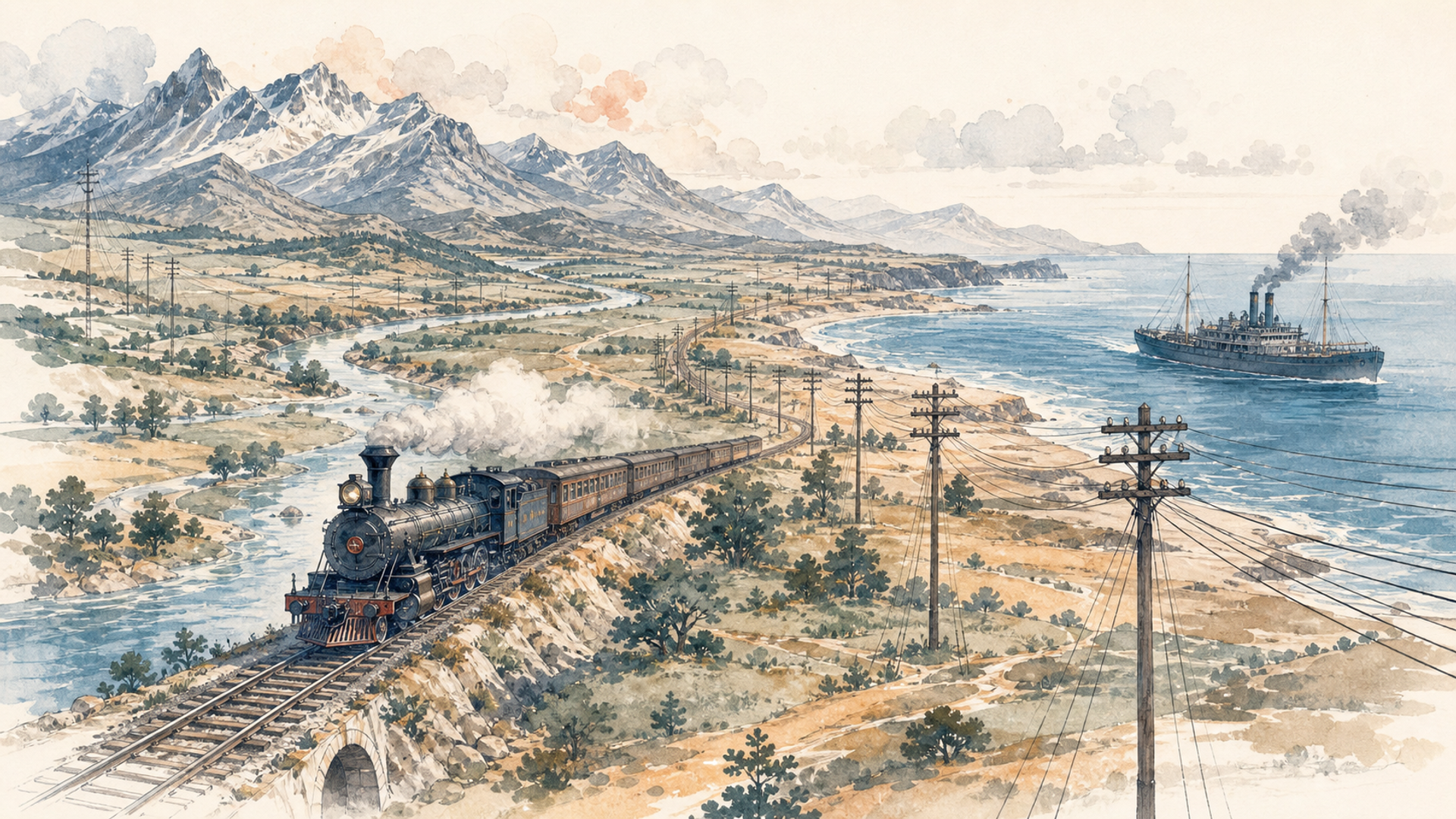
In 1800, if an important event takes place a thousand kilometres away from you, the news might take days or weeks to arrive. By 1900, in many parts of the world, a telegram can cover that distance in minutes. The mountains are still there, the rivers have not grown shorter and the Earth has not become smaller. Yet, for politics and economics, space has been compressed. The nineteenth century is when transport and communications begin to separate. For almost all of history, a message travels with a person, a horse or a ship. With the telegraph, information can move without the messenger being physically transported. For government, it is a rupture comparable to the invention of the Internet.
The train changes the meaning of ‘near’
The first modern railways develop in Britain in the early nineteenth century and spread rapidly. A steam locomotive can carry large quantities of goods and people at regular, relatively predictable speeds. This changes the economy. Fish and milk can travel farther before spoiling. Factories receive coal and raw materials more reliably. Workers can move around. Cities grow around stations. Politics changes too. A government can move troops in a few hours where once it took days. A local rebellion becomes harder to isolate from the centre. During the American Civil War, railways were essential for moving armies and supplies. In the European wars of the second half of the century, planning railway mobilisation becomes part of military strategy. The train, in short, is not merely a means of transport. It is a technology for integrating territory.
One curious detail shows just how profoundly railways change everyday life. Before railway timetables, many towns used their own local solar time: noon was the moment when the Sun reached its highest point. As long as you travel slowly, a difference of a few minutes between two towns matters little. With trains, it becomes a problem. If every station follows a slightly different time, timetables are confusing and potentially dangerous. British railway companies gradually adopt a standard time based on Greenwich, helping to spread a single national time. Technology therefore forces society to standardise even time.
In 1884, an international conference in Washington adopted Greenwich as the prime reference meridian for international longitude, although the practical adoption of time zones was gradual and uneven. Today we check the time on our phones without a thought; behind it lies a history of trains, navigation and global coordination.
The telegraph makes information travel faster than any human being
In the 1830s and 1840s, several inventors develop practical telegraph systems. Samuel Morse is the most famous name in the United States, but the technology emerges from the contributions of many people in different countries. For the first time, a message can travel along an electric wire almost instantaneously on a human timescale. Stock exchanges, newspapers, governments and railways change the way they operate. Imagine a grain merchant. Previously, he has to wait days to learn the price in another city. With the telegraph, he can receive the information quickly and decide where to ship his goods. Markets become more integrated because prices can be ‘seen’ from a distance. News becomes fresher for newspapers. Orders travel faster for armies. The centre can intervene more directly at the edges of empires.
Taking the telegraph across an ocean requires something more: an undersea cable thousands of kilometres long. The first transatlantic cable of 1858 worked for only a few weeks, but it proved the idea was possible. In 1866, a more reliable link established lasting transatlantic communication. Before then, a letter between Europe and America depended on a ship. Afterwards, a message could arrive incomparably faster. This transformation has a direct parallel in the present: today, more than 99 per cent of international data traffic passes through undersea fibre-optic cables. The cloud seems to be ‘in the air’, but the history of the connected world continues to run across the seabed.
Steam changes the sea too. A sailing ship is extraordinarily efficient, but depends on the winds. A steamship can maintain more predictable routes and schedules, provided it has access to coal and refuelling points. This alters imperial geography. Naval powers need coaling stations distributed along their routes. Strategic ports gain new value not only because of their position, but because they can refuel ships. The opening of the Suez Canal in 1869 combines perfectly with steam. More direct routes, more predictable journey times and telegraphic communications make the British Empire far more integrated than it had been a century earlier. The distance between London and India does not change. What changes is how quickly London can know, command and move.
The state reaches the periphery
Railways and the telegraph give states an unprecedented ability to penetrate their territory. Police, administrators and soldiers can move quickly. Taxes and censuses are managed with more up-to-date information. Capitals cease to be distant in a temporal sense. This can strengthen nation-states, but colonial empires too. Many colonial railways are built to connect mines and plantations to ports, facilitate the extraction of resources and move troops. They are not neutral infrastructure: their shape reflects the aims of those financing them. After independence, many states will inherit networks designed to carry raw materials to the sea rather than to connect inland regions economically with one another. A railway can therefore continue to tell the geopolitics of an empire even after the imperial flag has disappeared.
The more systems become interdependent, the further a disruption can spread. An efficient railway allows a city to be supplied with fewer local reserves, but if the line is blocked, the city depends on something it does not control. The telegraph accelerates markets, but financial panic can travel faster too. This principle will become even more powerful in the twentieth century and in the world of supply chains: efficiency reduces costs, but often removes safety margins.
The modern world begins to breathe in the same rhythm
By the end of the nineteenth century, great cities receive news from distant continents, trains follow standardised timetables, steamships travel regular routes and financial markets react to faraway events. It is not yet our world, but its structure is becoming recognisable. And the population grows along with goods and news. Better transport makes it easier to move food; sanitation systems and medical knowledge gradually reduce some causes of death; fertilisers increase agricultural capacity. This population growth will change the scale of states and wars. The Suez Canal, opened in 1869, saves ships travelling between Europe and Asia the long voyage around Africa. For Britain, which controlled India and possessed ever-expanding interests in Asia, the route became strategic. In 1875, London bought the Egyptian ruler’s shares in the canal company and, after the British occupation of Egypt in 1882, the security of Suez became still more central to imperial strategy.
It is a perfect example of infrastructure changing the value of a place. Egypt was important before the canal; afterwards, an artificial strip of water concentrates a much greater share of imperial traffic. Technology does not eliminate the chokepoint: it creates a new one.
Artificial cold changes what can cross the sea
In the late nineteenth century, improvements in refrigeration make it possible to transport meat and other perishables over long distances. Australia, New Zealand, Argentina and other regions can connect to European markets in new ways. This may seem like a detail of commerce, but it changes land use on a planetary scale. A pasture on the other side of the world can help feed a British city. The urban diet no longer depends only on relatively nearby agriculture. Distance does not disappear: it is ‘paid for’ with ships, coal, refrigeration plants, ports and capital. Every technology that seems to erase a geographical limit creates a new infrastructure that must be financed and protected.
For a state in which more children survive, cities are less deadly and fields produce more is also a state with different demographics, different armies and different needs. A sailing ship can be extraordinarily fast in the right conditions, but it depends on winds, currents and seasons. The steamship introduces something geopolitically precious: greater predictability. If you have to organise mail, passengers, military supplies or a commercial chain, knowing more precisely when a ship will leave and arrive is enormously valuable.
At first, steamships did not immediately replace sail on every route. Engines consumed coal, which took up space and required refuelling stations; for long voyages, sail remained competitive. As engines and ships improved, however, steam transformed the maritime system. Suddenly, small territories where a ship could take on coal—Aden, Malta, Singapore and other points—acquired new value. Once again, technology does not eliminate geography: it creates a new geography of bases. The Suez Canal amplified this transformation. Steamships could make good use of a narrow, relatively predictable route; the link between the Mediterranean and the Red Sea shortened journey times on many British imperial and commercial routes to India and Asia. An artificial infrastructure and an energy technology reinforced each other.
Before the railway, moving large quantities of goods over land was expensive and slow. Canals and rivers could help, but they did not reach everywhere. The railway creates corridors in which the cost of distance collapses. Grain grown in the interior of a continent can reach a city or port; coal and minerals can fuel distant factories; armies can be mobilised at a speed unimaginable to Napoleon. This changes even the practical size of markets. A farmer no longer competes only with the neighbouring village if a train carries grain from hundreds of kilometres away. A city can grow because it receives food and fuel from vast regions. Price differences between areas tend to narrow as transport becomes easier. The railway is therefore as much a political and social machine as a means of transport.
Colonial empires used it with mixed aims. In India, the railway network built under British rule connected regions and markets, facilitated mobility and, in time, would become an essential part of the independent country’s infrastructure. But it also served colonial requirements: moving troops, exporting raw materials and controlling territory. The same track can integrate an economy and strengthen an empire.
The telegraph separates the message from the messenger for the first time
This is perhaps the most radical revolution. For almost all of human history, information could not travel faster than the means carrying it: a person, a horse, a ship. The electric telegraph breaks that link. The message runs along a wire while the sender remains still. The difference is difficult to grasp for anyone born with the Internet. Imagine a government going from weeks of waiting to hours or minutes. A market price can be communicated between distant cities before the goods arrive; a commander can receive instructions from the centre; a newspaper can publish news from abroad with far less delay.
Undersea cables extend the revolution between continents. The first transatlantic attempts encountered technical difficulties, but in 1866 a stable link between Europe and North America proved that information could cross the ocean almost instantaneously compared with the time taken by a ship. Over time, the British Empire built a vast telegraph network connecting many of its parts. Information and empire became increasingly inseparable. The railway has a surprising consequence: time must be standardised. Previously, many towns set their local time by the Sun. A difference of a few minutes between one place and another was not especially important when a journey took hours or days. With trains that must follow timetables and pass one another without colliding, the situation changes. Railway companies begin to use standardised times; in 1884, an international conference in Washington adopted the Greenwich meridian as the international reference meridian, although the practical adoption of time zones followed different paths in different countries.
It is a marvellous curiosity because it shows how thoroughly a technology can change everyday life. We did not merely build faster trains: we reorganised the clock to adapt society to the speed of trains. The point of the chapter, then, is not that a thousand kilometres really become a thousand kilometres shorter. It is that their cost in time, money and uncertainty falls. When this happens, distant territories enter the same market, governments can intervene more quickly and societies once separate become dependent on one another. Physical distance remains identical; political and economic distance changes completely.
When even the clock must obey the network
The railway did not change speed alone. It forced societies to realise that even time, which seems one of the most natural things in the world, can be politically organised. Before the nineteenth century, many towns set their clocks by local solar noon: when the Sun reached its highest point, it was midday. As long as a journey between two towns took many hours or days, a few minutes’ difference mattered little. With trains, however, a timetable had to state precisely when to depart, when to pass another train and when to clear a section of track. A railway system in which every station lives by its own local solar time quickly becomes a nightmare.
Railway companies therefore began to impose standardised timetables, and states eventually adopted common time zones and reference points. The International Meridian Conference of 1884 helped establish Greenwich as the reference for longitude and world time, although the practical adoption of time systems was gradual and varied from country to country. It is a wonderful curiosity because it shows the depth of infrastructure’s effects: the railway did not simply put faster wheels on rails; it helped synchronise society. Factories, markets, schools and offices increasingly began to live by a standard national time rather than the time of the local church tower.
The telegraph pushed this compression further still. Previously, a political order and the body carrying it travelled at more or less the same speed. With the telegraph, information separated from physical transport. A government could receive news from a distant province and reply on the same day; a stock exchange could learn the prices in another city; a newspaper could report events that had taken place hundreds of kilometres away with unprecedented speed. The British Empire invested in a vast network of land and undersea cables precisely because communicating quickly with distant ports and colonies meant governing differently.
The transformation also had a less visible side. The faster the centre could communicate, the more the expectation of control grew. A governor who had previously decided autonomously because London was weeks away could now receive instructions almost in real time. Technology therefore shrank not only commercial space, but the political room granted to the periphery. The same invention that allowed a family to receive news sooner also enabled an empire to coordinate itself more effectively. As will happen with the Internet, a communications technology does not bring an inevitable politics with it: it can distribute information while simultaneously concentrating the capacity to command.
When we say that the world has ‘shrunk’, then, we are not describing a mere sensation. Railways, steam and the telegraph changed economically useful distance, the time needed to make decisions and even the scale on which a state could imagine itself as a single space. Someone in Turin and someone in Palermo might live hundreds of kilometres apart, but railway timetables, newspapers, post and administration increasingly drew them into the same national rhythm. This takes us directly to the next step: once millions of people are connected by the same market, the same school, the same newspapers and the same clock, it becomes much easier to convince them that they also belong to the same political people.