Chapter 16 · Part 04
Why Did the Industrial Revolution Begin There?
Coal, capital, institutions, trade and contingency.
Britain industrialised first through a combination, not one cause. Concentrated energy, markets, capital, institutions and innovation transformed production, war and empire.
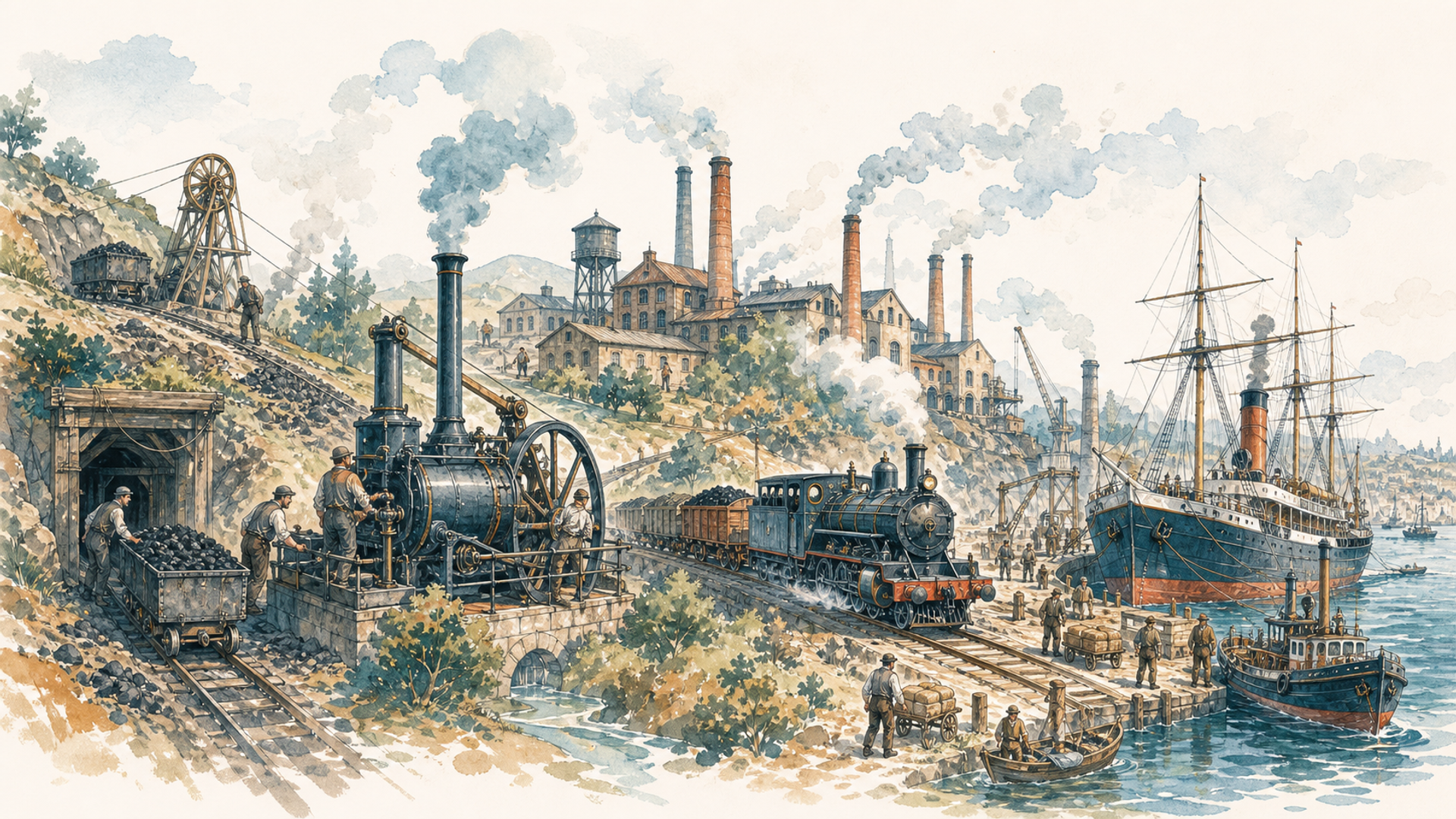
Imagine two societies in 1700. Both have cities, merchants, craftspeople, sophisticated agriculture and technical knowledge. Looking only at that moment, it would not be at all obvious that, during the next century, a small island on Europe’s edge would begin a transformation capable of remaking the world economy. Yet that is what happened in Britain. Mechanical spinning and weaving, coal, steam engines, iron, factories and then railways multiplied the energy and labour a society could mobilise. Within generations, a growing share of production ceased to depend chiefly on human and animal muscle, wind and water, and began to depend on fossil fuels. The famous question is: why there? The most serious answer is: not for one reason.
Coal is not enough
Britain had large coal reserves, relatively accessible in some areas. This matters because coal is concentrated energy. Burn it and you produce heat; use a steam engine and you can turn that heat into mechanical work. But other places with coal did not industrialise first. ‘They had coal’ cannot be the whole answer.
Historians have debated a combination of factors for decades: relatively high labour costs in some regions, access to coal, domestic markets, Atlantic commerce, financial institutions, patents, technical culture, productive agriculture, available capital and a commercial empire supplying markets and raw materials. The exact weight of each remains disputed. That uncertainty is healthy. Great historical transformations rarely have one lever that produces the same outcome wherever you pull it.
One of the Industrial Revolution’s finest curiosities is that the first commercially important steam engines were not designed to pull trains or run factories. Their main purpose was to pump water out of mines. The deeper you dig for coal, the greater the problem of flooding. In the early eighteenth century, Thomas Newcomen’s engines used steam to drive pumps. They were inefficient, but solved a real problem. In the second half of the century, James Watt greatly improved steam-engine efficiency, particularly by separating the condenser from the cylinder. Steam then became increasingly useful for many kinds of industry.
Notice the entanglement. You need coal, so you dig mines; mines flood, so you develop steam pumps; better pumps extract more coal; more coal powers more machines. Technology forms a feedback loop.
Textiles drove much of Britain’s early industrialisation. Innovations in spinning and weaving sharply raised productivity. Yet much of the cotton supplying British factories came from plantation systems—especially in the southern United States—based on enslaved labour. This link is fundamental. The Industrial Revolution is not a story sealed inside Manchester. It belongs to the Atlantic economy. Raw material grown by coerced workers crossed the ocean, became cloth in mechanised factories and was sold in global markets. Industrial capitalism, empire and slavery were not separate phenomena following one another neatly. For long periods, they overlapped.
Energy means concentration
Before fossil fuels, most mechanical energy came from humans, animals, water and wind. Each source imposed limits. A watermill must stand beside a suitable stream. A horse requires land to feed it. Wood requires forests. Coal allowed energy to be concentrated in relatively small spaces. A factory could install a steam engine and produce continuously, so long as fuel and raw materials arrived.
This concentration helped industrial cities grow. People left farms and villages for expanding urban centres. Conditions were often brutal: long hours, pollution, child labour and overcrowded housing. Productivity advanced much faster than social rights. The Industrial Revolution was no uncomplicated festival of progress, but a transformation that created immense wealth alongside new poverty, exploitation and social conflict.
Its geopolitical consequence was enormous. Industrial societies could mass-produce rifles, cannon, ships, rails and ammunition. They could move armies by railway and supply them from factories far behind the front. During the nineteenth century, the military gap widened between industrial powers and many societies that had not industrialised. Technology was not the only factor: state organisation, finance, population and local strategy still mattered. But productive capacity introduced a new asymmetry.
The Opium Wars against Qing China displayed it brutally. Britain could project naval and industrial power thousands of kilometres from home. Chinese defeat did not mean China was ‘backward’ in every sense. It meant that in this particular military and economic confrontation, Britain’s combination of industry, navy and finance created an overwhelming advantage.
Empire feeds industry, industry feeds empire
Industrialisation strengthened imperial capacity: steamships reduced dependence on wind, telegraphs improved coordination, industrial weapons increased military force. Empire in turn provided raw materials, markets and strategic positions. Yet it is too simple to say either that ‘Britain industrialised because of empire’ or that it ‘built the empire because of industry’. The processes fed one another and changed over time. This relationship helps explain why European colonial expansion accelerated in the nineteenth century just as industry reached a new maturity.
Technological advantages never remain monopolies for ever. Belgium, France, Germany, the United States and others industrialised. Following the Meiji Restoration of 1868, Japan began rapid institutional and industrial modernisation and became powerful enough to defeat China in 1895 and Russia in 1905.
Britain was no longer the sole industrial centre. Germany and the United States developed huge industries, applied science, chemicals and electricity. Great-power competition became increasingly a contest of production, infrastructure and technology. Coal was only the beginning. Oil and gas would transform twentieth-century transport, war and industry. A fleet switching from coal to oil changes its supply needs and range. Cars, lorries and aircraft rely on liquid fuels. Oil-rich regions acquire new strategic value. The principle from Chapter 1 returns: geography has not changed, but technology has changed what is valuable. A desert with oil beneath the sand is geopolitically different from the same desert before oil becomes central.
The real revolution is scale
If we had to compress the Industrial Revolution into one word, it might be scale. More energy, production, cities, trade, weapons, population and speed. As soon as scale grows, distance becomes the next problem. A factory produces thousands of objects, but must deliver them. A city of millions needs food every day. A huge empire must move soldiers and orders. Railways, steamships and the telegraph answered those demands. In less than a century they would alter the physical experience of space. A thousand kilometres remained a thousand kilometres on the map, but ceased to mean the same thing.
The question ‘why Britain?’ contains another: why not regions that had long ranked among the richest and most technologically advanced? China had large cities, trade and manufacturing skill; India made textiles coveted around the world. Historians have no single agreed answer. Some emphasise British coal near economic centres; others relatively high wages that encouraged machinery; still others financial institutions, patents, technical culture, empire, Atlantic markets and raw materials. Current research distrusts explanations built from one variable. That is exactly our sort of problem: a great change occurs when different conditions combine into a self-reinforcing cycle.
British textile mills often appear as pure triumphs of machinery. But machines need raw material. Much of the cotton processed in nineteenth-century Britain came from the southern United States and was produced through enslaved labour. European industrial innovation, Atlantic commerce and slavery were directly connected. This does not mean slavery ‘single-handedly caused’ industrialisation, an oversimplified and contested claim. It means British industrialisation operated within a global economy and benefited from raw-material flows produced through profoundly coercive systems. A factory can look national. Its fibres tell a much wider geographical story.
Coal changes the energy balance
Before industrialisation, societies drew most of their energy from human and animal muscle, wood, wind and water. Coal offered concentrated energy accumulated over geological time. Steam engines gradually turned it into mechanical work in increasingly flexible ways. Newcomen’s early eighteenth-century engines mainly pumped water from mines; Watt and others introduced major improvements that raised efficiency and expanded their uses. Once again, there is no cinematic instant in which one inventor ‘creates the steam engine’. There is a sequence of practical problems, patents, craftspeople, capital and improvements.
When energy no longer depends only on a river beside the factory, production and people can concentrate in new places. The industrial city emerged partly from that geographic freedom—and created pollution, health and labour problems demanding new institutions. An industrial economy could produce railways and cloth, but also cannon, rifles, ironclads and ammunition in quantity. It could move armies faster and collect more taxes from a productive, monetised economy. In the Opium Wars, the naval and military disparity between Britain and Qing China helped Britain impose favourable terms. ‘The British had factories’ is not a sufficient explanation for Chinese defeat, but industry had begun to translate directly into international power.
Japan would absorb that lesson brutally. After Commodore Perry’s American ships arrived in the 1850s, the Meiji Restoration launched accelerated reforms in industry, education and the military. In 1905, Japan defeated Russia. In less than half a century, a country forced to open became a power capable of defeating a European empire. Technology does not make the world more equal. At first, it often opens new gaps between those able to adopt it at scale and those who cannot.
No single cause ignites an Industrial Revolution
Eighteenth-century Britain had no magic ingredient absent everywhere else. It had coal, but so did other places. It had relatively developed financial institutions and property rights, but was not the only sophisticated commercial society. It had an empire and access to materials, but other colonial powers held overseas territories. It had craftspeople, inventors and scientific knowledge, but innovation was no British monopoly. ‘Why there?’ remains one of economic history’s great debates because the best answer is a combination.
Coal nonetheless deserves a special place. For millennia, almost all human energy came directly or indirectly from the Sun: food for human and animal muscle, wood, wind, water. Fossil fuels opened stores accumulated over geological time. In Britain, relatively accessible coal lay close to population centres and markets. Mining itself created technical problems such as flooding, helping stimulate the earliest steam engines used for pumping.
Thomas Newcomen built his atmospheric engine for mine drainage in the early eighteenth century. James Watt improved efficiency enormously decades later, but did not ‘single-handedly invent’ the machine that began industry. It is a story of cumulative innovation: a practical problem, existing technology, technical improvement, patents, investment and commercial demand meet.
To see how global the Industrial Revolution was, enter a Manchester spinning mill and trace the cotton backwards. Machines multiply the productivity of spinning and weaving; the raw material increasingly comes from the Americas. In the nineteenth century, the slaveholding southern United States became a central supplier of raw cotton to British industry. A mechanised European factory and an American slave plantation belonged to the same economic system.
This does not mean that slavery alone ‘caused’ the Industrial Revolution, nor do historians assign empire and colonies identical weight. It means industrialisation cannot be confined within British borders. Colonial markets, Atlantic trade, raw materials and commercial capital interacted with internal change. The industrial world was woven from its birth. Wages and energy costs also enter the debate. Some historians argue that relatively high wages and cheap coal in parts of Britain made replacing human labour with machines especially attractive. Others stress institutions, an innovative culture, commerce, scientific knowledge or demography. We need not select a winner as if the causes were teams in a final. The debate’s value lies in showing that great transformations emerge when advantages reinforce one another.
A steam engine does not automatically produce an empire. But industrial societies can manufacture more steel, weapons, textiles, ships and infrastructure than societies relying chiefly on craft labour and traditional energy. That productivity changes warfare and international politics. Railways and steamships move troops and supplies faster; industrially made weapons increase volume and standardisation; telegraph and undersea cables accelerate command. States able to mobilise industry, finance and population sustain conflicts on a growing scale. Industrialisation does not make them invincible—colonial wars repeatedly demonstrate non-industrial societies’ capacity to resist—but it profoundly changes the relationship between economic resources and military force.
It transforms society at home too. Millions move to industrial cities; new classes of wage workers and employers emerge; harsh conditions feed trade unions and new political ideologies. Liberalism, socialism and reformism do not arise from factories alone, but industrial society gives them new ground. Cities grow before sewers and public services can keep pace, creating health problems we will soon encounter.
The Great Divergence was not written into geography
Seeing nineteenth-century European power, it is easy to project backwards and imagine Europe ‘destined’ to dominate the planet. Nothing of the kind was obvious. In the eighteenth century, large regions of China and India possessed complex economies, sophisticated craft production and extensive markets. Historians debate why industrialisation accelerated first in north-western Europe and when income divergence between world regions began. The uncertainty is useful: the result was not inevitable. Coal, Atlantic trade, colonies, institutions, knowledge, wages, demography, interstate conflict and contingency contributed in different measures. Change one and the sequence might have differed.
What we can say with confidence is that, once under way, industrialisation created cumulative advantage. More production financed infrastructure; infrastructure enlarged markets; larger markets encouraged investment; richer states could support science, fleets and administration. The revolution was not one explosion, but a circuit of acceleration.