Chapter 18 · Part 04
Why Living Longer Also Changes Politics
Vaccines, microbes, fertilisers and population growth.
Vaccines, germ theory, public health and synthetic fertilisers change mortality, population, agriculture and the capacity of states. Medicine enters the story only where it shifts the balance of power.
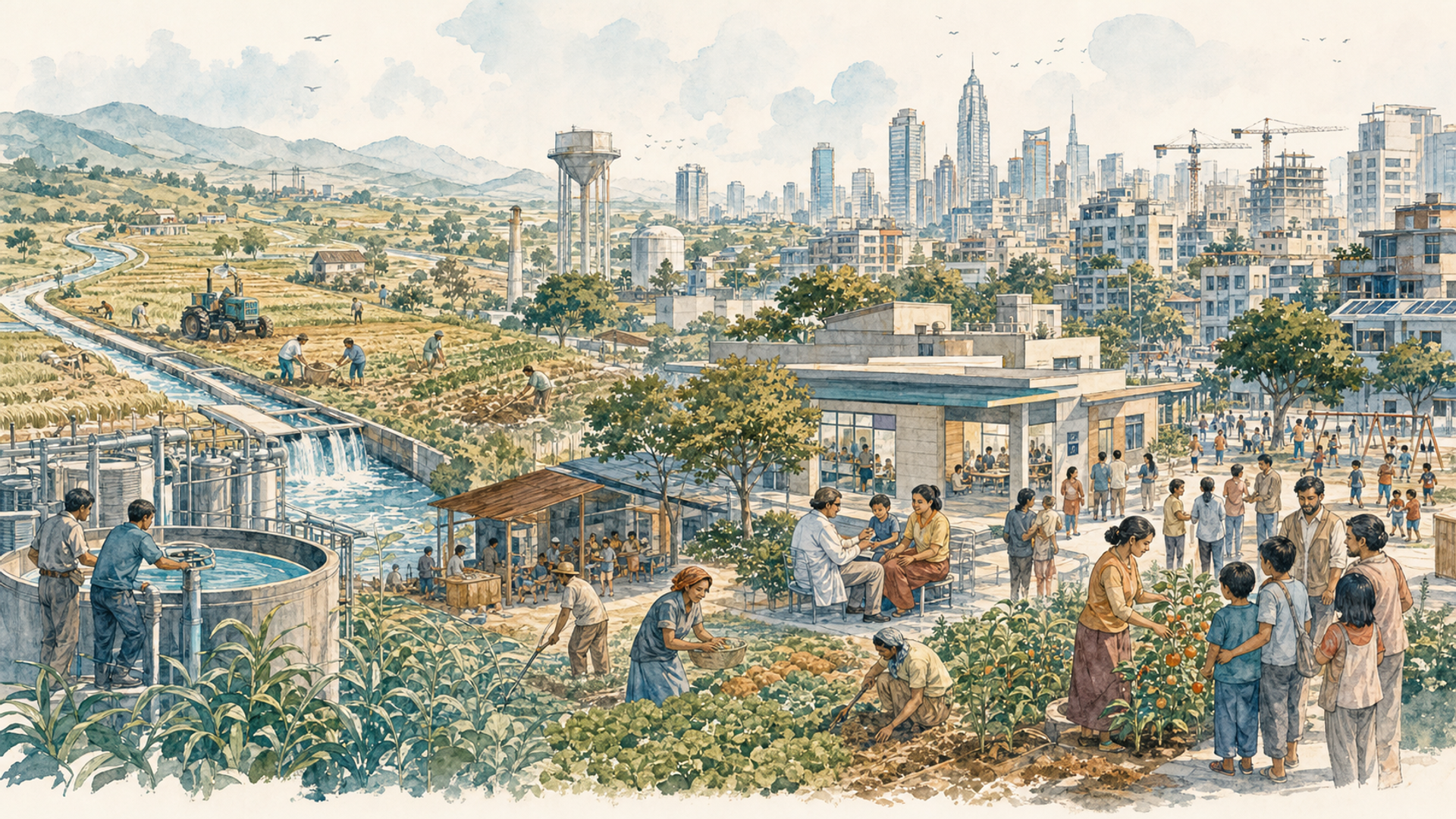
In 1800, even in Europe’s wealthy cities, an infected wound could kill you, childbirth was far more dangerous than it is today, and diseases such as smallpox scarred or killed millions of people. The growth of industrial cities, with contaminated water and overcrowded neighbourhoods, created new health problems just as the economy was becoming more powerful. Then, over the course of a century and a half, something changed. There is no single invention called ‘living longer’. Nutrition, drinking water, sewerage, hygiene, medicine, vaccines, working conditions and, later, antibiotics all improved. The overall result was an enormous demographic transformation. It matters to geopolitics because population is a form of power, but also a need that must be met.
Jenner and the cow that enters history
Smallpox was one of the most feared diseases. It killed a significant proportion of those infected and left many survivors disfigured or blind. Practices of variolation had long existed in several parts of Asia and Africa: controlled exposure to smallpox material intended to cause a milder form of the disease and provide protection. The practice carried risks, but it shows that the idea of immunisation did not simply appear out of nowhere in Europe. In 1796, the English physician Edward Jenner experimented with using cowpox to protect people from human smallpox. The word ‘vaccine’ derives from vacca, the Latin word for cow.
The way Jenner tested the procedure on a child would be ethically unacceptable by modern standards, but the result contributed to the birth of modern vaccination. Almost two centuries later, an international campaign led by the World Health Organization brought about the eradication of smallpox, certified in 1980: it remains the only human disease eradicated worldwide. It is an extraordinary story for another reason. During the Cold War, the United States and the Soviet Union managed to cooperate towards a shared public-health goal. Even rival geopolitical systems can find a common interest in fighting a biological enemy. In the mid-nineteenth century, Ignaz Semmelweis worked in a Vienna hospital and observed that women giving birth faced very different mortality rates in two clinics. He connected the problem to the fact that doctors and students went from autopsies to obstetric examinations, and introduced handwashing with disinfectant solutions, drastically reducing puerperal fever.
The idea met fierce resistance. Semmelweis did not yet have a complete germ theory, and many doctors found it offensive to think that their own hands were killing their patients. It is one of the most unsettling curiosities in the history of medicine: a practice that now seems so commonplace as to be obvious had to struggle against professional prestige and mistaken theories. Later, Louis Pasteur, Robert Koch and others helped establish the germ theory of disease. Joseph Lister applied microbiological ideas to surgery through antiseptic practices. Medicine began to fight an enemy that finally had a comprehensible mechanism.
Individual medicine receives a great deal of attention, but an enormous share of the improvement in health comes from public health. Clean water, sewerage systems, waste collection and better housing reduce the spread of disease. In 1854, during a cholera epidemic in London, the physician John Snow studied the distribution of cases around a water pump in Broad Street, helping to demonstrate that the disease was linked to contaminated water rather than to a generic ‘bad smell’ in the air. Snow’s famous map has become a symbol of modern epidemiology. What matters for us is that the industrial city has to invest in sanitation infrastructure if it is not to become a victim of its own success. The more people you concentrate in a small space, the more you need sophisticated collective systems. The modern state thus enters everyday life through pipes, regulations, vaccinations and hospitals. Power is not only police and armies; it is also the capacity to keep an enormous urban population alive.
Taking fertiliser from the air
But the same chemistry has a dark side: nitrogen compounds are also used to make explosives. During the First World War, Germany’s ability to produce synthetic nitrates helped the country sustain its war effort despite the blockade of foreign sources. Few technologies show the ambivalence of science more clearly: the same factory can help feed fields or supply guns. Between the nineteenth and twentieth centuries, many countries underwent a demographic transition: mortality began to fall before the birth rate declined at the same pace. For a time, the population grew rapidly. This meant more workers for factories, more consumers, more migrants and potentially more soldiers. The great industrial wars of the twentieth century would mobilise millions of men because states had enormous populations and administrations capable of counting and conscripting them.
Population growth also increased pressure on land, jobs and cities. Millions of Europeans migrated to the Americas and other regions between the nineteenth and twentieth centuries. Urban populations exploded. Social policy, public education and public health became central issues.
Medicine does not explain everything
Caution is needed here. The rise in life expectancy is not simply the result of ‘great doctors inventing cures’. Better nutrition, the reduction of some famines, water and sewerage, housing conditions, incomes, education and public policies all played enormous roles, and their relative importance varies from country to country and period to period. Antibiotics, introduced on a large scale in the twentieth century after Alexander Fleming’s discovery of penicillin and the crucial work of Howard Florey, Ernst Chain and many others in turning it into a practical treatment, arrived relatively late in the history of rising life expectancy.
It is another case in which the story of ‘one genius saving the world’ is too simple. Discoveries matter, but they become transformative only when systems exist that can produce, distribute and make them accessible. Vaccinations, birth registers, military medical examinations, mortality statistics: between the nineteenth and twentieth centuries, states accumulated more and more biological information about their citizens. This enabled better health policies, but also forms of control and discrimination. In the twentieth century, racist and pseudoscientific ideologies would use the language of biology to justify eugenics, segregation and, in the Nazi case, genocide. Science is not morally good by nature. The capacity to measure can be used to treat or to classify, to liberate or to oppress.
We now have societies that are larger, more urbanised, more literate and better connected. The state builds schools, railways, registers and mass armies. Millions of people who a century earlier identified primarily with a village, region, dynasty or religion are increasingly called by a new political name: French, Italian, German, Serbian, Greek, Polish. The nation does not appear out of nowhere, and many national identities have ancient roots. But in the nineteenth century, nationalism transforms them into a mass political project.
Before Jenner, a remarkable idea already existed
Modern vaccination against smallpox is associated with Edward Jenner and his 1796 experiments with cowpox. But practices of variolation—controlled exposure to material from smallpox cases in an attempt to provide protection—already existed in parts of Asia and Africa and were introduced into Europe before Jenner. They were risky because they could cause the actual disease and contribute to its spread, but they show that human beings in different cultures had understood that contact with a disease could alter future risk. Jenner helped develop a safer procedure using cowpox. Almost two centuries later, in 1980, the World Health Organization declared smallpox eradicated. It is one of the exceedingly rare cases in which humanity has not merely controlled a disease: it has eliminated the natural global transmission of a human pathogen.
For a book about geopolitics, the important detail is the organisational scale. A scientific discovery eradicates nothing by itself. Production, cold chains, healthcare workers, records, campaigns, international cooperation and the trust of populations are all required. In 1847, the Hungarian physician Ignaz Semmelweis observed that mortality from puerperal fever fell drastically when doctors washed their hands with a disinfectant solution before examining women in labour. The germ theory of disease had not yet been accepted, and his conclusions met fierce resistance. The story is often told as a fable about a genius ignored by fools. It is more useful to see it as an institutional problem: a sound observation has to be understood, replicated and incorporated into a sufficiently convincing theory to change the behaviour of thousands of professionals.
Pasteur, Koch and others would later help build germ theory; Joseph Lister would apply antiseptic principles to surgery. Together with sewerage, clean water and hygienic practices, this knowledge transformed the industrial city. An aqueduct and a sewer can save more lives than a general. They simply seldom have equestrian statues. During a cholera epidemic in London in 1854, the physician John Snow mapped cases in the Soho district and linked many infections to a public pump in Broad Street. The famous removal of the pump handle has become a symbol of epidemiology, although the real story is more complex and Snow had been working for years on the hypothesis of transmission through contaminated water.
The beautiful thing is that geography enters medicine directly here: plotting cases on a map can reveal an invisible network. People were not falling ill because they lived in a ‘bad’ neighbourhood in a moral sense; they shared a contaminated water source. Modern public health also grows out of the state’s capacity to measure populations, causes of death, water networks and urban conditions. The bureaucracy from Chapter 6 returns, but this time the register is not used only to tax you: it can help establish why you are dying.
Haber–Bosch: feeding billions with air
Plants need nitrogen that is available in the soil. The atmosphere is full of molecular nitrogen, but plants cannot use it directly in its most abundant form. In the early twentieth century, Fritz Haber developed a method for synthesising ammonia from nitrogen and hydrogen; Carl Bosch and BASF made the process viable on an industrial scale at high pressure. This gave rise to nitrogen fertilisers that would make an enormous contribution to the growth of global agricultural production. It is difficult to imagine the contemporary population without this capacity to ‘fix’ nitrogen industrially. But the same chemistry has a dark geopolitical side: ammonia is also a basis for explosives. During the First World War, Germany’s ability to produce nitrogen compounds synthetically reduced its dependence on imports of natural nitrates. A technology can feed and arm with the same molecule.
Alexander Fleming observed the antibacterial effect of a mould of the genus Penicillium in 1928, but penicillin did not immediately become a mass-produced drug. In the years that followed, Howard Florey, Ernst Chain and other researchers helped isolate and test it and develop its therapeutic use; during the Second World War, industrial production, especially in the United States, made it available on a growing scale. This is another antidote to the myth of the lone inventor. Great transformations often require a chain: observation, research, engineering, production and distribution. And when a society reduces infant mortality and infectious diseases before the average number of children falls, its population can grow very rapidly. This demographic transition changes the size of cities, demand for food, migration and pressure on governments. Medicine does not stay inside the hospital. It enters world politics.
Modern medicine is not born from a single ‘eureka’
If you had to choose a symbolic image of the nineteenth-century health revolution, you might choose Edward Jenner experimenting with smallpox vaccination in 1796, Louis Pasteur developing germ theory and laboratory vaccines, Robert Koch linking specific microorganisms to specific diseases, Joseph Lister applying antiseptic principles to surgery, or John Snow studying the distribution of cases around the Broad Street pump during London’s 1854 cholera epidemic. But none of these episodes tells the story of the transformation on its own. Even before germ theory was accepted, some practices could work without the mechanism being perfectly understood. Variolation against smallpox was practised in several societies before Jenner’s vaccination; Lady Mary Wortley Montagu helped introduce the Ottoman practice to Britain in the early eighteenth century. Ignaz Semmelweis showed in Vienna that handwashing drastically reduced puerperal fever, but met resistance and died before germ theory provided a shared explanation.
This is an important reminder: science does not always advance in an orderly fashion. Sometimes an effective practice precedes the theory; sometimes a theory arrives before the tools needed to apply it; sometimes a discovery remains marginal until institutions and professions change. The industrial nineteenth century concentrated people in cities at tremendous speed. Overcrowded neighbourhoods, contaminated water and inadequate sewerage systems became political problems. Cholera epidemics made it clear that the health of a wealthy family could not be completely separated from the sanitary conditions of the city in which it lived. If the shared water supply was contaminated, social boundaries offered less protection than people hoped.
Haber and Bosch: the invention you probably ate this morning
The geopolitical impact of agricultural and public-health growth is profound. As more people survive childhood, the population grows during the demographic transition; cities and workforces expand; states have to build larger schools, infrastructure and administrations. Later, as fertility falls, many societies age. Today, demography is one of the most important strategic differences between regions: some countries fear they will not have enough young workers, while others have to create opportunities for very young populations. Living longer is therefore not only a private story. It changes pensions, armies, migration, labour markets and relations between generations. A vaccine vial, a fertiliser and a sewerage network can affect a state’s power in ways that no military map immediately reveals.