Chapter 02 · Part 01
Can a Mountain Win a War?
Terrain, logistics and security.
Mountains, rivers, forests, deserts and plains can shelter, slow or channel armies and trade. This is our first encounter with logistics, strategic depth and the cost of distance.
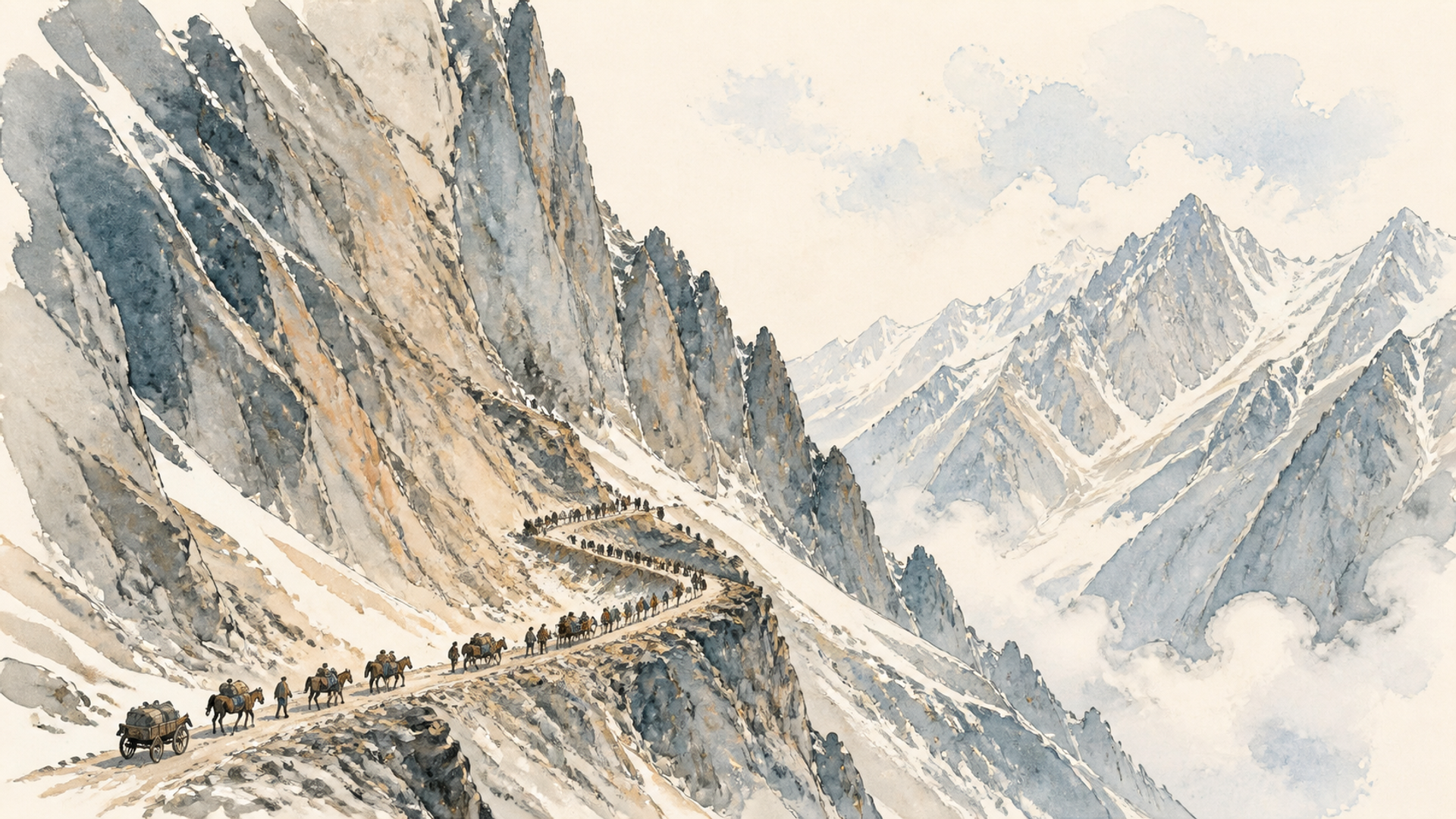
Imagine commanding an army that is stronger than its opponent on paper. You have more soldiers, more horses, more weapons and perhaps even better generals. Then someone spreads out a map and points to an uneven line running across the country: a mountain range. At that moment you discover a rule as old as war. The strength you possess matters only if you can bring it to the right place, at the right time, still fit to fight.
It is easy to picture war as a clash between armies. Yet before every battle comes a less spectacular and often more important question: how do you get there? An army has to march, drink, eat, sleep, receive ammunition, treat its wounded and replace lost people, animals and machines. The farther it moves from its bases, the longer and more fragile that chain becomes. Geography does not fight for you, but it determines how much work you must do before the fighting even begins.
A mountain cannot shoot, but it can choose the road
At Thermopylae in 480 BCE, a small Greek force tried to delay the Persian army under Xerxes. The story became legend and has often been reduced to a tale of a handful of heroes facing an innumerable host. The exact numbers—ancient estimates are disputed—matter less here than the place itself. The passage between mountain and sea narrowed the available ground and made it much harder for the Persians to use their numerical advantage fully.
The mountain did not “win” the battle. The Persians outflanked the position and continued their campaign. But Thermopylae demonstrates a principle that returns in every age: terrain can channel force. If you must pass through a gorge, over a bridge, across a pass or along a constricted road, you cannot use everything you possess at once. Landscapes created bottlenecks long before strategists adopted the word chokepoint.
The reverse is also true. Mountains can protect, but they can also trap. Defending mountainous country requires local knowledge, roads, depots and the ability to move where outsiders struggle. The Alps obstructed armies for centuries, but never made passage impossible. Hannibal brought a Carthaginian army across them during the Second Punic War; much later, Napoleon sent troops over the Great St Bernard Pass. The mountains did not disappear. They were overcome by paying in time, exhaustion, danger and organisation.
A saying attributed in several forms to Napoleon holds that an army marches on its stomach. Whether those exact words were his hardly matters; the idea is beyond dispute. An army that cannot eat soon ceases to be effective. For most of history, keeping thousands of people moving was an immense logistical problem. Every soldier needed food each day. Horses consumed even more, and could not live on whatever happened to be nearby. Add water, fodder, weapons, spare parts, tents, medicine and ammunition, and the visible army—the fighters—turns out to be only the tip of a much larger machine.
That is why roads matter. Rome did not build its road network merely to make merchants’ journeys comfortable. Roads also moved legions, messages and supplies with greater reliability. Railways, motorways and military airfields later served the same purpose at different scales. The technology changes; the principle does not: power needs infrastructure in order to move.
Where infrastructure is absent, distance becomes an enemy. During the invasion of Russia in 1812, Napoleon entered the Russian Empire with an enormous force, but every advance lengthened its supply lines. Russian forces withdrew, destroying or removing resources in some areas and drawing the invaders farther inland. Borodino was bloody and Moscow was occupied, but occupation did not produce the peace Napoleon expected. The retreat westwards—amid hunger, disease, combat and winter weather—turned the campaign into a catastrophe.
We should resist one of military history’s most convenient stories: “Napoleon lost because it was cold.” Cold worsened a situation already desperate; it was not a meteorological spell cast against an otherwise efficient army. Distance, casualties, logistics, disease, Russian strategy and weather accumulated. This is the kind of explanation we will use throughout this work: not one cause, but a chain of factors reinforcing one another.
Rivers have two faces
A mountain looks like an obvious barrier; a river is more ambiguous. It can protect you by forcing an enemy to cross at a few limited points, but it can also act as a natural road for people and goods. The Rhine and Danube were important Roman frontiers, yet also arteries along which armies, traders and information travelled.
Crossing a major river under military pressure is difficult because, for hours or days, your army becomes vulnerable. You must find a ford, build a bridge or use boats. While one part stands on one bank and another on the other, the enemy can strike at precisely the worst moment. Bridges therefore acquire strategic value far beyond their appearance. An unremarkable bridge may determine the pace of an entire campaign.
During the Second World War, bridges, railway lines and ports were crucial targets because they sustained industrial armies consuming prodigious quantities of fuel, ammunition and equipment. A tank evokes power and speed; it is harder to remember the fuel convoy that must follow it. Without that convoy, the tank is simply a very heavy object parked in the wrong place.
On a map, deserts can look deceptively simple: enormous areas with few towns, roads or natural boundaries. On the ground they are anything but simple. Heat, cold nights, scarce water, sand, immense distances and few landmarks turn every movement into a planning problem. Yet deserts have never sealed societies off completely. For centuries, trans-Saharan trading networks linked West Africa with North Africa. The spread of the camel made journeys more practical, though never easy. The desert was not an impassable wall; it was an environment in which transport costs selected routes, cargoes and stopping places.
The same logic applies to war. During the North African campaigns of the Second World War, modern armies moved quickly over open ground, but depended almost obsessively on ports, fuel, lorries and repair workshops. Every advance forced supplies along longer, more vulnerable roads. An apparently “empty” desert became a web of invisible lines. Break one, and even a mechanised force might stop.
Technology changes terrain; it does not erase it
We can now bore through mountains, span huge rivers, fly in supplies and observe the ground from space. It might seem that military geography has lost its importance. Something more interesting has happened: we have changed the way we pay geography’s price. A tunnel lets you cross a mountain in minutes, but becomes a strategic point in its own right. A motorway accelerates an army, but creates dependence on bridges, junctions and fuel. Aircraft reduce distance, but require bases, runways, maintenance and control of the air. Satellites enable observation and coordination, but become infrastructure that must be protected. Every solution creates new possibilities and often new vulnerabilities.
Logistics is therefore not a dull appendix to warfare. It is where geography, economics and technology meet. A country may possess a formidable army on paper yet struggle to project it far from home. Another may have fewer soldiers, but ports, railways and bases that let it move rapidly. The question is not simply “how strong are you?” but where can you be strong, and for how long?
This leads to strategic depth, a concept that will return when we examine Russia. Put simply, it means having room in which to retreat without immediately losing the political, economic or military heart of the country. If a capital, industrial centre or vital region lies close to a border, an attack can threaten it quickly. If an opponent must travel hundreds or thousands of kilometres, every kilometre adds time, consumption and risk.
But more space does not automatically mean more security. A huge territory may be difficult to defend, connect and administer. The distances that exhaust an invader can also exhaust the defender moving troops across them. There is no free advantage. The useful lesson is not that “mountains win wars”, but that every army fights two battles at once. One is against an enemy. The other is against space, time, terrain and the need for supplies. The second often determines what is possible in the first.
Time is geography too
Maps conceal something else: land changes with the seasons. A road firm in summer may become mud in spring, snow in winter or suffocating dust during drought. Rivers swell or shrink. Mountain passes close. Frozen ground can carry heavy vehicles that would sink a few weeks later. Military campaigns have therefore often followed agricultural and climatic calendars. In pre-industrial armies, campaigning during harvest might deprive farms of labour; in other cases the local harvest fed troops. Modern forces depend less on food gathered along the way, but fuel, maintenance and infrastructure remain sensitive to weather and terrain.
“Bad weather” is no more complete an explanation than “mountains”. Two armies exposed to the same rain may fare differently because one has better tyres, more recovery vehicles, prepared roads or stronger logistics. Nature creates the problem; organisation decides how badly it hurts.
During the Allied landings in Normandy in June 1944, the challenge was not simply to put soldiers onto the beaches. It was to keep feeding, arming and supplying them afterwards. Before securing major French ports, the Allies used artificial Mulberry harbours to unload equipment. It was an extraordinary feat of engineering, and not an invulnerable one: a storm badly wrecked the American Mulberry off Omaha Beach shortly after the landings.
Why remember that detail? It shows how much of a campaign depends on things that films leave outside the frame. You can win a battle on the beach yet lose the logistical war if fuel, ammunition and food cannot arrive quickly enough. A port, railway or bridge looks less dramatic than a tank, but the tank will not travel far without them. Whenever you read that an army has “taken” a city or territory, add a second question: can it sustain a force there? Occupying a place for hours and controlling it for months are entirely different problems.
A road is already a military decision
On a modern map, a road looks neutral: a line along which people travel. For an army, it can decide what is possible. A large force is not a crowd walking in one direction; it is a mobile city. It needs food, water, ammunition, animals or fuel, spare parts, hospitals, bridges and people able to repair whatever breaks. If the road is too narrow, a bridge collapses or a pass is blocked, the force that looked immense on paper can suddenly become clumsy.
This is one reason the Romans invested heavily in roads. It would be misleading to say they built them only for the legions: roads served administration, the post, commerce and ordinary movement. Yet the same network let the state move soldiers and orders with a regularity improvised tracks could not offer. Civil and military infrastructure are often the same thing seen at different moments. A motorway, railway, port or airport may drive prosperity in peacetime and become a logistical node in a crisis. Military geography begins decades before the first shot, when someone decides where to build a road, how much weight a bridge should carry and which regions to connect most closely.
We often treat geography as natural—mountains, rivers and deserts—but humans continuously manufacture new geography. A large city is an artificial landscape of walls, cellars, bridges, tunnels, railways, towers and narrow streets. In war it can transform the fighting that is possible. Stalingrad is an extreme example. The city’s name and political symbolism mattered enormously, but combat was also shaped by its urban and industrial form, the Volga as a Soviet supply artery and the difficulty of turning mobility and superiority into stable control street by street. The city alone did not decide the battle: leadership, resources, mistakes, industrial production, reinforcement and winter conditions all mattered. But urban terrain helped determine what kind of battle could be fought.
Saying terrain matters does not mean searching for a mountain or river behind every victory. It means asking what opportunities a place offers each side, and what price it demands. A good strategy may exploit that price. A bad strategy may pretend it does not exist—at least until the bill arrives.
When the problem is not winning, but arriving intact
Famous campaigns are remembered through their decisive battles, though armies spent most of their time marching, finding food, building bridges, repairing roads, tending animals and waiting for supplies. A general might be brilliant on the battlefield and lose the campaign after misjudging distance and time. Logistics is not warfare’s back room. It determines how much of a state’s theoretical strength can become real strength in one particular place.
Napoleon’s Russian campaign is a useful antidote to one-line explanations. The familiar version says “General Winter” defeated the French, as though all had gone well until the first snow. In fact, the Grande Armée suffered huge losses during its advance through disease, desertion, hunger, exhaustion and logistical failure. It entered a vast space where supply became ever harder, while Russian forces could retreat without immediately surrendering their ability to continue the war. Borodino opened the road to Moscow but did not deliver the political peace Napoleon sought. When retreat began, cold devastated a machine already breaking down. The point is not to minimise winter, but to see how historical causes work: almost never alone.
The same logic persisted as technology changed. The Allied armies landing in Normandy had to sustain a modern force consuming fuel, ammunition, spare parts and food on an enormous scale. They built two Mulberry harbours and later laid cross-Channel fuel pipelines under Project PLUTO. The storm that damaged the American Mulberry reminded them that engines do not remove nature from war. Allied victory depended on industrial, naval and air superiority, intelligence, combat and resistance on the ground, among many other things—but without immense logistical capacity, the beachhead could not have become the liberation of Western Europe.
Mountainous country also magnifies local knowledge. A minor path, side valley, seasonally usable pass or vantage point above a road may be worth more than numerical superiority. This helps explain why smaller forces rooted in a landscape and supported by local networks can make control extremely expensive for a larger army. Yet this invites clichés. Afghanistan is often called the “graveyard of empires”, a memorable but misleading phrase if it implies no power has ever conquered or ruled any of it. Empires and dynasties have governed Afghan territories in many periods. The recurrent difficulty has been turning military conquest into uniform, durable and inexpensive control over a country fragmented by terrain and multiple political and social structures.
During the Soviet–Afghan War, and later the US-led intervention begun in 2001, technology delivered surveillance and firepower no nineteenth-century invader could have imagined. Superior technology still did not equal stable government. A helicopter can cross a mountain but cannot administer a valley; a satellite can observe a village but cannot manufacture political legitimacy; an armoured convoy can travel a road, but if that road is one of few available, it is predictable. Geography does not “defeat” great powers. It helps create conditions in which political objectives become more expensive to achieve.
Natural frontiers are only natural up to a point
Rivers and mountain ranges are often called “natural boundaries”, but the word natural can make us forget that using them as borders is a political choice. The Rhine served at times as a Roman frontier, yet did not divide two worlds incapable of contact: goods, people, soldiers and ideas crossed constantly. The Alps separate drainage basins, but people have travelled through them for millennia. A physical barrier can make a border convenient; it does not draw one by itself.
Modern technology makes this clearer. A bridge transforms a river; a tunnel changes a mountain; a railway can turn a pass from barrier into corridor. But every structure that reduces an obstacle becomes strategic in its own right. If most traffic uses a handful of tunnels, they must be protected. If a bridge carries a supply line, it acquires enormous military value. Technology does not eliminate bottlenecks. It often moves them.
We will meet this pattern again when we consider Russia, China, shipping routes and undersea cables. Power is not merely the possession of people, money or weapons. It is the capacity to bring them where needed, maintain them there and continue doing so while someone else tries to stop you. A mountain cannot win a war. It can turn a short distance on paper into weeks of exertion, reduce a hundred possible roads to three passes and expose a larger army at the very place through which it must move. For a commander, that is reason enough to take it seriously.