Chapter 03 · Part 01
When a Place Is Worth More Than What It Contains
Straits, ports, passages and strategic positions.
A territory may matter not for what it possesses, but because everyone has to pass nearby. Gibraltar, the Bosporus, Hormuz, Malacca and Suez reveal the power of nodes and chokepoints.
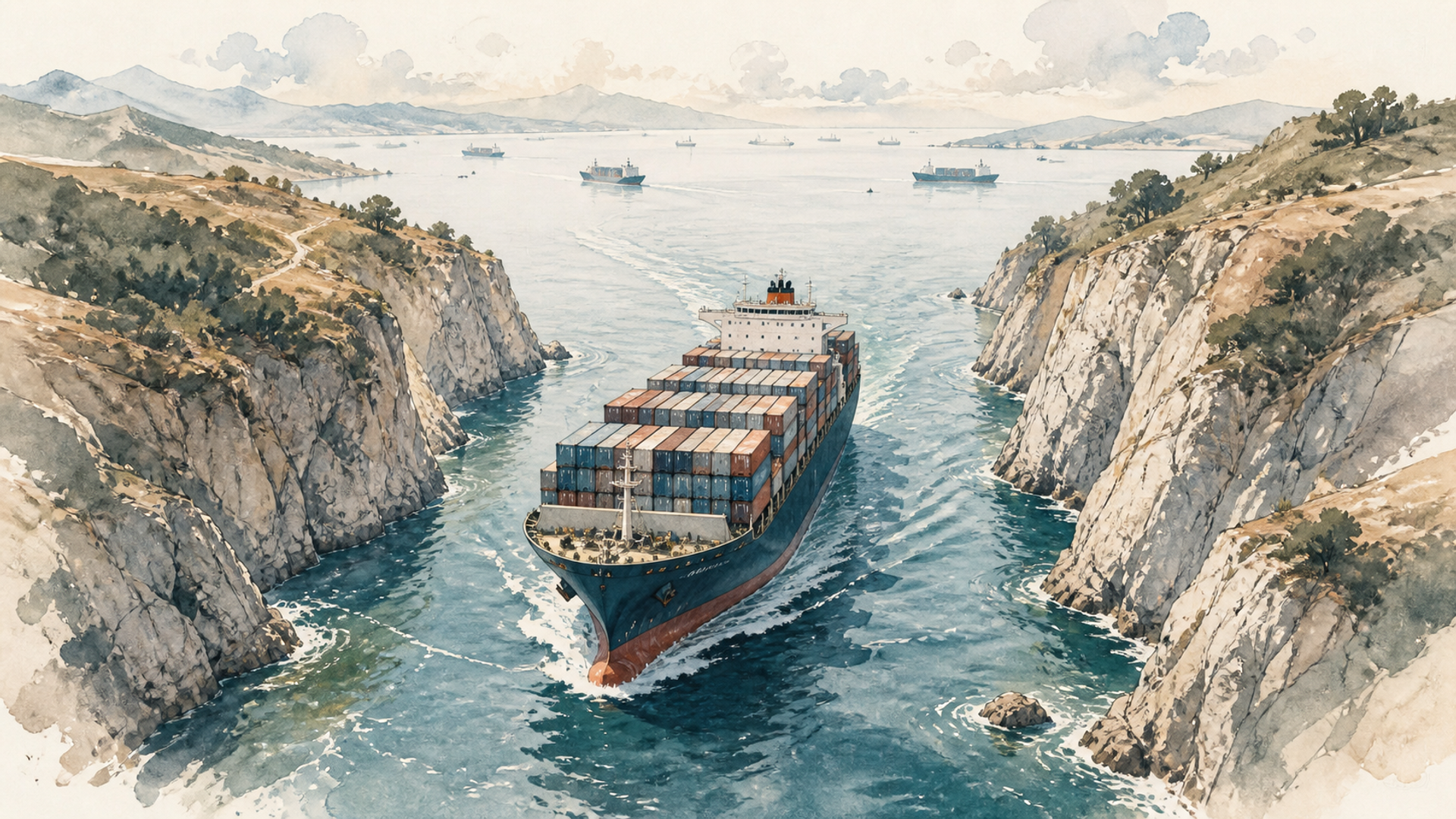
Picture two almost identical pieces of land: the same climate, water and soil, with neither oil nor gold. One, however, lies beside a passage used by hundreds of ships; the other is far from any important route. On paper their resources look alike. In reality, the first may become one of the most coveted positions on Earth.
This is where the meaning of resource begins to shift. A resource need not be something dug from the ground. Sometimes it is the position itself. A place that shortens a route, commands a passage, protects a harbour or overlooks a strategic area can be immensely valuable even when there seems to be nothing remarkable there.
The power of being in the middle
Take the Strait of Gibraltar, the gateway between the Atlantic and the Mediterranean. Ships travelling from the Mediterranean to the ocean must pass through this relatively narrow space. That does not mean whoever controls Gibraltar can simply switch off the Mediterranean; international law, politics and other states’ military power make reality far more complicated. But its position explains why one small headland has mattered so much more than its size suggests.
The same is true of the Bosporus and Dardanelles, which link the Black Sea with the Mediterranean through the Sea of Marmara. For centuries Constantinople, later Istanbul, mattered not just as a great city but because it sat on a geographical hinge: Europe on one side, Asia on the other; the Black Sea to the north and the Mediterranean to the south. It is one of those places where geography seems to have drawn an arrow saying, “Someone will pass here.”
Compulsory passages concentrate flows that would otherwise be dispersed. If a hundred roads cross a plain, blocking one achieves little. If there is only one bridge, that bridge suddenly matters a great deal. Maritime straits do something similar on a planetary scale.
The Suez Canal shows how profoundly position can change the world. Before it opened in 1869, a ship travelling between Europe and the Indian Ocean normally had to round Africa by way of the Cape of Good Hope. The canal cut across the Isthmus of Suez, directly linking the Mediterranean and Red Sea and dramatically shortening many routes between Europe and Asia. Humanity did not merely exploit favourable geography; it altered it.
But this also created a new vulnerability. Concentrate many routes in a shorter, more efficient corridor and that corridor becomes more valuable—and any interruption more costly. In March 2021, the world received a practical lesson when the container ship Ever Given ran aground in the canal and blocked traffic for almost a week. This was not war, an embargo or an attack. It was one ship sideways. Yet hundreds of vessels had to wait or consider the long journey around Africa. It is hard to find a clearer image of globalisation: a single ship in Egypt can disrupt delivery schedules and costs thousands of kilometres away.
Maritime transport carries more than four-fifths of world merchandise trade by volume. Not all of it passes through Suez, of course, but the scale explains why canals and straits remain exposed nerves of the global economy.
Malacca: a small strait with enormous consequences
Between the Malay Peninsula and the Indonesian island of Sumatra lies the Strait of Malacca, one of the world’s most important shipping routes. It connects the Indian Ocean with the South China Sea and the western Pacific. For many vessels carrying energy and goods to East Asia, it is the shortest and most economical route.
Here modern power reveals its dependence on networks. China is an immense continental power, but economic growth has also made it deeply maritime. Raw materials, oil and manufactured goods travel through spaces Beijing does not control exclusively. It is curious that a country of continental scale can worry about a maritime passage only a few kilometres wide in places. Yet that is what networks do: they turn small points into large problems.
A strait without traffic is only water between two shores. A harbour without connections is only a bay. An airport in the middle of nowhere is not automatically important. A node becomes strategic when it enters a network. Think of a major railway junction, pipeline, electricity substation, data centre or landing point for undersea cables. The more systems depend on it, the greater the damage if it stops working. The same logic that made a mountain pass strategic in antiquity can make a building full of servers strategic today.
This also changes how we see territory. On a political map, an empire of small islands, ports and bases looks fragmented. Draw the routes joining them, and it may form a coherent network. Portugal, the Netherlands and Britain would all exploit that logic.
The temptation of “the point that controls the world”
Chokepoints fascinate us because they seem to offer perfect explanations: control this strait and you control everything. Reality does not work that way. Routes can be diverted, new infrastructure can reduce dependence, other states can react, and blocking a passage may be ruinously expensive for the state doing the blocking. Geography concentrates risk; it does not hand unlimited power to whoever lives beside the bottleneck.
Still, systems seeking efficiency tend to concentrate flows. A short route is cheaper than a long one; one large port is more efficient than ten small ones; a pipeline is easiest to build along a favourable corridor. Efficiency creates dependence, and dependence creates strategic value. So next time you see a map, do not ask only, “What is here?” Ask: what must pass through here?
Suez crosses a desert and is fed by the sea; Panama works differently. Its locks raise and lower ships and consume large quantities of fresh water. This easily overlooked technical detail became conspicuous when drought reduced reservoir levels, forcing the Panama Canal Authority to limit vessel numbers and draught. The idea of a chokepoint now widens. The passage must not only remain politically open and free from war; it must physically function. Climate, maintenance and infrastructure can become matters of global commercial security. An artificial route built to shorten geography still depends on the geography around it.
Singapore: becoming rich because others pass nearby
At the eastern end of the Strait of Malacca stands Singapore, a city-state tiny beside Asia’s giants. It has neither a vast agricultural hinterland nor great oil reserves. Yet its place on one of the planet’s busiest shipping routes helped make it a global centre for ports, logistics, refining, finance and services.
Position alone is not enough. Some strategically placed countries remain poor or unstable. Singapore invested in institutions, education, infrastructure and port capacity. That is precisely the point: geography offers an opportunity, but society must turn it into value. The reverse is also true. Sitting astride a vital passage can attract pressure and conflict. The Turkish Straits have mattered to empires and states for centuries. Hormuz concentrates a huge share of the Persian Gulf’s energy flows. The more people depend on a passage, the more politically sensitive it becomes.
Modern chokepoints can also be less visible. A payment system, technical standard, specialised factory or indispensable software platform can resemble a strait: many flows have to pass through it, while alternatives take time to build. We will return to this with semiconductors and digital infrastructure. For now, remember that a node’s power comes from the network depending on it. An empty port is not strategic. It becomes so when goods, energy, data or people have no easy alternative.
In 1956, Egyptian president Gamal Abdel Nasser nationalised the Suez Canal Company. Britain and France, which had enormous interests in the route, planned a military intervention with Israel. The operation might have looked manageable in narrow military terms; politically, it became a crisis revealing how much the world had changed.
The United States and Soviet Union opposed the Anglo-French action for different reasons. Washington applied intense financial and diplomatic pressure. Britain and France withdrew, and the canal remained under Egyptian control. It was a symbolic turning point: two old imperial powers discovered that military control of a node was useless if the wider political and financial system prevented them from exploiting it. A chokepoint is geographical, but power over it also depends on alliances, finance and international legitimacy.
Hormuz: the threat matters even while the passage stays open
The Strait of Hormuz connects the Persian Gulf with the Gulf of Oman and the Indian Ocean. A substantial share of seaborne oil trade passes through it. Every rise in tension between Iran, the Gulf monarchies, the United States and other actors therefore draws immediate attention in energy markets.
A chokepoint can create leverage without actually closing. If operators fear attacks, mines or seizures, insurance premiums and transport costs can rise. Perceived risk becomes part of the price. Strategic geography works not only through events, but through what everyone fears might happen.
The useful question is not simply “Can ships go another way?” but “What would it cost?” How many extra days? How much fuel? How many more vessels are needed to move the same volume if each voyage is longer? How much alternative capacity really exists? A narrow stretch of water thus becomes a problem for distant companies, states and consumers. Insurers, shipowners and traders price risk into their decisions. A vessel may change route because the probability of trouble has become too expensive, not because anyone has literally drawn a chain across the strait. The power of a strategic place is often probabilistic: it changes behaviour before anything happens.
A city built on a hinge
To understand positional value without formulas, look at Istanbul. The Black Sea lies on one side; the Mediterranean, reached through the Sea of Marmara and Dardanelles, on the other. The Bosporus runs between Europe and Asia, so narrow in places that each shore is plainly visible from the other.
Constantinople was an imperial capital for centuries not merely because it possessed a fine harbour, but because it occupied a hinge between trading and military regions. When Mehmed II conquered the city in 1453, he did not “close the Silk Road” with a single gesture—a persistent oversimplification in accounts of European exploration. He incorporated one of Eurasia’s most important nodes into the expanding Ottoman Empire.
The Turkish Straits outlived empires and dynasties. After twentieth-century wars and treaties repeatedly changed their status, the Montreux Convention of 1936 established rules that remain fundamental to passage through the Bosporus and Dardanelles, including special provisions for warships. Geography and law overlap: nature created the passage, but international politics determines how it may be used.
Owning a chokepoint does not give a state a switch with which to turn off the world. It must contend with treaties, other powers, economic costs, military capabilities and diplomatic consequences. Strategic value is not omnipotence; it is leverage. Leverage means your decisions compel others to take you into account.
Panama offers a related lesson. Humanity cut across a continent to shorten the distance between two oceans, yet the work remains tied to rainfall in its watershed. Changing geography does not mean escaping it.
From rock to microchip: the principle remains
Now imagine a component made almost entirely in a handful of plants, a technology without which many factories cannot operate, or a point where numerous digital cables come ashore. None looks like Gibraltar, yet the logic is similar: when many flows depend on few nodes, those nodes acquire strategic power.
In the industrial and digital world, bottlenecks can be factories, technical standards, data centres, payment systems or expertise that is exceptionally hard to reproduce. Chokepoints are not merely a curious chapter about canals; they are a general way of reading networks. Efficient networks tend to gather around convenient nodes. Concentration creates dependence, and dependence can become political leverage or vulnerability. It is the same reason Singapore built prosperity from position and connectivity without vast territory or raw materials. Geography offers the opening; institutions, infrastructure and investment decide how well it is used.
The next time someone shows you a map of natural resources, add a second map in your mind, made of lines: shipping routes, railways, pipelines, cables and corridors. Power often lies not where a commodity begins its journey, but where many journeys are forced to meet.