Chapter 26 · Part 06
How Did We All Become Dependent on One Another?
Oil, containers, finance and supply chains.
Containerisation, oil, finance and distributed production connect distant economies in extraordinarily efficient but vulnerable networks. The chokepoints of the past are once again at the heart of geopolitics.
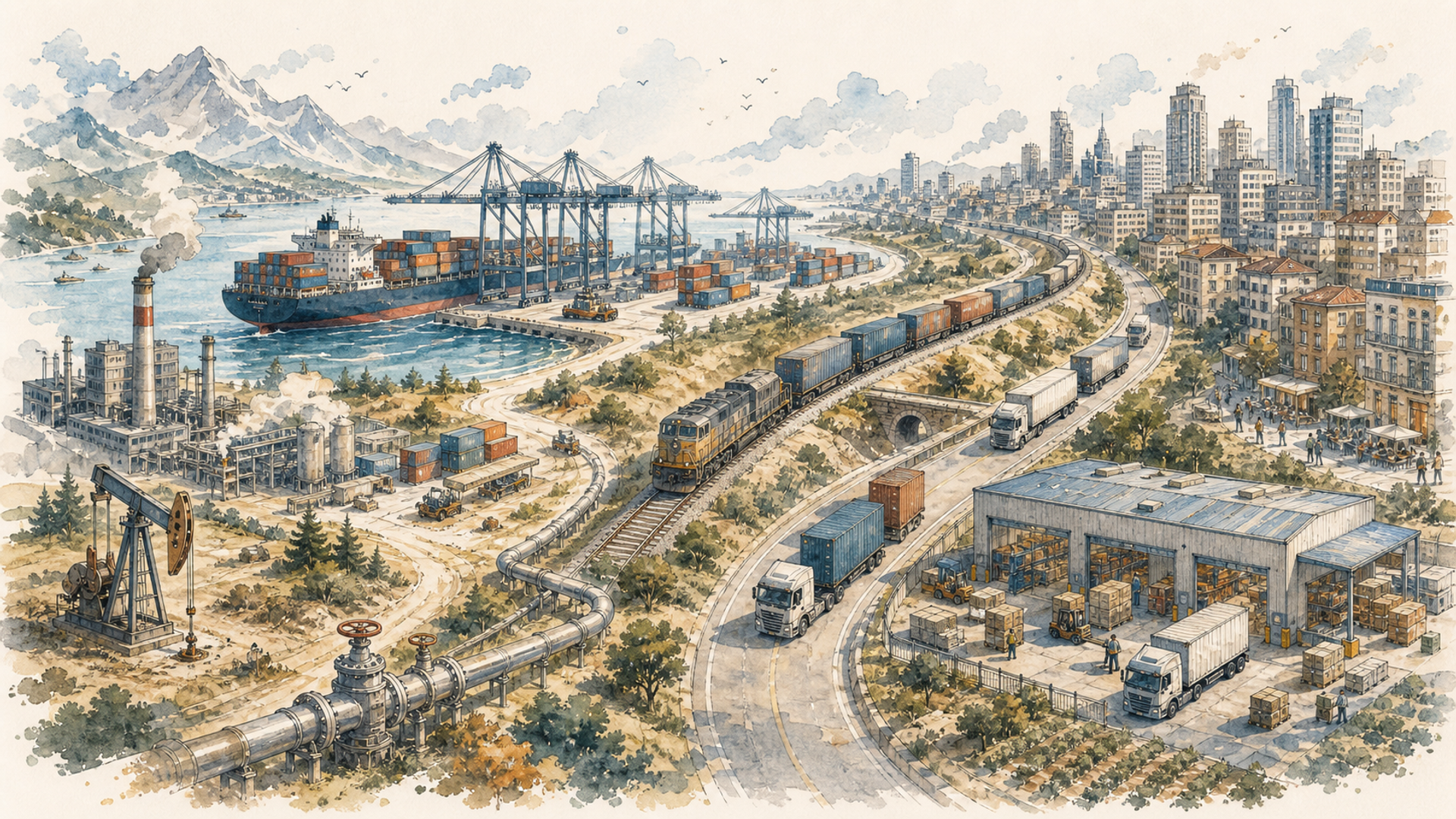
If one morning you decided to find out where the phone in your pocket really came from, you would probably tire before reaching the end. You might begin with the box and read the country where it was assembled, but that would be only the final stop on a much longer journey. Its glass may depend on materials processed on one continent, its memory on factories on another, and its processor on a supply chain spanning Taiwanese, American, Japanese and European companies; the machines needed to make the most advanced chips are themselves composed of thousands of parts supplied by specialist firms. Then there is the software, the patents, the mobile networks, the navigation satellites, the ships that carry the components, the ports that unload them, the lorries that distribute them and the financial system that allows all these companies to pay one another. That phone is an object, but it is also a map. If you could draw a thread from each of its components to the place it came from, a web would appear before you, enveloping almost the entire planet.
This is the most important characteristic of contemporary globalisation. It is not that human beings trade over great distances—they were already doing that when Chinese silk reached Rome and spices from South-East Asia crossed the Indian Ocean—but the extent to which we have broken production into separate stages and distributed them among distant countries. We have built an economy in which no single state often possesses everything needed to make a complex product. It is an extraordinarily efficient system: it allows billions of people to use things that no national economy could produce on its own at the same price. But it has a consequence that becomes apparent only when something goes wrong. The better we become at connecting the world, the more ways there are for a distant problem to reach us.
The most important revolution may have been a box
In 1956, a converted oil tanker, the Ideal X, sailed from Newark to Houston carrying fifty-eight large metal containers on its deck. The American entrepreneur Malcolm McLean became the name most closely associated with that transformation, although he neither ‘invented’ the container single-handedly nor was the first to experiment with similar systems. The true revolution lay in building a standardised system around the box: compatible dimensions, cranes, lorries, railway wagons, port terminals and procedures able to treat a container as a module that could pass from one form of transport to another without being emptied each time.
Before then, a port was a very different place from the one we imagine today. A ship might carry sacks of coffee, barrels, crates, machinery and bales of cloth all at once; teams of dockers had to move cargo almost piece by piece, stow it in the holds, record it and then repeat the work on arrival. It was slow, expensive and vulnerable to damage and theft. Containerisation did more than speed up the loading of ships: it changed the economic geography of port cities. Old quays near city centres lost some of their purpose because the new terminals required vast expanses of level ground, specialised cranes and efficient links to motorways and railways. Some dockside neighbourhoods fell into decline; others were redeveloped decades later as residential and tourist districts. Meanwhile, ports capable of investing in the new infrastructure became ever larger nodes in a global system.
What is fascinating is that the decisive innovation was not spectacular at all. There was no revolutionary engine to display to the public, no mysterious new material. There was a standard. A box of the right dimensions can be loaded in Asia, cross an ocean, transfer to a European train and end up on a lorry without anyone touching the individual goods inside it. Once millions of companies, ports and vehicles organise themselves around the same standard, that apparently dull rule becomes global infrastructure. It is a mechanism we encounter repeatedly in the modern world: power often lies not in the most visible object, but in the system of rules that enables millions of different objects to work together.
From the national factory to the global factory
The container, of course, did not accomplish all this on its own. After the Second World War, a growing part of the world built institutions and agreements intended to make trade more predictable: the monetary system created at Bretton Woods, the GATT and later the World Trade Organization reduced or regulated many barriers to trade, while new regional treaties integrated economies still further. Cheap oil powered ships, lorries and aircraft; telecommunications made it possible to coordinate distant activities; computers enabled inventories and orders to be managed with a precision unimaginable to a merchant only a few decades earlier. When China began its economic reforms in the late 1970s and then joined the World Trade Organization in 2001, hundreds of millions of workers and an enormous industrial capacity became still more deeply integrated into international production chains.
At that point, a company no longer had to ask only, ‘Where should I build my factory?’ It could ask where it was most economical to carry out each individual stage. One component in South Korea, another in Japan, design in the United States, assembly in China, software developed by teams spread across several countries. For less complex products, the process could be just as international: cotton grown in one country, spun in another, woven and sewn elsewhere, then finally sold thousands of kilometres away. The label ‘Made in…’ remains useful for legal and commercial purposes, but often tells only the last part of the story.
This organisation has dramatically reduced many costs and made goods available that were once much more expensive. But it also encouraged an idea that for years seemed almost self-evident: if a component can arrive precisely on the day it is needed, why keep a large warehouse full of unused parts? The just-in-time model, developed with particular effectiveness in Japanese industry and later adopted in various forms around the world, reduces stocks and waste by coordinating production and deliveries with great precision. From a financial point of view, it is elegant: less capital tied up in warehouses, less space occupied, leaner processes. But every time you remove a buffer, you must be more certain that the rest of the system will not stop.
For years, it seemed a reasonable trade-off. Ships arrived, factories produced, ports worked. Then the world received several very costly lessons in what it means to create efficiency by eliminating redundancy. The earthquake and tsunami that struck Japan in 2011 interrupted specialised supplies and revealed to many companies that they depended on suppliers of which even their executives lacked a complete picture. During the COVID-19 pandemic, factory closures, abrupt shifts in demand, port congestion and transport difficulties produced shortages in sectors that seemed far removed from the health emergency. Car manufacturers, for example, discovered that a vehicle worth tens of thousands of euros could remain unfinished for want of relatively inexpensive semiconductors. It was not the most expensive part that stopped the car; it was the one for which no substitute was available at the right moment.
When the world narrows to a canal
Globalisation may suggest a planet in which geography matters less. In reality, world trade remains surprisingly physical. Around 80 per cent of international trade in goods by volume is carried by sea. Oil, minerals, grain, fertiliser, cars and containers full of components must still cross real oceans, enter real ports and, very often, pass through the same narrow passages we encountered in earlier chapters. In March 2021, the Ever Given, a container ship roughly four football pitches long, ran aground in the Suez Canal. For several days, the internet filled with almost comic photographs: an enormous ship lying across the waterway and, beside its bow, an excavator that looked like a toy. But the reason the world followed the story so closely was not the oddity of the accident. It was the location. Immobilising a ship in the middle of the Indian Ocean is a problem for that ship; wedging it across Suez is a problem for an entire network. Hundreds of vessels backed up at either end of the canal, others considered the long voyage around the Cape of Good Hope, and apparently local delays propagated through distant production chains.
In the years that followed, tensions in the Red Sea offered an even clearer demonstration of the same mechanism. Many shipping companies chose longer routes around Africa to reduce the risk of attacks near Bab el-Mandeb. The goods still arrive, but the detour requires more days, more fuel, more ships committed to the route and higher insurance costs. In 2025, UN Trade and Development reported that tonnage transiting Suez remained about 70 per cent below the 2023 average. An alternative route exists; that does not make the shorter route irrelevant. As we learnt when discussing mountains, ‘possible’ and ‘economically equivalent’ are not the same thing.
The same is true of the Panama Canal, where the problem may be water rather than war. Its locks use enormous quantities of fresh water, and periods of drought can force the canal authority to restrict ships’ draught or the number of transits. It is a small lesson in the complexity of the modern world: a change in rainfall in a Central American country can alter the way Asian goods reach the east coast of the United States. Global logistics overlays climate, engineering, trade and geopolitics at the same point on the map.
Dependence does not necessarily mean weakness
In 1973, many Western economies discovered another form of interdependence. During the Yom Kippur War, Arab oil-exporting countries imposed an embargo on certain supporters of Israel and cut production. The price of crude oil rose sharply. Photographs from the period show long queues at petrol stations, limits on purchases and car-free Sundays in some European countries. A crisis in the Middle East entered the daily lives of people who had never seen the Persian Gulf. Oil demonstrated that a supply chain can be a political relationship as well as a commercial one.
Since then, governments and businesses have sought to reduce some vulnerabilities through strategic reserves, diversified suppliers, new infrastructure, energy efficiency, nuclear power and renewable sources. Yet the underlying question has remained: what matters is not only how much you depend on other countries, but how you depend on them. A gas pipeline creates an enduring physical relationship between producer and customer; liquefied natural gas, if terminals and ships are available, offers greater flexibility. A raw material found in many countries is different from a component made almost exclusively by a few companies. A supplier you can replace in three weeks does not wield the same power as one whose capabilities would take ten years to reproduce.
It is easy to make a mistake here. Dependence is not synonymous with absolute vulnerability. Two countries may be deeply interdependent and both have an interest in preserving the relationship. For decades, many leaders and scholars hoped that trade and investment would make war less worthwhile, and that is partly true: destroying a relationship that creates wealth for both sides carries a cost. But history does not guarantee that states will always choose the most economically advantageous option. Security, prestige, ideology, domestic politics and miscalculation may outweigh trade. Moreover, dependencies are rarely perfectly symmetrical. If I can do without your product for six months, while you cannot do without my market for six weeks, our interdependence already contains a power relationship.
This is why, in the twenty-first century, financial sanctions, export controls, critical technologies and access to markets have become instruments of foreign policy just as tariffs and naval blockades were in other eras. The power of a network may reside in an almost invisible node: a payment system, a widely used currency, a patent, an exceptionally difficult machine to build, software essential to industrial design. We have not replaced the old straits with new ones; we have added the new to the old.
Money travels faster than goods
If ships remind us that part of the economy still moves at the speed of matter, finance shows us the opposite extreme. A payment instruction can cross continents in moments; a European pension fund can own American bonds, Japanese shares and stakes in Asian companies without a single banknote boarding an aircraft. This speed has made it easier to finance investment and spread risk, but it has also created a new form of contagion. When the American housing-mortgage market entered crisis in 2007–08, the problem did not remain in the neighbourhoods where the mortgages had been taken out. Securities built upon those debts had ended up on the balance sheets of financial institutions in many countries; distrust spread through markets that had seemed remote from one another and forced governments and central banks into extraordinary interventions.
This matters because it shows us that a network need not be physical to have geographical nodes. New York, London, Frankfurt, Hong Kong, Singapore and other financial centres matter because they concentrate institutions, laws, markets, expertise and infrastructure. Digital money crosses the world almost instantaneously, but it does so within legal and political systems. A bank has a registered home, a currency is issued by a central bank, and a transfer passes through institutions subject to rules. That is why financial sanctions can have effects resembling a modern form of trade blockade: there is no need to stop every ship physically if you can make certain transactions extremely difficult to pay for, insure or finance.
The role of the dollar should also be understood in this way. The American currency is used for a vast share of international reserves, debts and trade. That is not because a global law compels everyone to use it, but because, over time, a deep system of markets, contracts and trust has developed that makes doing so convenient. That very convenience creates dependence. Changing the reference currency is not like choosing a different supermarket: it means finding markets that are equally large and liquid, counterparties willing to use them, financial instruments and rules that investors trust. The history of international systems is full of such inertia. A network also becomes powerful because everyone else has already organised around it.
This dimension helps us understand why talking about ‘decoupling’—the complete separation of major economies—is much easier than achieving it. You can move a factory, but you must rebuild its supplier base, skills, logistics, contracts, certifications and financing. You can ban a technology, but you may depend on another technology from the country you are trying to isolate. You can diversify away from one supplier, but the new supplier may depend on the old one for a raw material. Global chains resemble a neat row of links less than they do a network of roots: cutting one does not tell you in advance which branch will stop receiving water.
The return of the word ‘resilience’
To an economist focused on costs, keeping two suppliers when one would suffice may look inefficient. To an engineer designing a system to survive failures, it is called redundancy. It is the same difference as that between a bridge built to bear exactly the expected average load and one designed with a safety margin. After the pandemic, wars, sanctions and disruptions to logistics, governments and businesses have spoken increasingly of resilience: larger stocks, alternative energy sources, domestic production of strategic goods, supply chains spread among countries considered reliable, and the ability to replace a failed node quickly.
This is not a straightforward return to autarky. No large modern country can realistically produce everything it consumes on competitive terms, and trying to do so would impose enormous costs. The question is which dependencies are worth insuring against. A cheap toy can perhaps be bought anywhere; an essential medicine, a telecommunications system or a chip used in critical infrastructure raises different questions. Industrial policy, which for a time had seemed almost unfashionable in many Western economies, has therefore returned to the centre of debate. The United States, the European Union, China, Japan, South Korea and other countries are investing to secure capabilities in sectors they consider strategic. The old boundary between economics and security is becoming ever harder to draw.
Here, then, is the paradox of globalisation. The more connected the world is, the more wealth we can produce by drawing on dispersed expertise; but the more essential those connections become, the more we worry about who controls them. We are not necessarily witnessing the end of globalisation. We are learning that a global network is not neutral: it has centres, peripheries, alternatives, dependencies and points of failure. This prepares us for the question in the next chapter. If contemporary power depends not only on territory but also on the ability to occupy the centre of commercial, financial, technological and military networks, then the scale of American power appears in a different light. The oceans that protect the United States and the plains that feed it are only the first layer. Upon that physical geography, over the course of two centuries, Americans have built a continental market, an industrial power, a global navy, a currency used around the world, universities and technology companies, and above all a network of alliances without an exact equivalent in recent history. To understand why the United States became so powerful, we must therefore perform the operation we now know well: begin with the map, but do not stop at the map.