Chapter 19 · Part 04
Why Does Everyone Suddenly Want a Nation?
Print, school, language, armies and nationalism.
Print, literacy, bureaucracy, school and military conscription allow millions of people to imagine themselves as part of the same ‘us’, profoundly transforming European and world politics.
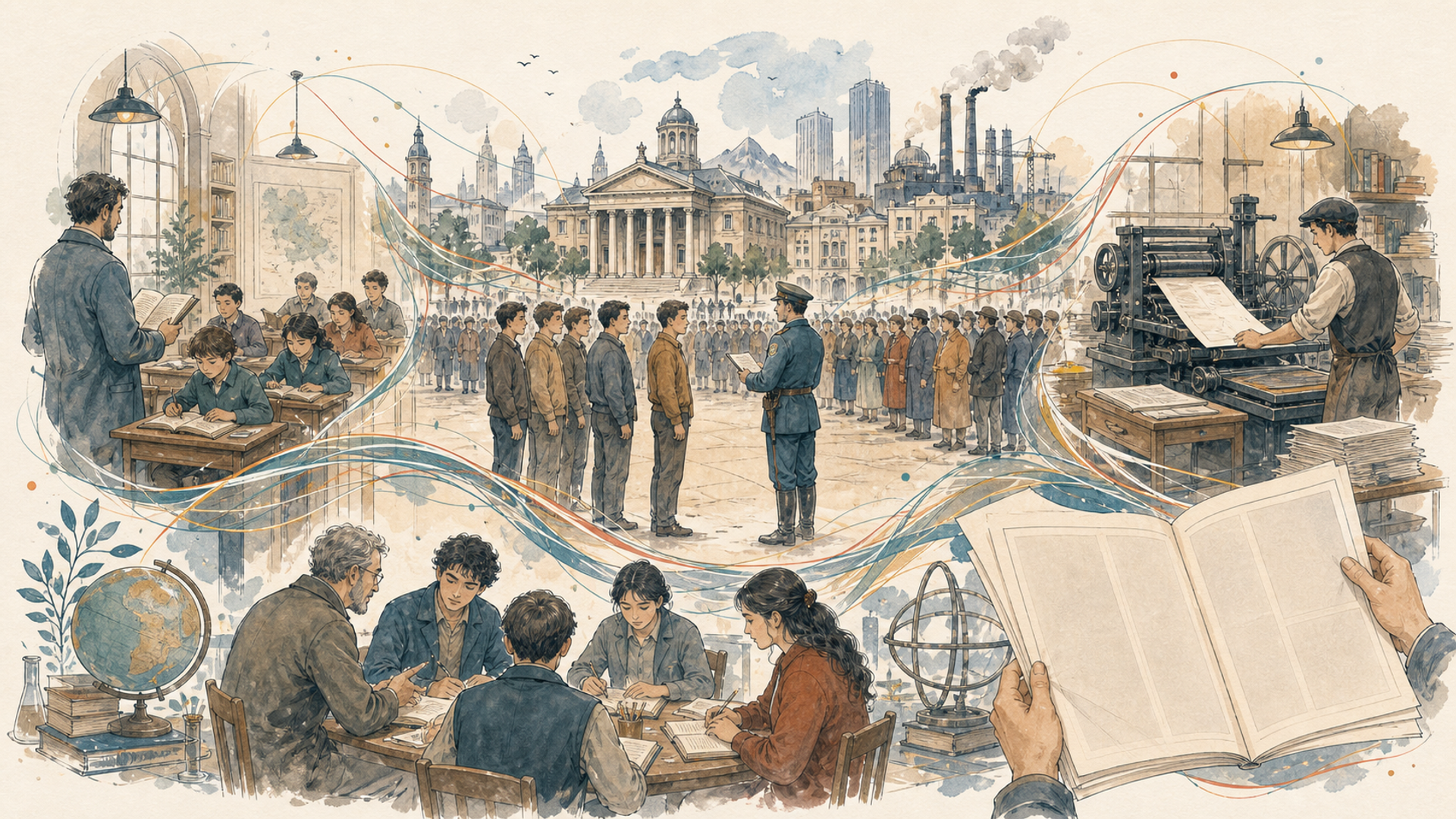
In 1780, a peasant in Brittany, one in Provence and an inhabitant of Paris all live under the king of France, but they might speak very different linguistic varieties, use different measures and have a surprisingly weak relationship with the state compared with a modern citizen. A century and a half later, the French state teaches millions of children the same standard language, registers, taxes and conscripts them, and tells them a shared national story. What happened? The nation is not simply ‘a people that has always existed’. Some communities possess very ancient memories, languages and identities, but the modern nation-state is the result of a relatively recent political transformation. Print, school, bureaucracy, mass armies and industrialisation make it possible to build a political community far more uniform than those that came before it.
The French Revolution changes who owns the state
Before the French Revolution, European political legitimacy was strongly dynastic: a territory belonged to a sovereign by hereditary right, conquest or treaty. People were subjects. The revolution powerfully introduced the idea that sovereignty belongs to the nation and its citizens. This was not the absolute birth of the concept, but it was a turning point. The state was no longer presented solely as the king’s property; it became the expression of a people. This changed warfare. If you fight for your king, the army can be relatively professional and limited. If the nation is in danger, you can mobilise far larger masses. The French revolutionary levée en masse of 1793 is a symbol of this transformation: war becomes the business of the population. Napoleon would carry these new political and military energies across much of Europe, conquering territories but also spreading institutions and, paradoxically, stimulating nationalisms opposed to French domination.
A child attending a national school learns far more than mathematics. They learn a standard language, a political geography, a history, symbols, festivals and often a canon of national heroes. In the nineteenth century, the expansion of public education in Europe helped reduce the cultural distance between regions. Dialects and local languages did not disappear, but the nation-state acquired a powerful instrument of standardisation. Schooling also made a more efficient bureaucracy possible: literate citizens could understand forms, newspapers and orders; soldiers could read instructions; workers could work in more complex industries. Print and newspapers did the rest. Millions of people read the same news and discussed the same events on the same day. They did not know one another, but they lived inside the same conversation.
Italian unification is a useful example precisely because it shows that the nation does not appear ready-made. The Kingdom of Italy came into being in 1861, uniting territories with very different political histories, administrations and linguistic varieties. Figures such as Cavour, Garibaldi, Mazzini and Victor Emmanuel II represented different strategies and ideas, but unification did not resolve the problem: it began the long process of building a nation-state. The phrase ‘Italy has been made; now we must make Italians’, traditionally associated with Massimo d’Azeglio although its exact wording is disputed, captures the issue well. Drawing a border is faster than creating a shared identity. Over time, schools, military conscription, infrastructure and administration would help integrate the country. But regional and linguistic differences would remain extremely strong.
Germany: a market before a state
German unification also reveals the interweaving of economics and politics. For much of the nineteenth century, the German-speaking region was divided into many states. The customs union, the Zollverein, reduced trade barriers between many of them and created growing economic integration under Prussian influence. Otto von Bismarck used diplomacy and wars against Denmark, Austria and France to forge political unification under Prussian leadership, culminating in the proclamation of the German Empire in 1871. Unified Germany was industrial, populous and located at the heart of Europe. Its emergence radically changed the balance of power. It is a perfect example of how nationalism and geopolitics feed one another: a political identity creates a larger state, and that state alters the security of all its neighbours. While the national idea strengthened France, Italy or Germany, it could destabilise multi-ethnic empires such as the Habsburg, Ottoman and Russian empires.
What happens when different groups within the same empire begin to demand autonomy or independence in the name of the nation? The Balkans of the nineteenth and early twentieth centuries became a dangerous laboratory for this tension. Greece, Serbia, Romania, Bulgaria and other states emerged through complex processes involving local nationalisms, Ottoman decline and intervention by the great powers. Identities are never perfectly separated across a territory: towns and countryside can be ethnically and linguistically mixed. Drawing a ‘nation-state’ therefore often means deciding who will remain a minority on the other side of a line. Here lies one of the problems that will accompany us through the twentieth century: the map of identities never aligns perfectly with the map of borders.
Nationalism can be a movement of emancipation. Peoples under foreign empires use it to demand self-government, representation and independence. But it can also become exclusive and aggressive: if the state belongs to ‘our’ nation, what happens to those considered outsiders? In the nineteenth and twentieth centuries, different nationalisms fuelled discrimination, expulsions and violence. The same idea that allows millions of strangers to feel solidarity with one another can turn millions of others into outsiders. This ambivalence is fundamental. It makes no sense simply to say that nationalism ‘is good’ or ‘is bad’. It is an immensely powerful political technology for creating belonging. The outcome depends on how ‘we’ is defined.
The colonised also learn the national language
European powers spread administrations, schools and political ideas through their colonial empires, but they could not control how those ideas were used. Indian, Vietnamese, African and Arab students read European concepts of liberty, sovereignty and nation and turned them against the empires. If the French had a right to a nation, why not the Vietnamese? If the Italians had unified their peninsula, why should a colonised people not govern itself? Nationalism thus also became the language of decolonisation. The empire unwittingly exported part of the ideology that would help destroy it. By the end of the nineteenth century, Europe was populated by nation-states that were better able to mobilise citizens, industries and armies. At the same time, the powers were competing for colonies and global influence. Germany, France, Britain, Russia, Austria-Hungary and Italy sought security and prestige in an increasingly tense system.
Nationalism was not the only cause of the First World War, but it made rivalries more emotional and mobilisations larger. States could demand enormous sacrifices from citizens convinced they were defending their homeland. Before we reach the war, however, there is one final step: the moment when the industrial powers divided territories in Africa and Asia with a new aggressiveness. The same railways, medicines and weapons that had compressed space made it easier to conquer and administer distant regions.
Germany: economy, war and identity
Austria-Hungary, the Ottoman Empire and the Russian Empire contained many linguistic and religious communities. The national principle placed these systems under pressure: if every ‘nation’ should have its own state, why should Czechs, Poles, Serbs or others accept the rule of an imperial dynasty? But nationalism is not always liberation. It can also justify expansion: if people whom I consider part of ‘my’ nation live beyond the border, I can argue that their territory should belong to me. It can create first-class citizens and suspect minorities. It can turn a language into proof of political loyalty. In the colonies, meanwhile, the same national ideas would be used against the European empires. Leaders in India, Vietnam, Africa and the Middle East would take the language of self-determination and turn it against those who had applied it mainly in Europe. Nationalism is therefore a tool with no fixed owner. It can unite, liberate, exclude and conquer. Industry changed the scale—and the human cost was enormous.
If you had stopped a European peasant in 1400 and asked, ‘What is your nationality?’, you probably would not have received the tidy answer we expect today. They might have identified with a village, a region, a lord, a religion, a city or a dynasty. They might have spoken a dialect that an inhabitant of another part of the same kingdom struggled to understand. The king ruled territories inhabited by communities with different languages and customs, and this did not necessarily seem like a problem to be solved. The modern nation-state changes the expectation. Ideally, a territory, a people, a political language and a sovereignty should coincide. In reality, they almost never coincide perfectly, and it is precisely this gap between the ideal and the real world that produces an enormous amount of conflict.
The French Revolution was a decisive acceleration. Sovereignty was no longer presented solely as the dynastic property of the king; the ‘nation’ became a source of legitimacy. Mass mobilisation and conscription linked the citizen to the state in a new way. Fighting was no longer merely service to the sovereign: it could be presented as defence of the homeland.
School builds a nation every morning
A modern nation does not live only in political speeches. It lives in daily repetition. Schools that teach a standard language, history books that select a shared memory, maps hung on walls, public holidays, anthems, the army, bureaucracy and newspapers lead millions of people to imagine that they belong to the same group. This process can seem natural when we observe it after generations. In Italy, at the time of unification, standard Italian was not the everyday language of most of the population; dialects and other languages predominated. Over time, school, military service, mobility, the media and administration helped spread a shared national language. The famous phrase attributed to Massimo d’Azeglio—‘Italy has been made; now we must make Italians’—is probably a later reworking and should not be treated as a reliable quotation, but it neatly summarises the perceived political problem: creating the state does not automatically create a shared identity.
Germany followed a different path, with unification under Prussian leadership and Bismarck’s wars in the 1860s and 1870s. Here too, a common language and culture were not enough: there were different states, dynasties, religions and regional interests. Nationalism can therefore be both a cultural movement and a strategy of state-building. The principle of self-determination seems simple until you ask where one people ends and another begins. In many regions of Central and Eastern Europe, populations with different languages and religions lived intermingled. Empires such as the Habsburg and Ottoman realms governed mosaics of communities. Drawing a ‘national’ state inevitably required deciding what to do with minorities left on the wrong side of the new frontier.
Here nationalism reveals its double face. It can mobilise populations against an empire and create representative institutions; it can also turn neighbours into foreigners, produce policies of assimilation and, in the most extreme cases, expulsions and ethnic violence. It is wrong to treat it either as straightforward progress towards democracy or as a disease that automatically produces war. It is an immensely powerful political technology for creating an ‘us’, and precisely for this reason it can also define a ‘them’. The expansion of print and literacy amplifies the process. Newspapers and books allow people far apart to read the same news and discuss the same events. The railway carries individuals and ideas across the territory; the telegraph creates a faster national political conversation. Once again, technology and identity meet.
A state that demands high taxes, compulsory schooling and military service from its citizens needs a deeper relationship than that between a subject and a distant monarch. Nationalism provides an answer: the sacrifice is not for the king, but for ‘us’. This capacity for mobilisation helps explain the frightening scale of the twentieth century’s wars. Millions of men can be called to arms and entire economies organised for conflict because the state possesses not only bureaucracy, but a mass identity. The paradox is that nationalism grows in the same period in which economics and technology make the world more interdependent. Nations define themselves as sovereign communities just as railways, trade and finance connect them ever more closely. It is a tension we have never truly resolved: we want to control our destiny politically within borders, yet materially we depend on networks that cross those borders.
The nation must be taught before it seems natural
Today, it is easy to imagine that a national language, a flag and a shared history have always existed in the same form. In the nineteenth century, however, many European states contained populations who spoke different dialects or languages and whose everyday ties were primarily to their village, region, religion or dynasty. Standard Italian, for example, was far less widespread in daily life than it is today; after political unification, school, military service, administration, internal migration and the media helped make it a genuinely national language over time. School played a gigantic role. It did not merely teach reading and writing: it taught maps, dates, heroes, public holidays and a narrative of the past in which millions of people could recognise themselves as members of the same community. Benedict Anderson described the nation as an ‘imagined community’, an expression sometimes misunderstood as meaning ‘fake’. On the contrary: an imagined community can be immensely powerful. You will never meet most of your fellow citizens, yet you can regard them as part of the same ‘us’, pay taxes for services they will use and, in extreme moments, risk your life in a war fought in the name of that group.
Print and then newspapers helped build this mental space. People far apart read the same news in the same language and learnt to think of events as parts of a single national story. Railways and telegraphs, which we encountered in the previous chapter, did the rest: they reduced the practical distances between provinces and allowed the state to maintain a more continuous presence. Modern nationalism is therefore not born solely from spontaneous feeling. It needs institutions that make belonging an everyday experience. This does not mean that identities are invented at will by all-powerful governments. Nation-builders use pre-existing languages, religions, memories and symbols; some national projects fail precisely because they cannot persuade enough people. And different individuals can simultaneously feel Sicilian, Italian, European, Catholic, Muslim, Basque, British or part of many other communities without one identity automatically erasing the others. Political power arises when one of these forms of belonging becomes strong enough to define who should govern a territory.
This is also where the dark side comes from. If the nation is ‘us’, anyone who does not match the language, religion or origin considered authentic risks becoming ‘them’. In the nineteenth and twentieth centuries, nationalism and self-determination helped free peoples from empires, but they also fuelled expulsions, forced assimilation and violence. The same idea that allows a dominated community to demand independence can be used by a majority to deny a minority full membership. It is this ambivalence that will make nationalism such a powerful force in wars and in the redrawing of the modern map.