Chapter 20 · Part 05
Why Do Empires Divide Up the Planet?
Imperialism, industry and colonial borders.
Industry, naval power, finance and medicine make a new wave of imperialism possible. Africa and Asia are incorporated into colonial systems that leave lasting borders and dependencies.
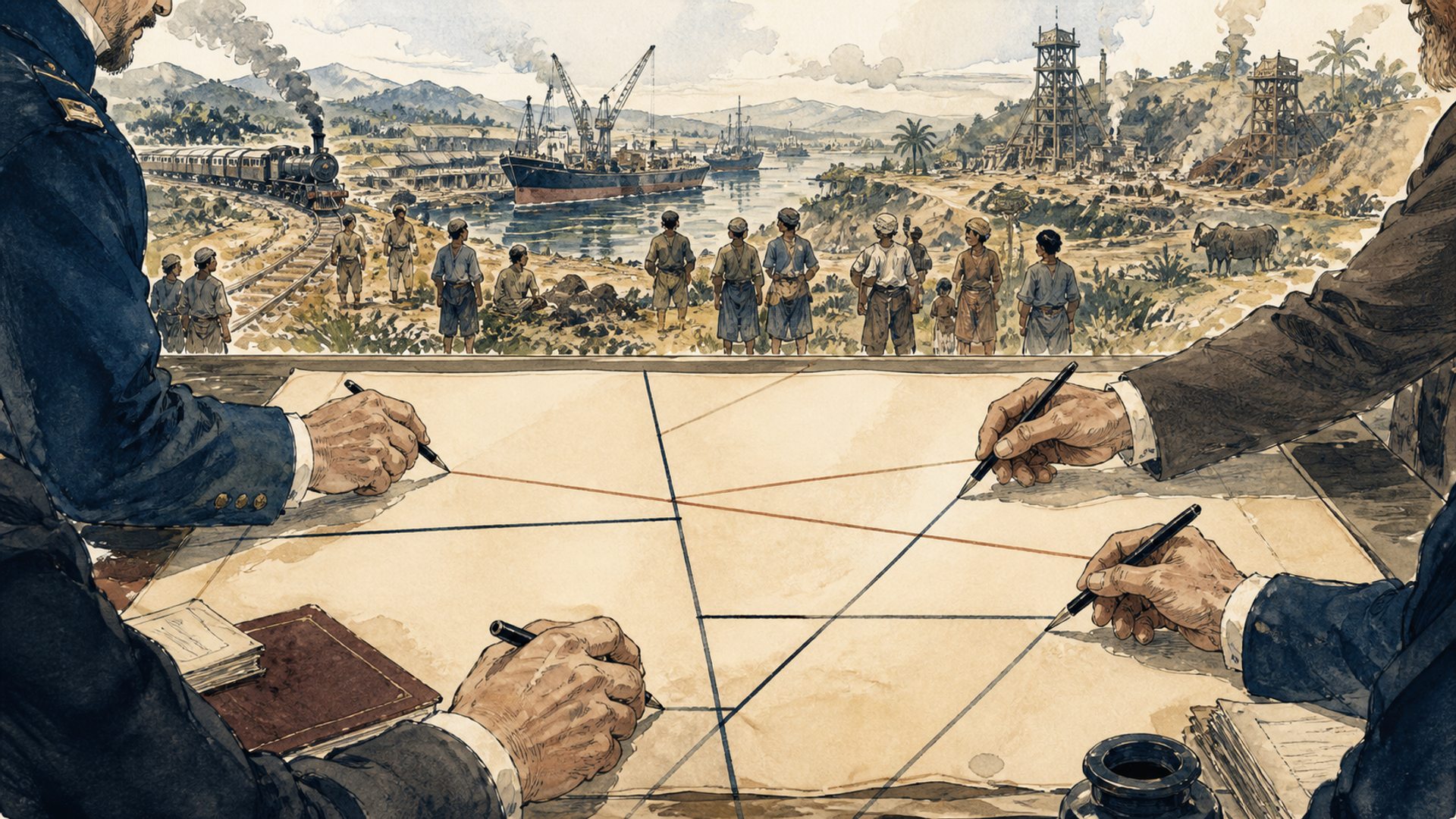
If you had looked at a map of Africa in 1870 and then another at the beginning of the twentieth century, you might have thought that someone had spilled a tin of European paint across the continent. Within a few decades, almost all of Africa had been claimed and conquered by outside powers. France, Britain, Germany, Belgium, Portugal and Italy appeared on the map with vast coloured territories, as though they were natural extensions of European countries. They were not, of course. Behind every colour lay wars, treaties, resistance, agreements with local authorities, military expeditions and an enormous amount of violence. The temptation is to tell this story with a very simple formula: Europe had become stronger through industry, so it conquered the rest of the world. There is some truth in that, but not enough. Industrialisation transformed the balance of power, yet it did not make European expansion an inevitable walkover. We must also add finance, medicine, transport, rivalry among the powers, racist ideologies, commercial interests, local political crises and, above all, the decisions of people and governments that could have acted differently.
This is the phase in which many of the tools we have encountered so far — steamships, the telegraph, industrial weapons, cartography, bureaucracy and credit — begin to work together. And when many different technologies combine, the result is not simply ‘a little more power’: it can be a leap in scale.
A continent is not divided up in a room
You may have heard that, at the Berlin Conference of 1884–85, European leaders sat around a table and used a ruler to draw all of Africa’s borders. It is a tremendously powerful image, which is precisely why it has endured. But it is too neat to be true. Convened by the German chancellor Otto von Bismarck, the conference established rules and principles to regulate colonial competition, addressed freedom of navigation on major rivers such as the Congo and the Niger, and dealt with the question of the Congo Basin. It did not produce, in a single sitting, the complete map of Africa we know today. Many borders were subsequently defined through bilateral agreements, wars, occupations and negotiations. That does not make the process any less colonial; it simply makes it more complex and, in a sense, more impressive. It was not a single act. It was a system.
What Europeans often called the Scramble for Africa accelerated in the closing decades of the nineteenth century. The powers feared that if they did not occupy a territory, a rival would. It is the same mechanism we have already seen with empires: expansion can be driven not only by what you want to gain, but also by fear of what someone else might gain. This logic produces strange outcomes. A territory can be expensive, difficult to administer and even unprofitable in the short term, yet still become desirable because possessing it enhances prestige, provides naval bases or prevents an adversary from taking it. Imperialism was not a single economic venture run by a global board of directors. It was a combination of often contradictory interests.
For an early nineteenth-century European army, establishing a lasting presence in many tropical regions could be extremely dangerous. Malaria and yellow fever killed travellers and soldiers. The growing use of quinine as a prophylactic against malaria reduced one of these obstacles, while steamships and railways improved the ability to move men and matériel. Industrially produced weapons widened the military gap in many cases. The telegraph made it possible to communicate with distant administrations at a speed unimaginable a century earlier. But it would be a mistake to picture a technologically omnipotent Europe arriving before passive societies. Africa contained kingdoms, empires, trading cities and political systems that differed greatly from one another. Some authorities sought alliances, some negotiated, and others fought. Under Menelik II, Ethiopia defeated the Italian army at Adwa in 1896, one of the clearest demonstrations that conquest was not written into the laws of physics. In other regions, resistance lasted for years and exacted an enormous price from both the invaders and local populations.
This detail matters because it changes how we interpret the word ‘colonisation’. If we describe it merely as a colour spreading across a map, we erase the human part of the story itself: people accepting, refusing, collaborating, resisting, betraying, negotiating and trying to survive amid rapidly changing conditions.
The Congo: when a map conceals what is happening on the ground
Few examples show the distance between colour on a map and reality better than the Congo Free State. It did not begin as an ordinary Belgian colony, but as a personal domain tied to King Leopold II. Behind the language of civilisation, trade and the struggle against slavery developed a brutal system of exploitation, particularly associated with the collection of rubber and ivory. Violence, forced labour, punishment and the destruction of communities caused a human catastrophe. Scholars debate the precise estimates of deaths and demographic decline, but not the system’s extreme violence.
Why does this case matter in a book about geopolitics? Because it shows that ‘controlling a territory’ can mean, above all, controlling its flows: labour, raw materials, taxes, rivers and points of export. An empire does not need every inhabitant of a colony to feel part of the imperial project. It need only build a machine capable of extracting resources and suppressing enough resistance to keep it running. A great deal of colonial infrastructure was designed according to this logic. A railway could certainly connect towns and create local economic opportunities, but the original question was often simpler: how do I carry a raw material from the interior to a port? This helps explain why, decades later, some independent states inherited transport networks that linked mines and coasts effectively but connected their own regions far less well.
The imperial scramble was not confined to Africa. In Asia, European powers controlled enormous territories, from British India to French Indochina and the Dutch East Indies. In China, following the nineteenth-century Opium Wars, foreign powers obtained concessions, commercial privileges and rights that curtailed the sovereignty of the Qing dynasty without turning the whole of China into a single colony. This is another form of power: you do not necessarily have to govern an entire country to force it to open ports, accept trading terms, or grant you territories and immunities. Then there is Japan, which makes it impossible to divide the story into a convenient opposition between a ‘conquering Europe’ and a ‘conquered Asia’. After the Meiji Restoration of 1868, Japan rapidly built modern state institutions, industry and armed forces capable of competing with the Western powers. By the end of the nineteenth and beginning of the twentieth century, it had itself become an imperial power, defeating China and then Russia and building its own empire in East Asia.
The lesson is not that Japan ‘copied Europe’. It is that an international system dominated by competition among industrial states created very powerful incentives to acquire military, industrial and imperial capabilities. Those that succeeded could join the club of powers; those that failed risked having to live by its rules.
The borders that remain after the empire leaves
When we look at a contemporary map, it is easy to attribute every African border to a European armed with a ruler. That, too, is a simplification. Some frontiers follow geographical features, others earlier political divisions, and still others were negotiated among colonial powers; many cut through areas in which peoples, languages and trading networks did not correspond at all to the new line. The problem is that once a state has been created, changing a border may become even more dangerous than retaining an imperfect one. When we reach decolonisation, we shall see that many new African governments chose to preserve the inherited frontiers precisely to avoid a cascade of territorial wars. It is an immense paradox: lines born within a colonial system end up being defended by independent states because they have by then become part of the international order.
This does not mean that ‘all of Africa’s problems come from colonial borders’. That would be another overly convenient explanation. Postcolonial states have different histories, different leaders, different institutions, different economies and different relationships with the rest of the world. But it does mean that colonialism does not vanish when a flag is lowered. It can survive in a railway, an administrative language, a tax system, an economic structure or a frontier. By the beginning of the twentieth century, the great industrial powers were more interconnected than ever. They traded, invested in one another, exchanged technologies and shared a cosmopolitan European culture among their elites. At the same time, they regarded one another with suspicion, built fleets, forged alliances, competed for colonies and thought in terms of national prestige.
You might think that more trade automatically makes war irrational. War can indeed be economically disastrous. But states do not make decisions with a spreadsheet alone. Fear, prestige, ideology, misperceptions and expectations about the behaviour of others can push highly interdependent systems towards catastrophe. That is what is about to happen in Europe. In 1914, a young nationalist will shoot the heir to the Austro-Hungarian throne in Sarajevo. The bullet will not ‘cause’ a world war by itself, just as a match does not explain why a room was full of petrol. To understand how a local assassination can redraw the planet, we shall have to look at what had accumulated beforehand: empires, nationalisms, alliances, mass armies, railways, industrial mobilisation and a dangerous conviction that, if war came, perhaps it would be brief.
Medicine can become an imperial advantage
We have just seen how quinine and public health reduced some of the risks Europeans faced in tropical regions. It is worth pausing here, because the relationship between medicine and empire is full of paradoxes. Medical tools can save lives regardless of who uses them, but in the context of conquest they can also make a foreign military presence more sustainable. The same infrastructure can have two effects. A colonial railway can facilitate the extraction of raw materials and at the same time be used by local populations to travel, trade and organise political movements. A school can train officials for the imperial administration and help create the elites who will lead the struggle for independence. Empires often inadvertently produce tools that the colonised will use against them.
In 1898, a French expedition and an Anglo-Egyptian force met at Fashoda, in present-day South Sudan. Britain and France had intersecting imperial designs: London imagined north–south continuity in East Africa, Paris a west–east belt of influence. For several weeks, the confrontation seemed capable of leading to war between the two powers. In the end, France withdrew and the crisis was resolved diplomatically. A few years later, London and Paris would establish the Entente Cordiale and find themselves on the same side in the First World War. It is a useful curiosity because it shows how fluid rivalries can be. A country can almost go to war with you over a distant swamp and, six years later, become your principal partner against another threat. Interests are not eternal friendships.
Imperialism also has a domestic audience
Conquests were sold to the public in the language of national prestige, a civilising mission, Christianisation, science and racial superiority. Pseudo-scientific theories turned political hierarchies into supposed biological ones. Racism was not merely private prejudice; it provided justifications for systems of domination. But imperial societies also had their opponents: missionaries who denounced abuses, socialist and liberal anti-imperialists, journalists and activists. Empire was not an opinion shared by every European citizen. Remembering this prevents us from turning entire peoples into a single will. States conduct politics through internal as well as international conflicts. Between 1884 and 1885, representatives of European powers and the United States met in Berlin to discuss rules governing trade and colonial claims in Africa, particularly in the Congo and Niger regions. No African representative took part in the conference as an equal. It is often said that the diplomats ‘divided Africa with a ruler’ around a table. The image captures colonial arrogance but oversimplifies: many borders were defined in negotiations, treaties and conquests that took place before and, especially, after Berlin, and the European powers actually had to occupy the territories they claimed to control.
The conference nevertheless remains symbolically fundamental. It formalised the principle that a colonial claim required some form of effective presence and accelerated a competition already under way. Within a few decades, almost the entire African continent, with important exceptions such as Ethiopia and Liberia, had been subjected to European colonial rule. Why then? Once again, there is no single cause. Strategic rivalry among powers, the pursuit of prestige, markets and raw materials, religious missions, racist and nationalist ideologies, and new technological capabilities all combined. Colonialism was not merely ‘economic’, nor was it merely a frenzy of prestige: motives varied from country to country and territory to territory.
Industry makes conquest easier, but not easy
Steamships, railways, the telegraph and industrial weapons enormously increased the European powers’ ability to project force. Medicine played an equally important role: for centuries, malaria and other diseases had made many tropical regions extremely dangerous for Europeans; the prophylactic use of quinine reduced some of those risks without eliminating them. The Maxim gun, introduced in the 1880s, has become a symbol of colonial technological superiority. But it would be wrong to imagine a continent conquered by a machine alone. African states successfully resisted at various points; Ethiopia defeated Italy at Adwa in 1896, one of the most important anti-colonial victories of the era. Conquest depended on alliances, logistics, local divisions, disease, resources and political decisions, not simply on the most modern weapon.
Japanese imperialism also reminds us that the phenomenon was not exclusively European. After the transformations of the Meiji era, Japan industrialised rapidly and built its own empire in Asia, defeating China in 1894–95 and Russia in 1904–05. An Asian society was adopting industrial and institutional tools to enter the same competition among powers. Colonial rule reshaped infrastructure and production around priorities often connected to exports. Railways might connect mines or plantations to ports more readily than they connected African regions to one another; tax systems forced populations into the monetary economy; export crops replaced or supplemented local production. But the effects varied enormously, and not everything that exists today can be traced mechanically to colonialism.
Colonial administrations often governed through local authorities, creating or hardening ethnic and political categories to make the population more legible. In some cases, pre-existing institutions were adapted; in others, new elites were favoured. The result was not a single ‘colonial model’, but many systems that left different legacies. Frontiers deserve particular care. Many colonial lines cut through areas inhabited by connected communities and joined different populations within the same territory. Yet almost no border in the world corresponds perfectly to a single culture, and attributing all contemporary African conflicts to ‘artificial borders’ is too easy an explanation. Even seemingly ancient European states have frontiers constructed by wars and treaties. The task is to understand how particular frontiers were created, how legitimate they appeared to local populations, what institutions were left behind and how independent governments managed them.
Empire also produces the resistance that will ultimately challenge it
One paradoxical effect of colonialism was the creation of networks and institutions that contributed to later anti-colonial mobilisation. Schools and universities educated elites who would use the language of rights, nationalism and self-determination against the very same empires; railways and cities connected populations; colonial soldiers fought in the world wars and returned with new experiences. At the end of the nineteenth century, however, this outcome was still a long way off. The imperial powers looked at a map increasingly coloured by their empires, and many observers could imagine that this order would endure. In less than seventy years, much of it would disappear. First, however, rivalry among industrial states and empires would help drag the world into the most destructive war it had yet known.