Chapter 29 · Part 06
Why Does China Want the Sea—and Why Does Taiwan Matter So Much?
Industry, shipping routes, semiconductors and the Indo-Pacific.
Industrial China depends on ports, energy and shipping lanes. Malacca, the South China Sea and Taiwan show how physical geography and technology have fused.
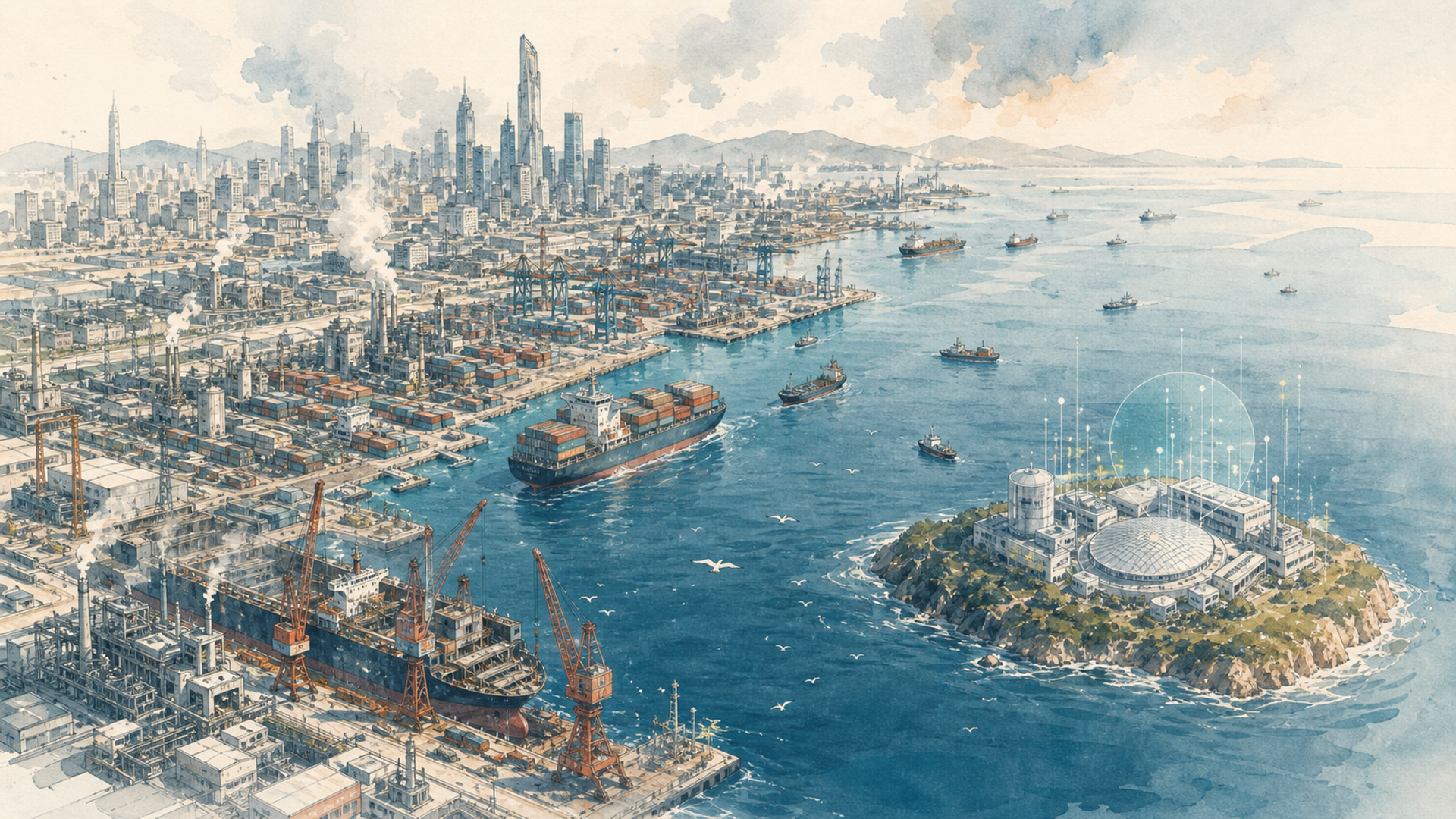
To an emperor of the Qing dynasty, the sea would have meant something very different from what it means to China today. Chinese power was continental: great agricultural plains, rivers, inland cities, steppe frontiers and a bureaucracy built to govern an immense territory. Maritime trade existed and mattered, of course, and centuries earlier Zheng He’s fleets had reached the Indian Ocean. Yet the state’s survival did not depend on container ships passing through Malacca or tankers arriving from the Persian Gulf.
Contemporary China is a different animal. Economic reforms begun in the late 1970s turned coastal provinces into one of history’s greatest concentrations of industry. Shenzhen, then a comparatively small city near Hong Kong, became a technology metropolis. The Pearl River Delta, Shanghai and the Yangtze Delta filled with ports, factories, motorways and manufacturing districts. Much of the energy and raw material feeding this industrial machine arrives by sea, and many of the goods China sells leave through the same ports. The richer the country became through connection with the world economy, the more sensitive it became to the security of the routes sustaining that wealth.
You should recognise the paradox by now. Connection creates opportunity and vulnerability together. European powers once sought the sea as a route to commerce and empire. Twenty-first-century China must protect an economy that is already deeply maritime. Just off its coast it encounters complicated geography: peninsulas, archipelagos, US allies, disputed seas and, at the centre, Taiwan.
The coast that changed China’s economy
When Deng Xiaoping and other Chinese leaders gradually opened parts of the economy after Mao’s death, they did not liberalise the whole country at once. Some of the first Special Economic Zones were established on the southern coast at Shenzhen, Zhuhai, Shantou and Xiamen. The locations were deliberate: close to Hong Kong, Macao, Taiwan and East Asian commercial networks. Investment, technology and export manufacturing could enter through these points and connect China with world markets.
Their success reshaped population as well as the economy. Hundreds of millions moved from countryside to cities and industrial districts. Shanghai, Ningbo-Zhoushan and Shenzhen became ports of global scale. China built motorways, high-speed rail, power plants and manufacturing capability stretching from inexpensive consumer products to sophisticated technology. Entry into the World Trade Organization in 2001 accelerated integration further.
The strategic consequence is easy to state and enormous in implication. A richer China could fund far more modern armed forces. An integrated China also depended more on flows through waters Beijing did not control. Much imported oil comes from the Middle East and Africa across the Indian Ocean. Many ships heading for Chinese ports pass through the Strait of Malacca, between the Malay Peninsula and Sumatra. Alternatives exist, but are often longer or less economical. “There is another route” does not mean the main route is irrelevant.
China has therefore invested in ports, pipelines and overland links, in the Belt and Road Initiative and, above all, in a much larger navy capable of operating farther from shore than it could a few decades ago. Reducing every project to one secret plan for world domination would be a mistake. Different ventures answer different commercial, diplomatic and strategic interests and have produced varied results. Together, however, they reveal a transformation: a great continental power also became a great maritime power because its economy supplied both the means and the reason.
The sea as a memory of vulnerability
The symbolic force of coasts and maritime access in Chinese politics reaches back to the nineteenth century, when the Qing Empire discovered how the balance of power had shifted towards industrial Europe. In the Opium Wars, British naval and technological superiority helped impose defeat and treaties that opened ports, granted foreign privileges and ceded Hong Kong to Britain. Other powers later gained concessions and spheres of influence. War with Japan in 1894–95 brought another shock: rapidly modernised Meiji Japan defeated China and acquired Taiwan, among other gains.
In the People’s Republic, these events form part of the “century of humiliation”, a national narrative connecting foreign interference, state weakness and lost sovereignty. Like every national memory, it selects and arranges complex events into a shared story. It would nevertheless be a mistake to dismiss it as propaganda without real effects. It helps explain why Chinese leaders present national rejuvenation, control of the coasts and resistance to foreign interference as parts of one historical project.
That memory meets contemporary geography. From the Yellow Sea to the South China Sea, China’s coast faces archipelagos and states linked in different ways to the United States. Strategists often speak of a “first island chain” running roughly from Japan through Taiwan to the Philippines. It is no physical wall, but it illustrates the problem. A Chinese navy seeking freedom of movement in the western Pacific must pass through or alongside straits and territories where other countries’ forces can operate.
The growth of the People’s Liberation Army Navy, missile capabilities and Chinese bases can partly be read as an attempt to change that balance. The United States and regional partners interpret some of that growth as reason to strengthen their own positions. The European security spiral returns on water.
A sea small on the map, enormous in politics
The South China Sea sits almost enclosed by China, Vietnam, the Philippines, Malaysia, Brunei and Indonesia. Crucial shipping lanes cross it, and it holds fisheries and potential energy resources. Maritime claims overlap. In recent decades China has built facilities on disputed reefs and islands and turned some shoals into artificial land through extensive reclamation.
Beijing claims broad rights in the area and roots its position in Chinese history and sovereignty. Other coastal states invoke their exclusive economic zones and the law of the sea. In 2016, an arbitral tribunal constituted under the UN Convention on the Law of the Sea, in a case brought by the Philippines, found among other things no legal basis for Chinese historic rights to resources inside the “nine-dash line” beyond the rights allowed by the Convention. China did not participate in the proceedings and rejected the award as null and void.
You do not need to master maritime law to see the geopolitical point. At sea, a line is never only a line. Deciding who may fish, drill, patrol or build turns water into political space. Because the United States and its allies also operate there, an encounter between ships or aircraft can become far larger than the local dispute that begins it.
Alliances change geography’s meaning. Japan, South Korea and the Philippines have security treaties with Washington, and the United States maintains a strong military presence in the western Pacific. To Beijing, islands and US-linked states may look like an obstacle to free Pacific access. To many regional governments, US power is a counterweight to a growing China. What one actor calls deterrence, another calls encirclement.
Taiwan is not important because it makes chips. But the chips matter.
Taiwan’s history is far more complex than “China versus Taiwan”. Austronesian Indigenous peoples inhabited the island long before large-scale Han migration from the Chinese coast. Dutch and Spanish colonial footholds appeared in the seventeenth century; later the Zheng regime and then the Qing dynasty extended control across larger areas. After China’s defeat in the First Sino-Japanese War, the Qing ceded Taiwan to Japan in 1895, and Japan ruled it for fifty years.
At the end of the Second World War, administration passed to the Republic of China. In 1949, after Communist victory in the Chinese Civil War, Mao Zedong proclaimed the People’s Republic in Beijing while Chiang Kai-shek’s Kuomintang government withdrew to Taiwan. Since then, separate political authorities have governed either side of the strait. The People’s Republic has never administered Taiwan, but considers it part of China and regards unification as a fundamental national objective. Taiwan is governed by its own institutions and, after decades of authoritarian rule and martial law, has become a competitive democracy with direct elections.
This history makes language acutely sensitive. Beijing asserts a “one China principle” and seeks unification, preferably peacefully, without renouncing force under specified circumstances. Taiwan’s current authorities describe the Republic of China (Taiwan) as a sovereign democracy and say they seek peace and the status quo. The United States has no official diplomatic relations with Taiwan and diplomatically recognises the People’s Republic. Its own “one China policy”, however, is formulated differently from Beijing’s principle. Washington maintains unofficial ties through the American Institute in Taiwan and, under the Taiwan Relations Act, provides Taiwan with means to maintain a sufficient self-defence capability. The ambiguity is deliberate: it has sought to deter both forcible change to the status quo and unilateral moves that might trigger crisis.
Then come semiconductors. Taiwan hosts one of the world’s most important chip-manufacturing concentrations. TSMC is especially vital as a contract manufacturer of leading-edge processors designed by companies in many countries. This produced the popular idea of a “silicon shield”: dependence on Taiwanese chips supposedly makes the island too important to attack.
It is a useful metaphor, not a guarantee. War could destroy the very factories an aggressor sought to control and interrupt electricity, ultrapure water, chemicals and access to foreign machinery. Taiwan’s capacity is valuable because it belongs to a global network: European lithography, Japanese equipment and materials, American software and design, Taiwanese expertise and customers everywhere. It is not treasure that an occupier could simply seize and operate as before.
A democracy built in a few generations
The picture of Taiwan as merely a remnant of the Chinese Civil War hides its internal transformation. The Kuomintang ruled for decades under martial law; the period known as the White Terror included repression, imprisonment and execution of real and alleged opponents. Martial law ended in 1987, and the political system opened rapidly. Citizens directly elected a president for the first time in 1996. Since then, rival parties have exchanged power through competitive elections.
This evolution changed political identity. Generations born and raised on Taiwan developed forms of belonging that do not simply match the categories of 1949. People on the island hold different views about China, Taiwanese identity and the state’s constitutional description; treating twenty-three million people as if they share one opinion would be wrong. One point is difficult to ignore: any lasting settlement must address not only old diplomatic documents, but a democratic society that considers its own voice politically relevant.
That helps explain why the status quo is so ambiguous and so persistent. Beijing does not accept permanent separation and treats unification as a historical goal. Many Taiwanese want to preserve the system in which they live without provoking war. The United States seeks to deter force without offering a formula resolving sovereignty. Each actor prefers a different future, but forcing that future now could be enormously costly. This is stability built not on agreement, but on fear of the consequences of disagreement.
A strait wide enough to separate two systems, narrow enough for global crisis
At its narrowest, the Taiwan Strait is a little over a hundred kilometres wide. That seems modest in the age of missiles and aircraft, but carrying a force large enough to conquer and hold a populous island across it would be among the most difficult military operations imaginable. It would require air and naval superiority, immense logistics, usable ports or beaches and sustained supply under attack.
Conflict is not impossible; the difficulty explains why deterrence, blockade, economic coercion, military exercises and political pressure matter so much around Taiwan. For the wider world, crisis would reach far beyond the island. Essential shipping lanes cross the surrounding seas. Japan and South Korea depend heavily on maritime trade and imported energy; the United States has alliances and bases in the region; China itself depends on stable flows feeding its factories.
A war pursued to improve strategic position could destroy the economic networks that made all sides richer. That is why Taiwan embodies this book’s argument so well. Look only at Chinese history and you lose Taiwan’s political evolution. Look only at law and you lose military reality. Look only at chips and twenty-three million people become a factory. Look only at geography and you forget that alliances and technology transformed what geography means.
China, like Russia in the previous chapter and the United States before it, is not imprisoned by natural law. Naval growth, South China Sea claims and pressure on Taiwan are strategic choices made inside real constraints. Others answer with choices of their own, changing Beijing’s calculations in turn. Geopolitics is rarely one player against the terrain. It is many players studying the same terrain, imagining what the others might do and trying to avoid the future they fear most.
In the final chapter we take that idea farther. As we debate seas, mountains and islands, a growing share of world power seems to inhabit places we cannot see: cables on ocean floors, data centres, satellite orbits, semiconductor plants, electricity grids and deposits of critical minerals. It can look as though technology is finally setting humanity free from geography. The question is whether that is true—or whether we have simply built a new geography on top of the old one.