Chapter 07 · Part 02
Why Do Empires Arise?
Expansion, security, wealth and prestige.
Persia, Rome and imperial China show why conquest can increase resources and security—and why every new conquest makes a system harder and more expensive to control.
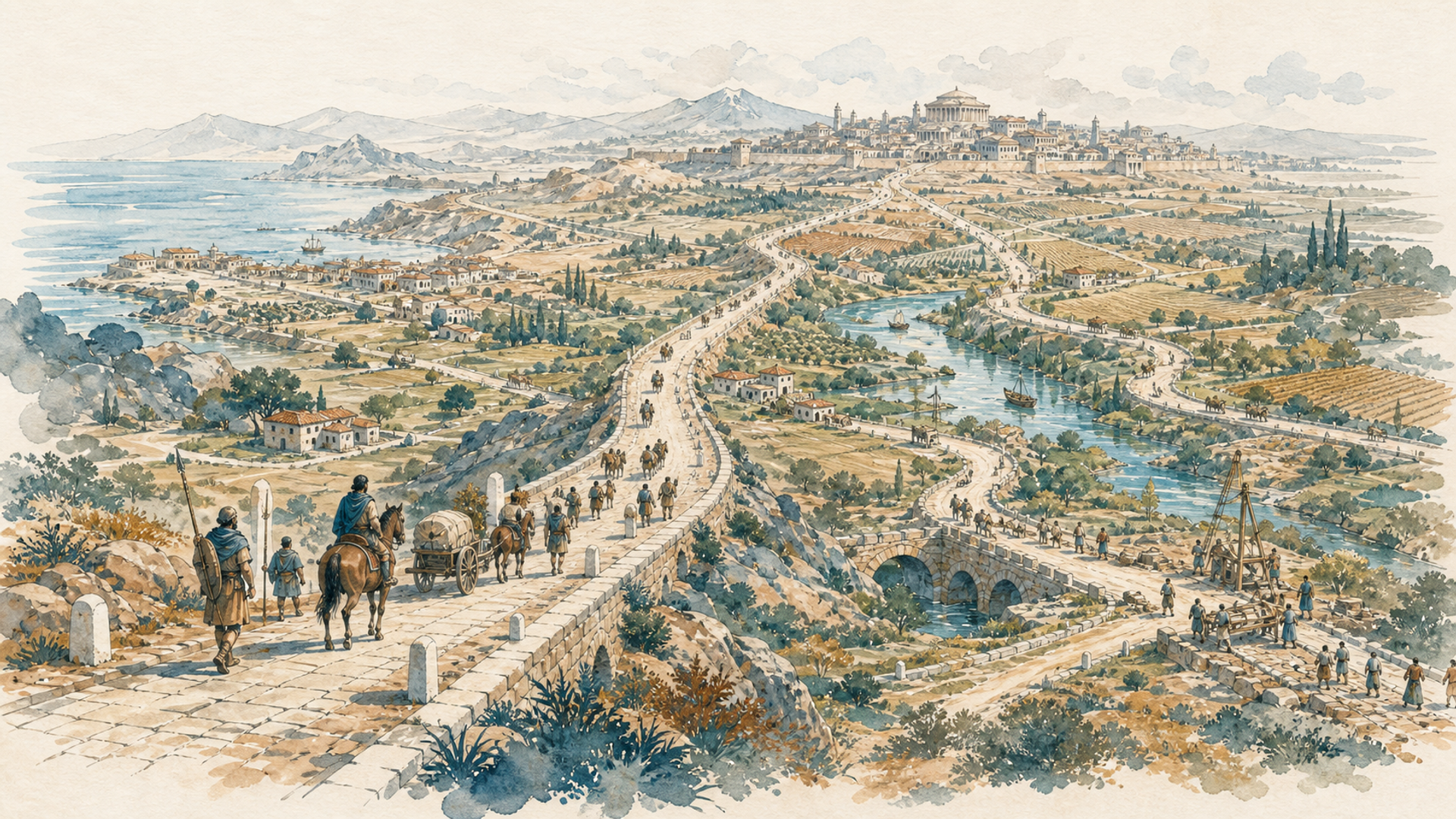
Imagine ruling a wealthy city. Its walls are strong, nearby fields productive and merchants arrive from afar. To the north, however, stands a rival community. If it grows stronger, it might attack. You can wait and hope it remains friendly, or conquer it now, move your frontier outward and add fields, taxes and soldiers to your domain.
Once you have taken the northern city, you discover another city beyond it—and a new frontier just as vulnerable as the old one. This pattern runs through history: expanding in search of security can create an even longer border to defend.
Empires do not all arise in the same way, and no “imperial gene” compels powerful societies to conquer. Some expand for security; others for resources, tribute, prestige, religion or political opportunity. Usually the motives mix. Yet empire’s recurrence tells us something about pre-modern power. To many rulers, more land meant more people, more production and more military capacity.
Persia: governing difference
In the sixth century BCE, Cyrus the Great built the core of the Achaemenid Persian Empire. His successors extended it across an enormous area from Central Asia to Egypt and Anatolia. Its scale is impressive, but the interesting question is: how do you govern people who speak different languages, worship different gods and follow different traditions?
Persian rule did not attempt to erase every difference. The empire used provincial administrations, commonly called satrapies, and relied extensively on local elites and practices. The centre demanded tribute, loyalty and order, but did not necessarily try to make everyone culturally identical.
That flexibility teaches an important lesson. A multi-ethnic empire must continually choose what to standardise and what to leave autonomous. Too much autonomy may let the periphery drift away; too much control may provoke resistance. There is no perfect answer, and every great empire moves somewhere between the two.
The Persians invested in roads and communication. The Royal Road, supported by messengers and stations, linked parts of the empire and accelerated orders. It did not abolish distance, but made distance more manageable.
Rome took a different route. From one city on the Tiber it expanded across the Italian peninsula, then the Mediterranean, and eventually from Britain to North Africa and the Near East. Its strength did not come from legions alone. Rome became remarkably capable of drawing defeated communities into a political and military network. Citizenship, initially restricted, expanded to larger groups until the Constitutio Antoniniana of 212 CE extended it to nearly all free inhabitants of the empire.
This did not make Rome egalitarian. Slavery, hierarchy and violence remained structural. But it shows a principle: an empire may last longer if it can turn at least some conquered people into participants in the system. Roads, cities, armies, law, commerce and citizenship built ties beyond military occupation.
Rome was pragmatic. Local elites often continued governing their communities in partnership with imperial authority. No empire has enough officials to control every village directly. It usually needs to persuade somebody on the spot that cooperation is worthwhile.
In China, Qin’s unification of the Warring States in 221 BCE established a highly centralised state, though the dynasty itself was short-lived. The succeeding Han developed and adapted administrative systems that contributed to a long imperial tradition. It would be wrong to treat “imperial China” as one unchanging entity over two thousand years. Dynasties rose and fell, borders shifted, unity alternated with division and invasion. Yet the idea that a large territory could be reunited under central political order proved remarkably durable.
Over later centuries, civil administration and examination systems selected officials partly through knowledge of texts and procedures, even though access remained deeply shaped by class, gender and family networks. This was another answer to the same challenge: turning government from a chain of personal loyalties into a structure capable of reproducing itself.
Why expansion so often looks sensible
From a ruler’s perspective, expansion promises at least four benefits. First, material gain: fields, mines, ports and taxpayers. Second, military manpower. Third, strategic depth, moving the frontier away from the heartland. Fourth, political prestige, as victory strengthens the ruler at home.
Every benefit hides a problem. New land needs administration. New soldiers can rebel. Frontiers lengthen. Conquered people may reject the order. Distant garrisons are expensive. Expansion therefore has diminishing returns. Nearby conquests may be easy to integrate; remote ones become costlier. Many empires reach a point where growth creates more problems than resources.
Here lies the paradox of imperial security. You conquer a neighbour because it might threaten you. Now you have a new neighbour. Follow the same logic and you should conquer that one too. You cannot continue for ever, yet the desire for “buffer zones” returns in every age.
Empires build different kinds of frontier: walls, forts, client states, tributary lands and alliances. The Great Wall was not one structure built once, but works constructed and connected in different periods to manage relations and threats along China’s northern frontiers. Romans developed fortified systems such as Hadrian’s Wall in Britain and limites elsewhere. None was an absolute barrier. They controlled movement, signalled danger and raised the cost of crossing.
Force is not enough. A durable empire must explain why its rule is legitimate. Persian rulers portrayed themselves as guarantors of order; Rome invoked law, citizenship and civilisation; Chinese empires used ideas such as the Mandate of Heaven. These were not necessarily empty propaganda. People could sincerely believe them, and they offered common language to diverse societies. They also transformed domination from military fact into moral order. People accept systems more readily when they seem natural, just or sacred.
The empire on a map moves faster than the real one
Drawing an empire is easy: colour a large area. Governing it is not. If a distant province rebels, how long until the capital hears? How long before orders return? How many weeks to move an army? What stops the local governor behaving like a king?
Before telegraphy, information moved no faster than a person, horse or ship. An empire could be immense while its centre lived permanently behind events at the periphery. This placed an invisible limit on political scale.
Empire is also a promise
Every great political system tells a story about itself. The Persian king guarantees order; Rome brings peace and law; China’s emperor possesses Heaven’s mandate. The stories need not be objectively “true” to have political effects. They must be credible enough to important groups.
The Mandate of Heaven is especially interesting because it contained something like an escape clause. An incompetent, disastrous ruler could be understood to have lost the mandate. If rebellion succeeded, success itself could become evidence that the old order no longer deserved obedience. The logic differs from a modern constitution, but answers the same question: why should the ruler be obeyed?
Expansion for safety can create ever longer, costlier frontiers. Rome experienced it along the Rhine, Danube and eastern border; imperial China in relations with steppe peoples; Russia later on a vast scale. It is not automatic law, but a useful pattern: more territory can mean more resources and more problems at the same time.
The right question is not “why does an empire stop expanding?” but “when does governing and defending what it has taken cost more than taking something else is worth?” An empire might demand periodic tribute—pay, remain loyal and otherwise continue much as before. Or it may integrate a province into fiscal, legal and administrative systems. Integration offers tighter control and often more revenue, but costs far more. This is why some imperial peripheries appear lightly governed and others intensely administered. The same colour on a map does not mean equal control.
Local elites present a similar choice. Eliminating them removes immediate rivals but also the people who know the territory. Co-opting them lowers administrative costs while allowing them to accumulate power. Every empire balances centralisation and delegation.
Empires do not fall for one elegant reason
Books and videos love asking “Why did Rome fall?” as if there were one quiz answer: invasions, taxes, moral decay, lead pipes. In reality, the western Roman Empire fragmented and transformed across centuries of military, fiscal, political and migratory change, while the eastern Roman Empire continued for almost another millennium.
This is an important methodological warning. Large systems absorb crises that would destroy smaller ones; when they transform, multiple pressures usually interact. If someone offers the single true cause of a thousand-year empire’s fall, the story is probably neater than history.
Historical maps are too clean. Uniform colour suggests that a ruler exercised identical control everywhere. Most empires were mosaics. One region paid tribute under local elites; another held garrisons; a third was tied to the centre through marriage or alliance; a remote frontier recognised the emperor while doing so remained useful.
Military conquest and political integration are different crafts. Alexander the Great conquered enormous territory in a few years, but after his death his empire fragmented among successors. Conquest had outrun the construction of a political system able to remain united without the conqueror.
Rome expanded over centuries and experimented with integrating communities, extending citizenship, co-opting elites and incorporating soldiers. This was neither peaceful nor linear, and Roman violence was immense. But longevity cannot be explained by victorious legions alone. What happened after battle mattered. No empire can place a soldier in every village. It needs collaborators—officials, landowners, merchants, religious leaders and local notables. Part of imperial power lies in making participation more attractive, or at least less costly, than permanent resistance.
An empire may offer secure trade routes, larger markets, prestige, office, protection or shared law. It may also use exemplary punishment, deportation and repression. Usually it combines incentive and coercion differently from place to place. Empires often work precisely because they govern indirectly, leaving others to perform local tasks so long as they recognise hierarchy and send what the centre demands.
The true limit of empire is the return on control
Imagine conquering a province that produces a hundred units of wealth but costs ninety in soldiers, roads and administration. You are formally larger, but perhaps no stronger. As empire grows, marginal conquests can cost more than they return. Distance slows information, creates opportunities for rebellion and obscures reality.
This is why empires do not grow indefinitely even without an equal rival. They can exhaust resources, enter fiscal crisis, fragment politically or discover that some borders cost too much. No universal maximum radius exists: roads, ships, horses, writing and other technologies all change the equation. The principle remains: power must produce more control than it consumes.
The next chapter follows that question. How far can an order travel before losing force? How long before news reaches the capital? A huge empire on a map may in practice be a set of local governments separated by weeks or months of travel. When information accelerates, what a political centre can realistically govern changes too.