Chapter 06 · Part 02
How Do You Govern a City?
Writing, taxes, laws and bureaucracy.
As a community grows, personal memory is no longer enough. Writing, accounting, archives, granaries and administration become technologies of power.
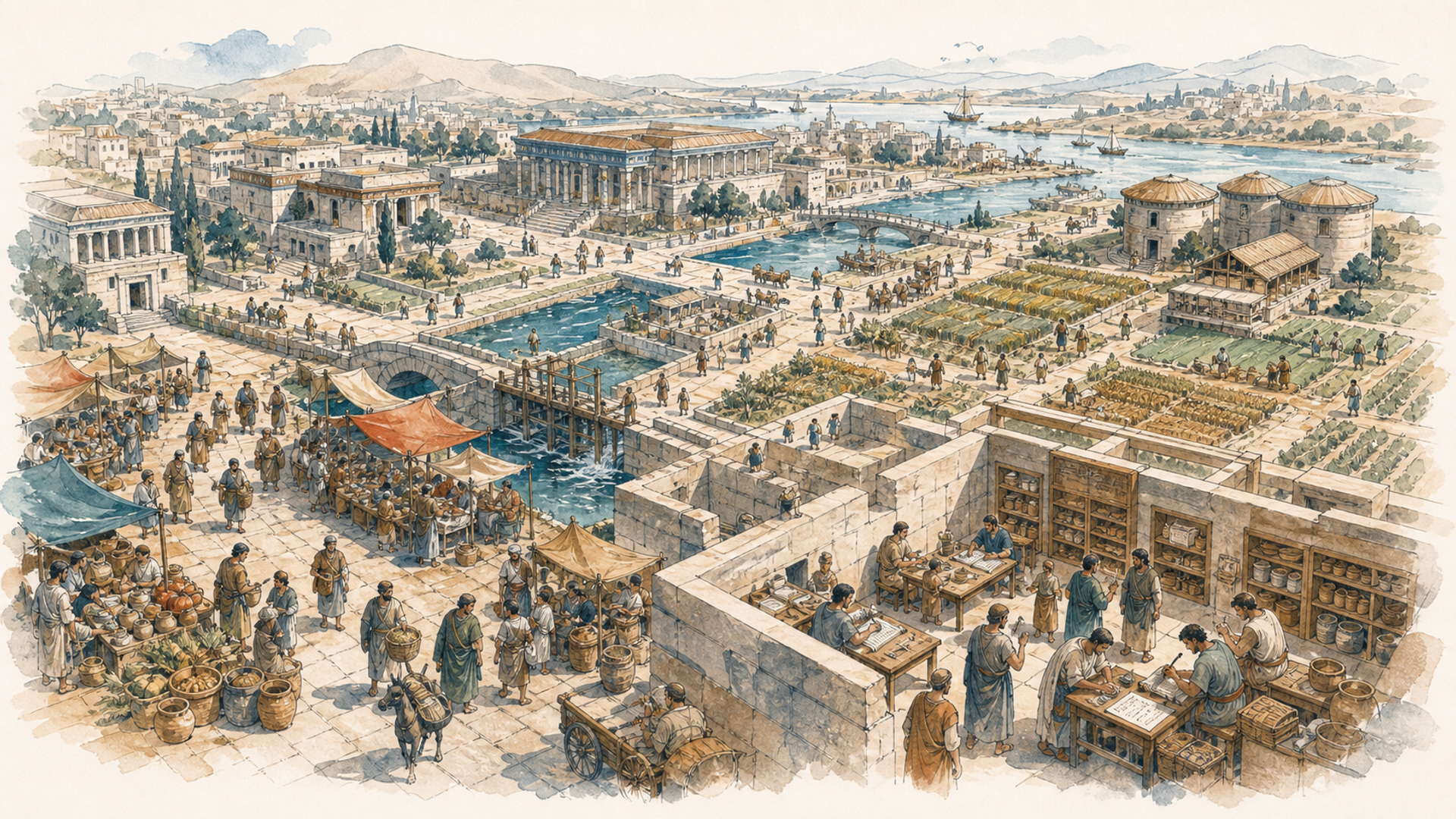
Step for a moment into Uruk, in Mesopotamia more than five thousand years ago. Do not expect a modern city: no traffic lights, street numbers or council offices with forms to complete. Yet much would feel unexpectedly familiar. Granaries are full, workers need organising, goods enter and leave, land must be managed, temples control resources and people receive rations.
The problem is already that of every large organisation: how do you remember it all? In a small village, personal memory may be enough. You know who lent you a goat, who owns the neighbouring field and who failed to return a tool. Once the community reaches thousands, memory stops being a reliable system. You must record, measure and count. One of history’s most important technologies appears in a form far less romantic than we might expect.
Before poetry came accounting
The earliest known proto-cuneiform tablets from Mesopotamia, dating to the end of the fourth millennium BCE, are largely economic records: barley, livestock, rations and labour. They are not novels. They are administration. It is almost comic that a technology later used to preserve epics, law and prayer developed in part because somebody wanted to avoid an argument over how many sacks had arrived.
The Metropolitan Museum holds tablets recording grain and ration distributions. These small lumps of clay reveal something enormous: information can leave a person’s head and become external, open to checking and available later. An administration can now accumulate memory.
Writing did not originate once and then spread everywhere in an identical form; writing systems arose independently in other places too. Mesopotamia nevertheless lets us see with unusual clarity the connection between urban growth, resource management and record-keeping.
We think of cities as places that produce civilisation—art, commerce and politics. First, however, a city consumes. Thousands must eat every day. They need water, fuel, construction materials and somewhere to live. No city survives cut off from the land that feeds it. This creates a political relationship between city and countryside. Grain grown beyond the walls must enter them; taxes and tribute may be collected in kind; rulers must protect roads, canals and warehouses. A city controlling a wider agricultural region must coordinate people who do not all live together.
Irrigation mattered in Mesopotamia, and maintaining canals and managing water required cooperation. We should avoid the famous shortcut claiming that great irrigation systems automatically created authoritarian government. Societies have organised water in different ways, and historians have long debated how strongly environments determine institutions. The careful conclusion is that the more complex a material system becomes, the greater its need for coordination.
Suppose you are a ruler collecting taxes. “Give me part of the harvest” is not enough. How large is the field? What did it produce? In what unit is grain measured? Who verifies the weight? If every market uses a different system, every transaction becomes harder. States in many eras have standardised weights, measures, currencies, calendars and even writing. When Qin Shi Huang unified much of China in the third century BCE, his regime promoted common weights, measures and administrative practices. Rome spread currency, law and administrative habits across an enormous territory. Modern states later did something comparable through school languages, the metric system, censuses and official time.
An apparently bureaucratic fact transforms politics: a state sees most clearly what it can count. Knowing a region’s population, fields and production lets a government tax, recruit and plan more precisely. Censuses and land registers would become instruments of power.
Laws become larger than people
Larger communities also generate more disputes. Who must repay a debt? What happens if property is damaged? What penalty follows an offence? Tradition and personal mediation may suffice in a village. In complex systems law tends to become more formal.
The eighteenth-century-BCE laws associated with Hammurabi are Mesopotamia’s most famous example. They should not be presented as the first laws in history; older Mesopotamian collections survive. Nor were they a complete modern code. They are still extraordinary evidence of a society in which power publicly stated ideas about justice, social rank, obligation and punishment.
An oral order can die with its speaker. A written rule can be copied, cited and transmitted. Writing does not make society fair—law can entrench profound inequality—but it makes power more impersonal. At least in principle, a rule exists before the particular case rather than everything depending on a village leader’s mood.
When picturing early states, it is easy to imagine kings, warriors and conquest. The official counting sacks of grain is less dramatic. Yet without people recording tribute, preserving documents, transmitting orders and administering stores, a large state will not last. Persian, Roman and Chinese empires developed very different administrations, but all faced the same problem: turning the centre’s political will into action at a distance. A ruler may claim a vast country; if no one collects tax in its farthest province or delivers orders there, the claim means little.
Here we begin to distinguish personal power from an institution. A system dependent on one charismatic ruler may collapse at death. Offices, procedures, archives and defined roles allow some power to outlive individuals. Early bureaucracies were not modern ministries. They were often entangled with temples, aristocratic households and religious authority. But the principle is visible: to govern many strangers, you build a machine that works when you are not in the room.
Bureaucracy solves problems and creates new ones. Who watches the watchers? How do you stop a distant official keeping the taxes? How do you know whether a governor is lying? How do you prevent administration consuming more than it produces? States create checks, inspectors, hierarchies and punishments. The Achaemenid Persian Empire divided territory into provinces ruled by satraps, while kings maintained other officials and mechanisms to limit governors’ autonomy. Delegated power must itself be supervised.
Those mechanisms never remove uncertainty. An inspector may conspire with the person being inspected; records may be complete and still false; a governor may obey the wording of an order while defeating its purpose. Administration therefore becomes a continuing contest over information. The centre tries to compare reports, rotate appointments and divide responsibilities. Local officials try to preserve discretion and protect the relationships on which they depend. A large state is not simply a pyramid through which commands move cleanly downwards. It is a negotiation conducted through offices, archives and people with interests of their own.
The result is a permanent contest between centre and periphery. The centre wants taxes, soldiers and obedience; local elites want autonomy and wealth. They cooperate when imperial power is strong. In crisis, they may rebel or break away. Many empires fell not only because an enemy invaded, but because their internal systems could no longer coordinate their parts.
The city invents the problem of the state
We can now trace the path. Farming enables surplus and concentrated population. Cities concentrate people and resources. Concentration demands memory, measurement, rules and administration. Those tools allow control of wider territories. Once that control becomes possible, a temptation appears that will accompany humanity for millennia: why stop here? Conquer the next valley and you gain fields, taxes, soldiers and a frontier farther from the centre. Then perhaps another valley, and another. You are no longer governing a city. You are building an empire.
When you administer thousands or millions, knowledge becomes power. How many fields exist? How many men can be recruited? How much tax should arrive? Where does the road run? Who owns a house? Censuses, land registers, weights and measures let government “see” territory. Rome conducted censuses and registrations for fiscal and civic purposes; Chinese states developed sophisticated administrative traditions; modern cartography and statistics later became central to state power.
Yet there is always a gap between the register and reality. Villagers hide crops, officials falsify figures, mapped roads become impassable. The state never sees perfectly. It constructs a simplified version of society that it can administer.
Why standardisation is a form of power
Imagine each city using its own unit of length, every market different weights and each region an incompatible calendar. People can live that way and did for centuries. But standards become valuable when taxes are collected across large areas, roads built to common specifications or provisions bought for armies. Shared currency, measurement and rules reduce the cost of cooperation.
This is why states standardise. Standardisation eases trade and administration, but can erode local customs. Even selecting the language of public documents can improve efficiency while privileging one cultural group. We will meet this tension again in modern nationalism: making a population easier to govern can help make it more alike.
Among the earliest Uruk tablets are records of barley, malt and rations. This can feel disappointing if you expected the first writers to compose grand poems about the universe. Yet it is magnificent. A technology developed to remember who owed how much grain later preserved myths, letters, mathematics and literature for people not yet born. Bureaucracy occasionally produces poetry by accident.
Hammurabi’s laws show a society structured by property, debt, trade, marriage and status-dependent punishment. They were not a modern constitution, nor should we assume each rule was automatically enforced by courts like ours. The monument was also royal propaganda: a ruler portrayed himself as guarantor of justice and order. Law is at once a practical technology and a story power tells—“Rules exist, and I guarantee them.”
A city must pay someone to do the invisible work
As a city grows, it sustains professions no isolated farmer would need: guards, judges, scribes, maintenance workers, builders and soldiers. All must eat. Taxes, tribute and compulsory labour are not only a ruler’s greed; they also finance collective goods and apparatuses of power. Of course, deciding what counts as a “collective good” is already political. A wall may defend everyone and glorify the king. A canal can irrigate fields and enrich particular landowners. An army can protect territory and suppress revolt. The state grows in this ambiguous space where organisation and coercion are difficult to separate.
There is a huge difference between a leader personally remembering a debt and an administration keeping records. In the second case, the obligation outlives individual memory. The official changes, the taxpayer dies, grain moves to another warehouse—and the system continues because a trace remains. At Uruk around the end of the fourth millennium BCE, surviving proto-cuneiform tablets deal largely with accounts and goods. We are not watching the birth of the novel, but of a technology that lets large organisations remember. Poetry will come; first, somebody must know the barley ration.
That continuity can protect people as well as constrain them. A written receipt may prove that tax has already been paid; a recorded judgement can stop a dispute being reopened whenever a powerful person wishes. The same archive can also preserve a debt for years or make a household permanently visible to the tax collector. Writing does not belong naturally to freedom or oppression. It multiplies what an organisation can remember, and therefore what it can promise, claim and enforce.
An archive also creates power by deciding what is visible. Measured land, registered harvests and classified people can be taxed and mobilised more systematically. Yet a census is never a perfect photograph. Administrative categories flatten a richer reality. Governing often means reducing the world to boxes an office can read.
Conquest makes noise; bureaucracy rarely does. An empire that wins battles but cannot collect revenue, distribute orders, maintain roads or pay soldiers will not remain powerful. Administrative capacity separates a successful raid from a durable state. Chinese administrative traditions and Roman censuses, fiscal systems, law and provincial government differed, but addressed a common challenge: turning millions of local lives into information and obligations a centre could manage.
This is why modern states permeate everyday life almost unnoticed. Birth certificates, addresses, property records, identity documents, budgets, statistics and postcodes look mundane. They descend from an ancient idea: to govern territory, you must first see it in a form administration can use.
When human memory is no longer enough
A small community can rely heavily on personal relationships. You know who owes you a goat, who promised harvest help and who may use a field because you know them or someone who does. A city changes the scale. When thousands trade, labour, pay tribute and depend on shared stores and canals, individual memory ceases to be reliable administration. You must record, measure and count.
This does not mean someone “invented writing for taxes” one morning. Systems of signs, tokens, seals and economic notation developed gradually, and writing later served countless purposes. The link with administration nevertheless tells us something essential: when society grows, information becomes infrastructure. A canal carries water; an archive carries memory through time. A ruler may die and an official be replaced. A tablet, register or document lets the system continue.
Hammurabi’s laws reveal how deeply law already touched property, family, labour, debt, violence and hierarchy. Penalties were not equal; social status mattered. A written rule is not automatically fair by modern standards. But writing changes it. A rule can be proclaimed as part of an order larger than one judge’s immediate decision. It can be copied, debated, used to legitimise the king and remembered after his death. Mesopotamia had not invented the modern rule of law, but we can see a powerful idea developing: authority governs not only with armed people, but through categories, procedures and texts.
Classification is among the state’s quietest weapons. To tax a field, you need to know it exists, how large it is and who works it. To recruit soldiers, you need to know who is eligible. To organise public works, you need people, materials and schedules. To distribute grain, you must count stores and recipients. Modern governments take this much further with censuses, maps, civil registers, statistics and identity documents. The principle is already present in the first cities: governing means making society legible.
Cities also require strangers to cooperate. If you buy grain from an unfamiliar merchant, how do you know their measure matches yours? Standard weights and measures look technical, but enable wider markets and consistent taxation. Coinage later reduced some costs of trust and eased payments, military wages and commerce, though it neither ended barter overnight nor arose once for one purpose.
Standards are what cities and states produce. A calendar fixes when; measurement fixes how much; writing fixes what was recorded; currency expresses value in a shared language. Each makes coordination easier and gives power to whoever sets it. Your modern life depends on numbers and documents others recognise: tax identifiers, bank accounts, addresses, passports, registered property and currencies. Uruk and today’s state look worlds apart, yet both must turn masses of human relationships into information orderly enough to administer.
The gain is easy to overlook because a successful standard disappears into routine. Builders can work from the same measure; traders can compare prices; officials can estimate stores; distant units can follow one calendar. The political cost is equally easy to miss. Local measures, languages and practices may be pushed aside, and the group defining the common standard gains an advantage. What looks like a neutral technical improvement can quietly rearrange whose knowledge counts.
Bureaucracy may feel dull precisely because it works
When we think about power, we picture kings, presidents and soldiers—not scribes. Yet one of history’s most important figures may be the anonymous official who can read a register. Empires conquer with armies; keeping territory requires knowing who pays, produces, owns and obeys. Bureaucracy need not meet modern standards of efficiency to matter. It only needs to perform regularly what once required personal negotiation every time.
Every administration also creates corruption, conflict and resistance. Recording a tax does not mean collecting it. Writing a law does not enforce it in every village. Distance, local elites and central capacity remain decisive. The tension between what the centre orders and what the periphery actually does follows us from cities into empires.
Once you have learnt to count people, harvests and debts, the next temptation is to use that machine over a larger territory. Governing one city is hard. Governing distant regions, different languages and different peoples is something else again.