Chapter 23 · Part 05
Who Writes the Rules After a Catastrophe?
The UN, Bretton Woods, the dollar and a new international order.
After 1945, a system of institutions, alliances and rules emerges that still structures much of the world order: the UN, Bretton Woods, the dollar, the Marshall Plan and NATO.
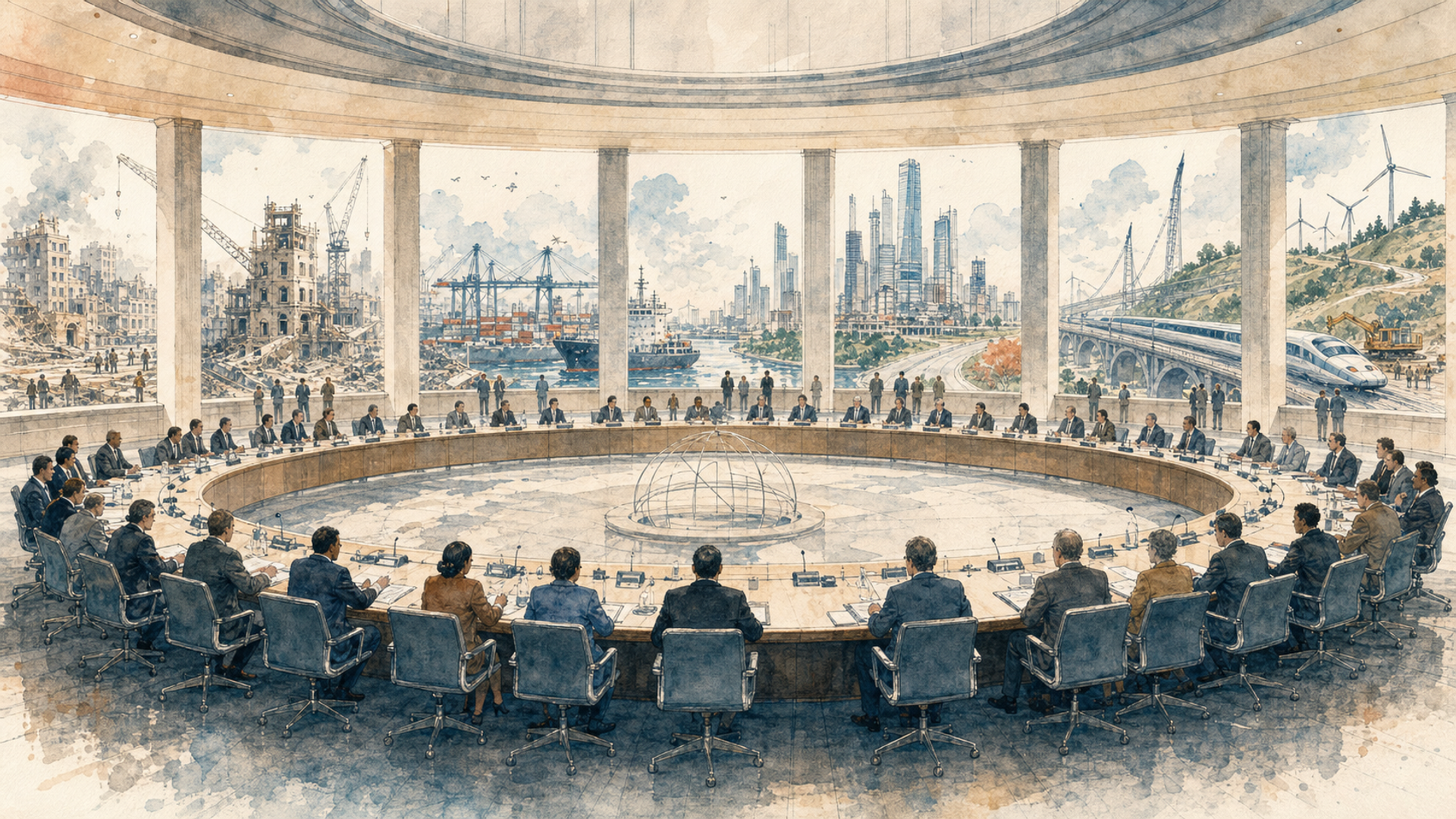
In July 1944, while fighting still raged in Europe and nobody knew exactly how the Pacific war would end, delegates from forty-four Allied countries gathered in a hotel among the mountains of New Hampshire in the United States. The place was called Bretton Woods. It is the sort of event that schoolbooks can make sound designed to put a student to sleep: monetary conference, delegates, exchange rates, financial institutions. In fact, they were wrestling with an enormous question: how do you build a world economy that will not slide back into the chaos of the 1930s? The participants were not idealists who had forgotten about power. The United States came to the table in an extraordinary economic position; Britain, although still a great power, was financially exhausted. The ideas of negotiators—including the British economist John Maynard Keynes and the American Harry Dexter White—mattered, but so did who possessed the money, industry and capacity to lend.
Bretton Woods created the International Monetary Fund and the institution that would become the core of the World Bank. The new monetary system linked many currencies to the dollar, while the dollar was convertible into gold at an official rate for monetary authorities. That mechanism would change decades later, but the central role of the American currency would survive. Here we begin to see a form of power that does not resemble an army: writing the rules within which everyone else does business.
A United Nations built around the reality of power
The United Nations formally came into being the following year. Its promise was ambitious: a system in which states could confront threats to peace collectively and cooperate on shared problems. Yet look at the structure of the Security Council and you immediately see a compromise between idealism and power. Five states—the United States, Soviet Union, China, United Kingdom and France—received permanent seats and vetoes. Why let a handful of countries block decisions? Because the architects had learnt something from the League of Nations: an international organisation that claims to govern security while ignoring the great powers risks becoming irrelevant. The veto is profoundly unequal, but reflects a brutal calculation: better to keep the leading powers inside an imperfect system than build a perfect one they can simply leave.
That tension has never disappeared. The UN is at once a place of international law, cooperation and diplomacy, and an arena in which states defend their interests. It is not a world government. It has no independent army able automatically to enforce its decisions. It works when states give it authority and resources, and stalls when the greatest powers clash over fundamental issues. Understanding this avoids two opposite errors: imagining the UN to be omnipotent, or declaring it useless whenever it fails to stop a war. It is an institution built within the system of states, not above it.
In 1947, twenty-three countries signed the General Agreement on Tariffs and Trade, or GATT. For decades it provided the principal framework for lowering tariffs and setting trade rules, until the World Trade Organization was created in 1995. Beneath the apparent technical detail lay a political conviction: protectionism and the economic fragmentation of the 1930s had formed part of an unstable world; more predictable trade could support growth and cooperation. That does not mean free trade makes war impossible. The year 1914 has already taught us that deeply connected societies can destroy one another. But interdependence changes incentives, creates economic groups with an interest in stability and raises the cost of rupture. In a system dominated by the United States, open trade also provided markets for American companies and consolidated an economic order favourable to the power underwriting much of its security. International rules are never completely separate from the distribution of power. They can offer mutual gains while reflecting who was strongest when they were written.
The Marshall Plan: reconstruction and strategy
In 1947, US Secretary of State George Marshall proposed a vast programme of aid for European reconstruction. From 1948, the Marshall Plan transferred resources to numerous western European countries. It is remembered as a symbol of post-war recovery, but its motives were multiple. The United States wanted Europe to recover because a prosperous region made a good market, a political partner and a more stable barrier against the growth of communist movements. European governments desperately needed imports, investment and foreign currency. Economic integration also began to look like a way of making another war between European powers far less likely.
The Soviet Union refused to participate and prevented eastern European countries under its influence from joining. What might, in theory, have become a broader programme thus became part of the widening separation between two blocs. This was a crucial moment. In 1945, Americans and Soviets were victorious allies against Hitler; within a few years, they were systemic rivals. Defeated Germany was divided into American, British, French and Soviet occupation zones. Berlin, although located inside the Soviet zone, was divided too. In theory, the four powers were to administer the country together; in practice, their visions of its political and economic future moved steadily further apart.
In 1948, the western authorities introduced a new currency in their zones. The Soviet Union responded by blocking land access to West Berlin. The city risked running out of supplies. The United States and Britain organised a gigantic airlift that carried food, coal and other goods for months. Imagine the logistics: a city of millions supplied from the sky, day and night, aircraft landing at extraordinarily tight intervals. It was geopolitics turned into an airport timetable. Nobody wanted a direct war, but nobody wanted to surrender Berlin. Technology and organisational capacity offered a third option between capitulation and military confrontation. In 1949, the division crystallised with the creation of the Federal Republic of Germany in the west and the German Democratic Republic in the east.
That same year, twelve countries founded NATO. The alliance’s political heart is Article 5 of the North Atlantic Treaty: an armed attack against one ally is considered an attack against them all, with each member then taking such action as it deems necessary. For western European states, this meant binding American military power permanently to European security; for Washington, it meant finally abandoning the idea of returning to the relative distance from European affairs that had characterised other periods of American history. The Soviet Union and its allies created the Warsaw Pact in 1955, formalising the eastern bloc’s military structure. An interesting detail is that NATO would outlive both the Soviet Union and the Warsaw Pact, and later expand eastwards. This became one of the most controversial issues in contemporary European security, and will return when we discuss Russia. For now, notice the structure being born: the order of 1945 does not abolish power politics. It organises them within new institutions and alliances.
Europe tries something radical: sharing sovereignty
Another experiment began almost quietly. France and Germany, enemies in three major wars between 1870 and 1945, were placed inside common economic structures. The European Coal and Steel Community was founded in 1951. Coal and steel were not selected for poetry: they were essential materials of industry and war. Placing strategic sectors under common institutions made future mobilisation against each other harder and, more importantly, entwined interests. Through many later stages, those first agreements would grow into the European Union. It is one of the most original examples in our story: states do not disappear, but choose to share parts of their sovereignty because they believe some things can be done better together.
At this point, we could describe the post-war era as an orderly march towards liberal institutions and cooperation. It would be comforting, and false. In 1945, hundreds of millions still lived under colonial rule. The international system spoke of self-determination while France, Britain, the Netherlands, Portugal and other powers held empires. The United States supported decolonisation in some cases and prioritised allies and strategic interests in others. The Soviet Union denounced Western colonialism while imposing very tight political control over eastern Europe. The new order was filled with contradictions from the beginning. The Cold War would develop inside them.
Washington and Moscow had different ideologies, economic systems and memories of security and, above all, nuclear weapons. The question dominating the next forty years was almost absurd: how do you compete with an adversary when total war between you might destroy both of you? The answer would be to compete almost everywhere, while desperately trying not to cross certain lines.
Nuremberg: even rulers can be tried
After the war, leading Nazi criminals were tried at Nuremberg before an international military tribunal. The trial did not resolve every legal issue and was criticised as ‘victors’ justice’, but it asserted a principle destined to become fundamental: certain acts—war crimes, crimes against humanity and aggressive war as then developed in law—could create individual responsibility even when committed by state officials. ‘I was following orders’ was not accepted as an absolute shield. State sovereignty should not be an unlimited licence. The Genocide Convention and Universal Declaration of Human Rights followed. Declaring a right does not automatically guarantee it, of course. But international language changed: the treatment of a state’s own citizens was no longer always and only an internal affair.
The Bretton Woods monetary system provided for relatively fixed exchange rates and a dollar tied to gold for monetary authorities. In 1971, President Richard Nixon suspended the dollar’s convertibility into gold, and in the following years the fixed-rate system largely dissolved. Yet the IMF and World Bank survived, as did the dollar’s central role. This is an excellent example of institutions changing function without disappearing. International rules are not immutable buildings: they are reinterpreted as power, economies and problems change. It also explains why post-war organisations face constant demands for reform. The Security Council’s composition reflects 1945; voting quotas in financial institutions have changed over time, but remain tied to economic balances and negotiation. An order may endure precisely because it adapts enough not to break.
Japan changes its strategy of power
Defeated Japan was occupied by the United States and adopted a new constitution. Article 9 renounces war as a sovereign right in the terms of the constitutional text, although Japan later developed Self-Defense Forces and an extremely close security relationship with Washington. The transformation was remarkable: within decades, a militarist imperial power became one of the world’s largest economies, integrated into the American-led trading order. West Germany underwent an equally profound transformation in Europe. These cases reveal a possibility geopolitical stories often neglect: a state can increase its weight enormously without expanding its territory, through industry, trade, technology and alliances.
Post-war American supremacy did not consist in turning western Europe and Japan into colonies. Washington built relationships in which sovereign allies accepted bases, rules and coordination because they received security, economic access and other benefits. Interests did not always coincide, and there would be severe crises, such as Suez in 1956 and disagreements over the Iraq War decades later. This form of hegemony is more robust when allies see the system as useful to them too. Power that produces voluntary cooperation tends to cost less than power that requires constant coercion. The lesson extends far beyond the United States: an international order endures more easily when enough participants believe they have something to lose from its collapse.
In 1945, fifty countries attended the San Francisco Conference that drafted and signed the United Nations Charter; Poland signed later and became one of the 51 original members. The organisation officially came into being on 24 October. Its most ambitious aim was to prevent the world repeating two world wars in one generation. Yet the founders faced the problem that had helped weaken the League of Nations: how could the great powers be persuaded to stay inside the system when they disagreed? The answer was a Security Council with five permanent veto-holding members: the United States, Soviet Union, China, Britain and France. It is easy to criticise the injustice of a system that grants some states special power, and debate over reform continues today. But the veto was not a lapse in democratic attention; it was the political price demanded by the great powers for participating. A world organisation that tried to compel them against their will risked simply being ignored.
The result is contradictory. The Charter proclaims the sovereign equality of states and limits the use of force, while the security order simultaneously recognises a hierarchy of power. The United Nations can be paralysed precisely when permanent members are involved in a crisis; at the same time, it supplies a diplomatic arena, norms, agencies and operations that no other institution fully replaces. International rules do not abolish power: they try to contain and channel it.
Bretton Woods: geopolitics enters your wallet
This shows that a currency can be geopolitical. If businesses and governments in many countries trade, borrow and hold reserves in one currency, the country issuing it gains particular advantages and responsibilities. It is not absolute power, but a form of invisible infrastructure. In 1947, US Secretary of State George Marshall proposed a vast programme of aid for European reconstruction. From 1948, the United States transferred resources to participating countries through the European Recovery Program. The aid supported recovery, but also had a clear strategic dimension: Washington feared economic instability, the strength of communist parties and expanding Soviet influence.
The new order was international, but not truly universal
In 1945, hundreds of millions still lived in colonial territories. Many countries we now regard as central actors were not yet independent or had not acquired their later weight. China was in the midst of civil war; India would become independent in 1947; much of Africa only in the 1950s and 1960s. The post-war institutions were therefore built in the name of universal order by a still deeply hierarchical world. With decolonisation, dozens of new states joined the United Nations and changed the balance of the General Assembly, demanding development, economic sovereignty and an end to colonialism. The international order was not designed once and for all: it has continually been challenged from within.
Yet many structures born in the 1940s remain with us. When you hear about the IMF, World Bank, UN, NATO, dollar or trade rules, you are hearing the echo of a question asked after the most destructive war in history: how do we build a system in which competition between states does not once again destroy everything connecting them?