Chapter 24 · Part 05
What Happens When the World Splits in Two?
The Cold War, nuclear weapons and proxy conflicts.
Nuclear deterrence prevents an all-out war between the United States and the Soviet Union, but pushes their competition into alliances, technology, space and regional conflicts from Korea to Afghanistan.
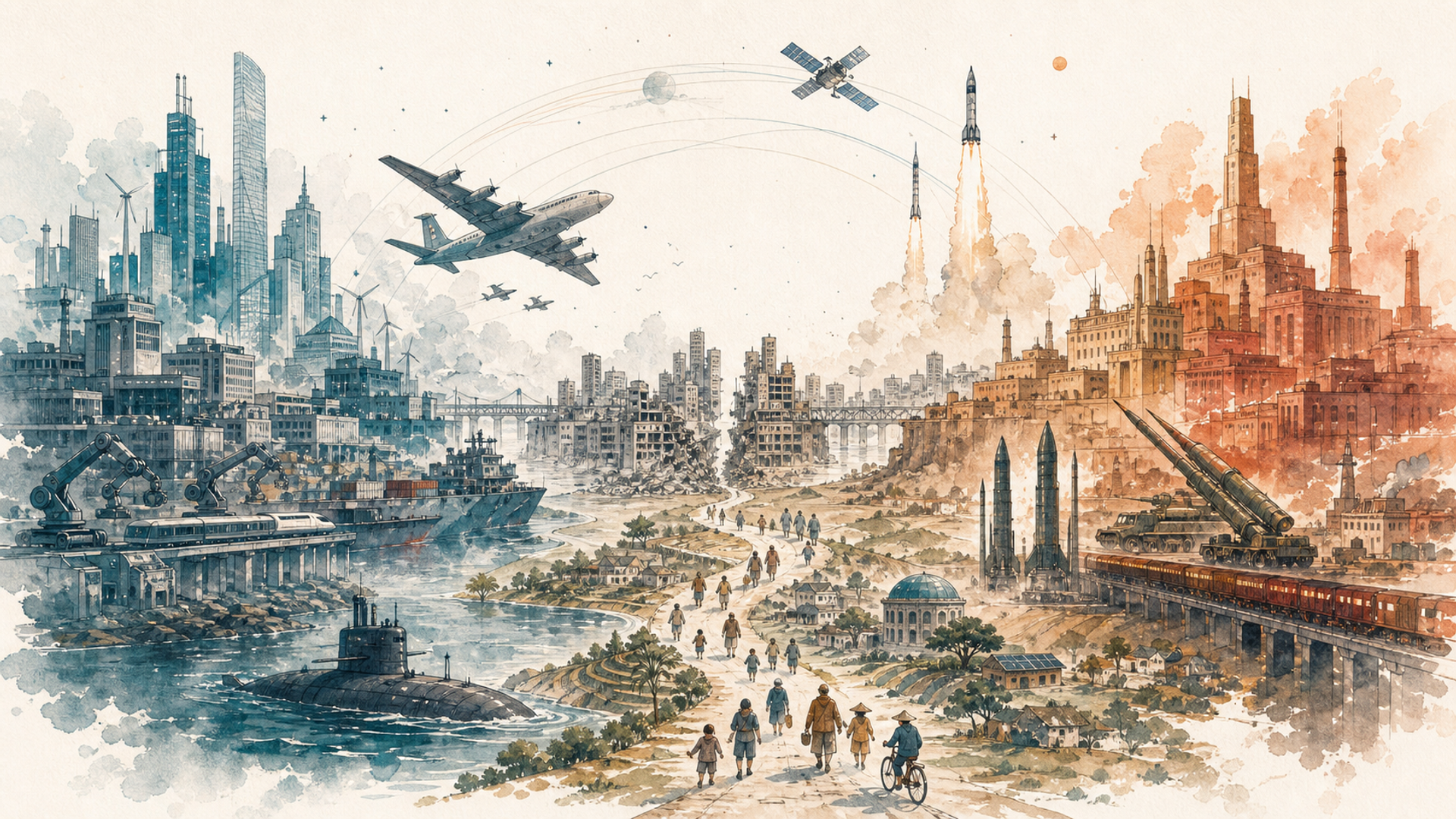
For thirteen days in October 1962, millions of people went about their lives without knowing how close the world had come to something that had never happened before: nuclear war between superpowers. American reconnaissance aircraft had photographed Soviet nuclear-missile sites in Cuba, barely 150 kilometres from Florida. President John F. Kennedy announced a naval “quarantine” of the island. Soviet ships approached the exclusion zone. Nuclear forces went on alert. A mistake, a nervous commander or a misunderstood message could have produced consequences beyond calculation.
The Cuban Missile Crisis ended in an agreement. The Soviet Union withdrew its missiles from Cuba. The United States publicly promised not to invade the island and, in a separate confidential understanding rather than a public bargain, later removed its Jupiter missiles from Turkey. Yet one of the most unsettling facts became fully clear only afterwards: weapons and decisions on the ground were not under perfect central control. Even inside a system designed around deterrence, fallible human beings remained part of the machinery.
The Cold War is often shown on a simple map: blue on one side, red on the other. That is useful for orientation and dreadful as a complete explanation. The world was never divided neatly in two. China and the Soviet Union, both communist, became bitter rivals. India, Yugoslavia, Egypt and many other states sought room to make their own choices. Local wars had causes of their own even when superpowers supplied money and weapons. Nevertheless, the rivalry between the United States and the Soviet Union grew powerful enough to enter almost every region of the world.
The weapon you do not want to use
Before nuclear weapons, a great power could imagine a war that was catastrophic yet winnable. Once rival arsenals could destroy cities—and eventually strike back even after absorbing a first attack—the calculation changed. Deterrence does not require you to defeat an enemy in war. It requires you to persuade that enemy that beginning a war would impose an intolerable cost.
It is a deeply peculiar logic. To preserve peace, you build weapons you hope never to use, disperse them so that some will survive an attack, and convince your opponent that you would use them if necessary. If you announce that you could never press the button, the threat loses credibility. If you appear too eager to press it, the chance of disaster rises. Stability becomes psychological as well as technological.
Nuclear submarines, strategic bombers and ballistic missiles formed a system intended to preserve a retaliatory capability. The oceans, the Arctic and eventually outer space acquired new geopolitical meanings as routes, bases and environments of deterrence.
The phrase mutually assured destruction describes an important condition and logic of the nuclear age, but it was never a mathematical guarantee of peace. Technical failures, false warnings, accidents and human decisions could still drive escalation. Cuba demonstrated the danger dramatically. It also encouraged Washington and Moscow to establish better communications and pursue forms of arms control. Deterrence did not remove risk. It tried to manage it.
If Cuba reveals the nuclear danger, Berlin reveals the Cold War’s geographic absurdity. West Berlin was a Western-controlled enclave surrounded by East Germany. For years, many East Germans used the city as an escape route to the West. In 1961 the East German government, backed by the Soviet Union, built the Berlin Wall. The structure was concrete, propaganda and political confession at once. It divided streets, neighbourhoods and families, while revealing that one of the Eastern bloc’s central problems was stopping people from leaving.
For the West, the wall became the great symbol of communist repression. Eastern governments presented it as protection against Western threats. For almost thirty years, one of the world’s most important frontiers ran through houses, roads and underground railway lines. Could political geography have looked more artificial? Yet guards, checkpoints, mines, alliances and nuclear arsenals made that artificial line painfully real.
Berlin had already demonstrated the stakes in 1948–49, when the Soviet Union blocked Western land access to the western sectors of the city and the Western Allies responded with an enormous airlift. A city divided inside a divided Germany had become the focal point of a divided Europe. In the Cold War, an argument about political systems could turn into aircraft landing every few minutes with coal, food and medicine.
The wars the superpowers preferred not to call their own
If the United States and Soviet Union avoided fighting one another directly, their competition moved elsewhere. After Korea was divided at the end of the Second World War, North Korea invaded the South in 1950. The US-led United Nations Command intervened for South Korea; China entered the war in force for the North. The Soviet Union supplied North Korea with weapons and advisers and covertly committed pilots, while avoiding an acknowledged direct war with the United States. The 1953 armistice left the peninsula divided. No final peace treaty followed.
In Vietnam, decolonisation, civil conflict and international rivalry became entangled. Calling it simply “America against communism” would erase Vietnamese nationalism, French colonial rule and the country’s internal political struggle. Calling it only a local civil war would ignore Soviet and Chinese aid to the North and the immense American military commitment to the South. The war ended with a northern victory in 1975; formal reunification as the Socialist Republic of Vietnam followed in 1976. It can be understood only at both scales: Vietnamese and global.
During the 1980s, the Soviet Union fought in Afghanistan to sustain a communist government, while mujahideen groups received support from the United States, Pakistan, Saudi Arabia and others. Once again, local actors did not become simple chess pieces merely because outside powers armed them. They had their own ambitions and used foreign sponsors even as those sponsors tried to use them.
This is why the term proxy war must be handled carefully. It can describe the way external powers support opposing sides without fighting each other directly. It can also make the people doing the fighting disappear from the story. A civil war does not lose its local causes when foreigners provide weapons; an international rivalry does not become irrelevant because the fighters have reasons of their own. Both layers operate at once.
For millions of people, therefore, the Cold War was never cold. Nuclear stability between the superpowers coexisted with devastating violence in Korea, Vietnam, Afghanistan, Angola and elsewhere. The name works if you stare only at the direct relationship between Washington and Moscow. It works far less well if you look at the rest of the planet.
In 1955, delegates from twenty-nine Asian and African governments met at Bandung in Indonesia to discuss cooperation, colonialism and autonomy in a world dominated by the superpowers. The Non-Aligned Movement was formally established at its first summit in Belgrade in 1961. “Non-aligned” did not mean neutral on every issue, nor exactly midway between Washington and Moscow. It meant claiming room to decide.
India, Yugoslavia, Egypt and the movement’s other members had very different political systems and interests. What they shared was a refusal to be placed automatically inside either bloc. This part of the Cold War is easily missed in European accounts. Just as the United States and Soviet Union seemed to dominate world politics, dozens of countries were emerging from colonial rule and insisting that they were political actors, not merely territory on which others competed.
The apparently solid communist bloc also fractured. Mao Zedong proclaimed the People’s Republic of China in 1949 after victory in the Chinese Civil War, while the government of the Republic of China withdrew to Taiwan. At first glance, the Soviet Union and China appeared to form a colossal united camp. Their relationship deteriorated, however, through disputes over ideology, national interest, borders and leadership of the communist world. By 1969 their forces were exchanging fire along the frontier.
In 1972 President Richard Nixon visited Beijing, exploiting the Sino-Soviet split to alter the strategic balance. If your mental model of the Cold War is simply “capitalists versus communists”, this episode breaks it. States sharing an ideology can become enemies; ideological opponents can cooperate against a common rival. Geopolitics has a habit of ruining beautifully tidy categories.
The space race was a contest over who could organise the future
In 1957 the Soviet Union launched Sputnik, the first artificial satellite. The psychological impact in the United States was enormous. If Moscow could put an object into orbit, it could also build missiles capable of crossing continents. The space race became a scientific, military, technological and propaganda contest.
When the United States landed astronauts on the Moon in 1969, it was not conquering useful territory in the traditional sense. It was demonstrating capacity: rockets, computers, advanced materials, industrial organisation, research and the coordination of hundreds of thousands of people. Power was being displayed through technology.
Space systems would soon become everyday infrastructure. Communications, weather forecasting, satellite navigation and observation of the Earth now depend on them. Space, which once seemed the least geographic place imaginable, entered the geography of power.
Coups become part of the global contest
The Cold War was fought not only with armies and open wars, but with finance, propaganda, intelligence operations and support for coups. In Iran in 1953, American and British intelligence services took part in the operation that helped overthrow Prime Minister Mohammad Mossadegh during a struggle involving the nationalisation of oil, the monarchy and competing Iranian political forces. In Guatemala in 1954, the CIA backed the operation against President Jacobo Árbenz.
In Chile, the 1973 coup led by General Augusto Pinochet took place after the United States had worked to destabilise Salvador Allende’s government and supported opposition forces. The available evidence does not establish that Washington directly organised Pinochet’s September coup itself. That does not turn Chilean institutions, conflicts and military officers into American puppets; it does mean the country’s internal crisis cannot be separated from external intervention. On the other side, the Soviet Union crushed political challenges in Hungary in 1956 and Czechoslovakia in 1968, and supported allied parties and governments elsewhere.
Cuba itself was no empty square. Fidel Castro had a revolution to defend and feared another attack after the failed US-backed Bay of Pigs invasion in 1961. Soviet missiles on the island therefore concerned Cuban security as well as the superpower balance. During the crisis, local commanders and Soviet submarines faced situations in which tactical decisions might have produced enormous strategic consequences. The episode is remembered as a chess match between Kennedy and Nikita Khrushchev, but there were many more hands near the board.
Even enemies need rules
In the 1970s the United States and Soviet Union entered a period of détente. Agreements including SALT placed limits on parts of the arms competition. The two systems had not reconciled. Both recognised that limitless rivalry was expensive and dangerous.
This gives us a useful geopolitical rule: negotiating with an adversary does not mean trusting them. It may mean that precisely because you do not trust one another, you need rules, verification and reliable channels of communication. The logic returns in nuclear treaties and in any system where rival powers can do catastrophic damage to each other.
The division rested on both ideology and security. The United States led a capitalist bloc whose core members were politically pluralist, while also supporting authoritarian governments when Washington considered them strategically useful. The Soviet Union led a one-party communist system and sought to preserve a belt of allied states in eastern Europe, including through force. Each presented its own policy as defensive and the other’s as expansionist. Berlin was the perfect symbol: a divided city inside a divided Germany, at the heart of a divided Europe.
The Soviet Union was not conquered by a Western army. During the 1980s it faced economic stagnation, heavy military costs and a political system increasingly difficult to reform. Mikhail Gorbachev attempted transformation through perestroika and glasnost, while reducing pressure in foreign policy. His reforms opened processes the centre could no longer control. Communist governments across Eastern Europe fell in 1989, as did the Berlin Wall. The Soviet system then dissolved through a combination of economic stagnation, political crisis, national movements within the union, reform, loss of control over satellite states and decisions taken by the republican elites. In 1991 the Soviet Union formally ceased to exist and its fifteen constituent republics became independent states. A great power had lost its system without losing a conventional war.
For a moment, the planet’s defining division appeared to have ended. Yet maps do not simply return to an earlier condition. The countries of Central and Eastern Europe faced new security choices. Russia had lost territory, population, bases and strategic depth compared with the Soviet Union. The United States stood without an equivalent global rival. China was already transforming its economy. Nuclear arsenals, military alliances and memories built during four decades of rivalry remained.
Nuclear weapons change the meaning of victory
In 1945, the United States was the only nuclear power; the Soviet Union tested its first atomic bomb in 1949. The arms race then produced thermonuclear warheads, strategic bombers, intercontinental ballistic missiles and nuclear submarines. Eventually, both sides possessed a credible ability to inflict catastrophic destruction even after absorbing a first strike. That second-strike capability underpinned deterrence. If attacking meant risking the destruction of your own country, total war became far less rational. Mutually assured destruction describes an important phase and logic of deterrence, but not a mathematical formula guaranteeing peace. False information, technical errors, accidents and human choices could still produce escalation.
The Cuban Missile Crisis showed how close the world could come to disaster. For thirteen days, political leaders, military officers and diplomats operated under extraordinary pressure. The settlement removed the Soviet missiles from Cuba and included a US pledge not to invade the island; through a separate confidential understanding, the American Jupiter missiles in Turkey were subsequently withdrawn. The crisis convinced both superpowers that they needed more reliable communication and forms of arms control. Deterrence did not remove danger. It made managing danger a permanent task.
Korea demonstrated how the nuclear shadow displaced rather than ended war. After North Korea invaded South Korea in 1950, the US-led United Nations Command fought for the South and China entered in support of the North, while Soviet support included equipment, advisers and covert air operations. The fighting ended in 1953 with an armistice, not a peace treaty, leaving the peninsula divided.
Vietnam again demands both a local and a global scale. An anticolonial struggle against France became entangled with civil conflict and competition between communism and anti-communism. The United States steadily deepened its military commitment to South Vietnam; North Vietnam received Soviet and Chinese support. Northern forces won in 1975, and formal reunification followed in 1976. To reduce this to ‘the United States against the Soviet Union’ erases Vietnamese nationalism. To present it only as a local civil war erases the international system that fuelled it.
The world was never truly divided into only two
When the Soviet Union collapsed in 1991, the defining division of the Cold War seemed to be over and a world dominated by one superpower appeared to have arrived. But its institutions, frontiers, arsenals, alliances and political memories did not vanish. Many contemporary crises still unfold inside structures created during those four decades.
Most importantly, while the Cold War unfolded, dozens of colonies became independent states. The next map was not merely redrawn by Washington and Moscow. It was also created by anticolonial movements, negotiations, wars and the difficult work of turning inherited territories into countries. Many lines that now look ancient are less than a century old.