Chapter 15 · Part 04
When Knowing You Do Not Know Becomes an Advantage
Science, measurement and more capable states.
The Scientific Revolution enters our story because better measurement, prediction and testing create new capacities to navigate, build, govern and fight.
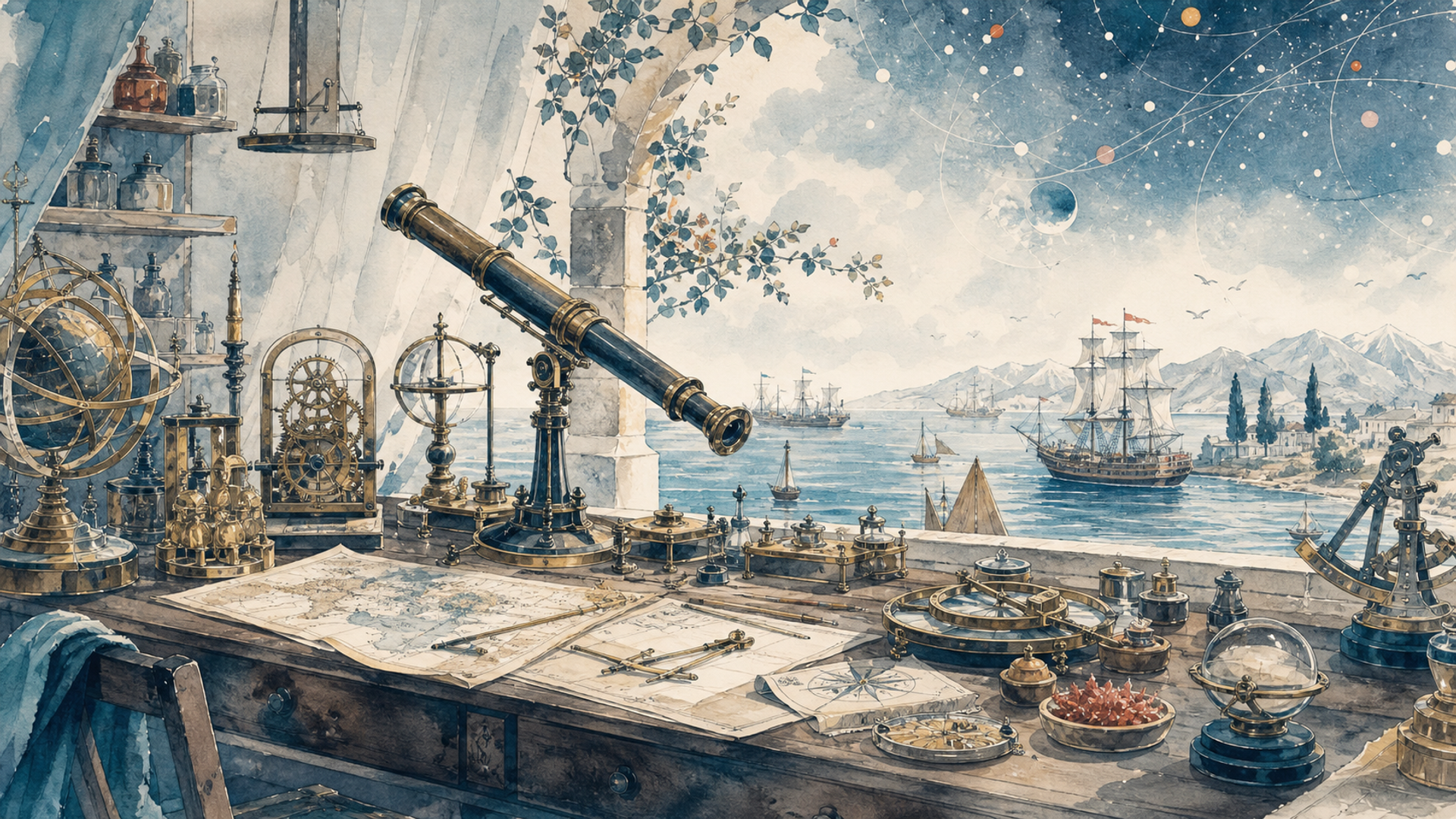
There comes a moment in the history of ideas when admitting that you do not know stops being a weakness and becomes a method. It did not happen in a day, in one country, or through one genius. Yet in sixteenth- and seventeenth-century Europe a transformation took shape that changed the relationship between knowledge and power: observe, measure, propose a hypothesis, compare it with evidence, use mathematics to describe phenomena previously entrusted above all to the authority of texts. The story is often reduced to a procession of famous names—Copernicus, Galileo, Newton—as though each switched on a light in history’s dark room. In reality, light entered through many windows. Greek, Islamic, Indian and other astronomical traditions had been translated, challenged and developed for centuries. Instruments, craft techniques, universities, print and political rivalry in Europe created an environment in which new ideas could circulate ever faster.
Our purpose is not a survey course in the history of science. It is to understand why knowing your position, the time, the path of a projectile or the movement of a planet more accurately also changes what a state can do.
When Earth loses the centre
In 1543, Nicolaus Copernicus published De revolutionibus orbium coelestium, proposing a heliocentric model in which Earth moves around the Sun. He was not the first person ever to imagine such a thing, and his model did not instantly solve every astronomical problem. It did, however, make a powerful break with the Ptolemaic system dominant in Europe. A few decades later, Tycho Brahe produced exceptionally accurate astronomical observations. Johannes Kepler used them to formulate laws of planetary motion based on elliptical orbits. Galileo pointed a telescope at the heavens and saw, among other things, moons circling Jupiter and the phases of Venus—observations incompatible with simple versions of the old geocentric universe.
At the end of the seventeenth century, Isaac Newton connected the movement of objects on Earth with that of celestial bodies through common mathematical laws. The same physics could describe a falling apple and the orbiting Moon. Its cultural impact is difficult to exaggerate: nature appeared to obey regularities that human beings could discover, measure and express mathematically.
Scientific instruments change the quality of the questions we can ask. Telescopes extend sight; microscopes reveal invisible worlds; more accurate clocks permit finer measurement of time; nautical instruments make navigation more reliable. An instrument does not produce knowledge automatically. You need to calibrate it, compare observations and persuade others that what you saw was not an error. New scientific communities, academies and publishing practices developed around these needs. The Royal Society in London, founded in the seventeenth century, is one example. The expectation that results and methods should be communicated and checked by others slowly helped construct modern science. This was an institutional revolution as much as an intellectual one. Knowledge became more cumulative because it could be recorded, debated and replicated.
Movable-type printing, developed in fifteenth-century Europe by Gutenberg and other innovators within a much longer Asian history of print, dramatically reduced the cost of reproducing texts. Copying a book had required immense time and labour. In print, an idea could travel in hundreds or thousands of relatively identical copies. This did not make ideas true: mistakes, propaganda and superstition could travel faster too. But it created a much larger arena for comparison. Information technologies repeatedly produce this double effect. Print spreads science and fanaticism; the telegraph will spread news and propaganda; the Internet spreads knowledge and disinformation. Increasing the speed of information does not automatically improve its quality.
Cartography: turning the world into something that can be administered
For a navigator, a good chart may save a ship. For a state, it can mean much more. Measuring coasts, rivers, roads and borders allows better administration and taxation. Maps gradually became instruments of government. Early modern monarchies and empires funded surveys, scientific expeditions and cartography. Science and power did not always share the same aims, but often helped one another. An astronomer may want to know Earth’s shape; a navy wants to know where it can sail. A geographer wants to describe a coast; an empire wants to know where to build a port. Geographic knowledge became strategic. Nautical charts were sometimes guarded as sensitive information, because giving a rival a route meant giving access to a market.
The Scientific Revolution also intertwined with war. Gunpowder artillery already existed, but advances in metallurgy, ballistics and engineering made cannon and fortification more sophisticated. European fortresses changed shape in response. High, thin walls effective against ladders and medieval assaults were vulnerable to guns. Low, thick forts appeared, with angled bastions allowing crossfire. Geometry entered the military landscape literally. This does not mean that ‘science caused European conquest’. That would be an enormous simplification. But states able to combine knowledge, metallurgy, artillery, finance and organisation acquired new tools.
The method was not born fully formed
We should avoid imagining one date on which Europeans ‘invented the scientific method’. Francis Bacon promoted observation and induction; René Descartes emphasised reason and method; Galileo combined experiment, mathematics and observation; Newton inhabited a world in which alchemy and theology coexisted with physics. Modern science emerged gradually from different practices. Even great scientists believed things we now consider wrong. The point is not that they suddenly became rational while everyone else remained superstitious. It is that institutions and procedures able to correct error grew stronger over time. That is the revolutionary part: a culture of knowledge that can improve even when individuals are wrong.
In the eighteenth and nineteenth centuries, science and technology became ever more entangled with industry and the state. The relationship was not linear: many inventions of the first Industrial Revolution came from craftspeople and experimenters rather than advanced scientific theories. Over the longer term, however, producing technical knowledge became a source of national power. States funded observatories, academies, universities, expeditions and later laboratories. Industries employed chemists and engineers. Discoveries generated new economic sectors. Nineteenth-century German chemistry became an industrial power; twentieth-century physics and engineering produced radar, nuclear power, electronics and spaceflight. The distance between ‘pure science’ and geopolitics narrowed.
Many important discoveries began without a political goal. Faraday studied electricity and magnetism without imagining a global grid. Maxwell formulated equations of electromagnetism without knowing radio, radar or Wi-Fi. Consequences arrived later, when others converted understanding into technology. Science therefore produces geopolitical surprises. A country can invest in knowledge without knowing which industry will result. Societies with universities, laboratories, capital and enough freedom to experiment may accumulate advantages that become visible decades later. Yet science alone is not enough in our story. Turning knowledge into power requires energy. At the end of the eighteenth century, one part of Europe found a way to release, on an immense scale, energy stored in coal for millions of years.
Science did not spring from nowhere in Europe
The European Scientific Revolution rested on knowledge accumulated and transmitted across many cultures. Greek texts were preserved, translated and discussed in the Islamic world; Indian mathematicians developed fundamental ideas that reached Europe through networks of exchange; Persian and Arab astronomers produced observations, tables and instruments; paper came from East Asia; European movable-type print belonged to a broader history of Asian printing. None of this diminishes Copernicus, Galileo, Kepler or Newton. It makes them more interesting: knowledge grows by crossing languages and generations. Intellectual revolutions are networks too.
When Galileo turned his telescope towards the sky in the early seventeenth century, he saw phenomena that placed traditional cosmology under pressure: mountains on the Moon, satellites around Jupiter, phases of Venus. The telescope did not ‘prove the entire Copernican system’ on its own, but made the heavens much less compatible with perfect, immutable spheres. The geopolitical detail is that better instruments produce better knowledge. Microscopes, telescopes, clocks, navigational and measuring instruments become part of a society’s and a state’s ability to see what was once invisible. When empires later mapped coasts and territories, they often brought astronomers, botanists, geologists and cartographers. Science and power are not the same, but can sustain one another.
Seventeenth-century institutions including the Royal Society in England and Académie des Sciences in France did more than gather clever people. They created communities that shared observations, debated experiments and built reputation through verifiable results. A lone genius can make a discovery. An institution can produce discoveries for generations. It is the same transition we met in politics: once a capacity no longer depends on one person and is embedded in a system, it becomes more durable.
Measuring territory means governing it better
Accurate cartography, geodesy and statistics help states understand population and resources. In the eighteenth and nineteenth centuries, great surveys converted territory into data: elevation, coasts, roads, borders and property. The Great Trigonometrical Survey of British India, begun in the nineteenth century, was among the most ambitious. It required decades and produced geographical knowledge of immense scientific and administrative value. But it took place in a colonial context. Knowing where mountains and villages lie also helps collect taxes, move armies and govern. Knowledge is not necessarily oppressive, but whoever possesses better information often has more options. Here human productive capacity changes by an order of magnitude—and the world’s balance changes with it.
It is easy to caricature scientific history as a contest between an ‘ignorant Middle Ages’ and ‘rational modernity’. Medieval European universities preserved, debated and developed philosophical traditions; scholars in the Islamic world translated, challenged and expanded Greek, Persian and Indian knowledge; mathematicians and astronomers in India, China and elsewhere produced foundational results. The European Scientific Revolution of the sixteenth and seventeenth centuries was a real transformation, but grew inside a far longer history of exchange and institutions. What changed was the increasingly powerful combination of mathematics, observation, instruments, experiment, publication and communities that tried to test one another’s claims. Copernicus proposed his heliocentric model in 1543; Kepler used Tycho Brahe’s observations to formulate mathematical laws of orbits; Galileo’s telescope placed aspects of traditional cosmology under strain; Newton showed in 1687 how the same laws of motion and gravitation could describe earthly and celestial phenomena.
None ‘invented the scientific method’ alone. Bacon argued for empirical inquiry; Descartes pursued a different rationalist programme; craftspeople and instrument makers built telescopes, pumps and clocks without which many observations were impossible. Modern science emerged from a community, not one flash of enlightenment.
The laboratory needs a social network
The Royal Society was founded in London in 1660 and received a royal charter soon afterwards. Members observed, experimented, debated and, above all, communicated. In 1665 it began publishing the Philosophical Transactions, one of the world’s oldest scientific journals. This is less famous than Newton’s apple, but perhaps more important. A discovery becomes vastly more powerful when others can read, challenge, reproduce and build on it. Scientific reputation gradually changes: it is not enough to say ‘I saw it’; you must explain how, with which instruments and under what conditions.
Reality remained messier than the ideal. Rivalry, error and social authority mattered; Newton and Hooke quarrelled bitterly; many people, especially women and craft workers, contributed without equal recognition. Yet the growing demand to make methods public made knowledge more cumulative.
That is what matters geopolitically. A society able to turn individual observations into shared knowledge can improve maps, weapons, navigation, agriculture and medicine faster. Not because every scientist serves the state, but because networks of knowledge produce tools that governments and businesses can adopt. Navigation makes the connection obvious. Establishing latitude, predicting astronomical positions, building chronometers and making accurate charts were scientific problems with commercial and military consequences. A small error at sea could mean shipwreck; a better chart reduced risk and made a route repeatable. States funded observatories, expeditions and prizes not only for an abstract love of truth, but because knowledge had economic and strategic value.
Modern cartography makes the same point. A map is not merely a representation; it enables administration. Measuring borders, coasts, depths, fields and roads makes territory more legible to government. Censuses and statistics would eventually do the same with population. Science became entangled with the state capacity we met in the first cities: count, classify, predict. The relationship had a dark side. Better geographic and medical knowledge facilitated colonial expansion; anthropology and pseudoscientific classifications were later used to justify racial hierarchies. Science does not automatically produce better moral choices. It produces the capacity to know and intervene, which can serve very different ends.
The title speaks of ‘knowing that you do not know’, but it should not become a slogan. Human beings have always known they lacked answers. The deeper change was to construct institutions in which a claim could be tested and, at least in principle, abandoned when evidence contradicted it. A better explanation must be able to replace an older one, however prestigious. The ideal is imperfect and constantly violated by ego, politics and inertia. When it works, it enables cumulative acceleration. Newton did not begin from nothing; centuries later, Einstein did not destroy Newton, but showed the limits within which Newtonian mechanics remains an extraordinarily effective approximation. Knowledge grows because it can be preserved and corrected.
In the next chapter, that capacity to accumulate knowledge meets coal, machinery, capital and markets. The result is not simply ‘more technology’, but a change in the quantity of energy a society can mobilise—and therefore the amount of production, transport and violence a state can sustain.
Science becomes powerful when it becomes a community
The Scientific Revolution is easily presented as a gallery of solitary geniuses: Copernicus moves Earth from the centre, Galileo points a telescope towards the sky, Newton discovers the laws of motion. The individuals matter, but the deeper transformation was the birth of institutions and practices that allowed knowledge to outlive them. An experiment described precisely enough can be repeated; a published observation can be challenged; a mathematical prediction can be compared with reality. Authority does not disappear, but becomes, in principle, contestable with better evidence.
The Royal Society’s motto, Nullius in verba, is often rendered ‘take nobody’s word for it’. It did not mean that all testimony was useless, but expressed the ambition not to accept a claim solely because a prestigious authority made it. Its Philosophical Transactions turned science into an organised conversation of letters, experiments, observations and disputes crossing borders. The network was never perfectly open or neutral. Universities and learned societies reflected social, religious and gender hierarchies; many contributors remained outside official institutions. European science absorbed knowledge from Arab, Persian, Indian, Chinese and many other traditions, often without adequately acknowledging those debts. To speak of a ‘European Scientific Revolution’ is not to claim that Europe invented mathematics, astronomy or medicine from nothing. It means that a particular mixture of institutions, print, instruments, mathematical approaches and political competition consolidated in some early modern European states and accelerated certain kinds of research.
States quickly found this useful. Better maps assisted taxation and administration; astronomy and chronometers aided navigation; statistics and censuses made populations more legible; chemistry and metallurgy improved industry and weaponry. The relationship ran both ways. Governments and navies funded observatories, expeditions and research in search of advantage; scientists used that funding to investigate questions that produced unforeseen results. Modern knowledge often grows in this ambiguous space between curiosity and utility.
The great innovation, then, is not admitting ignorance in a general sense—every civilisation has faced unanswered questions—but building procedures that turn ignorance into a programme of work. Measure. Compare. Publish. Let somebody else try to prove you wrong. When it works, such a system accumulates corrections faster than a tradition in which an authority’s error becomes untouchable. It is precisely this cumulative capacity that, joined to capital, energy and institutions, will power the industrial transformation of the next chapter.