Chapter 14 · Part 03
How Can a Small Country Build an Enormous Empire?
Sea power, trading companies and control of strategic nodes.
Portugal, the Netherlands and Britain show how power can spread through ports, fleets, credit, insurance and routes without directly controlling every kilometre of territory.
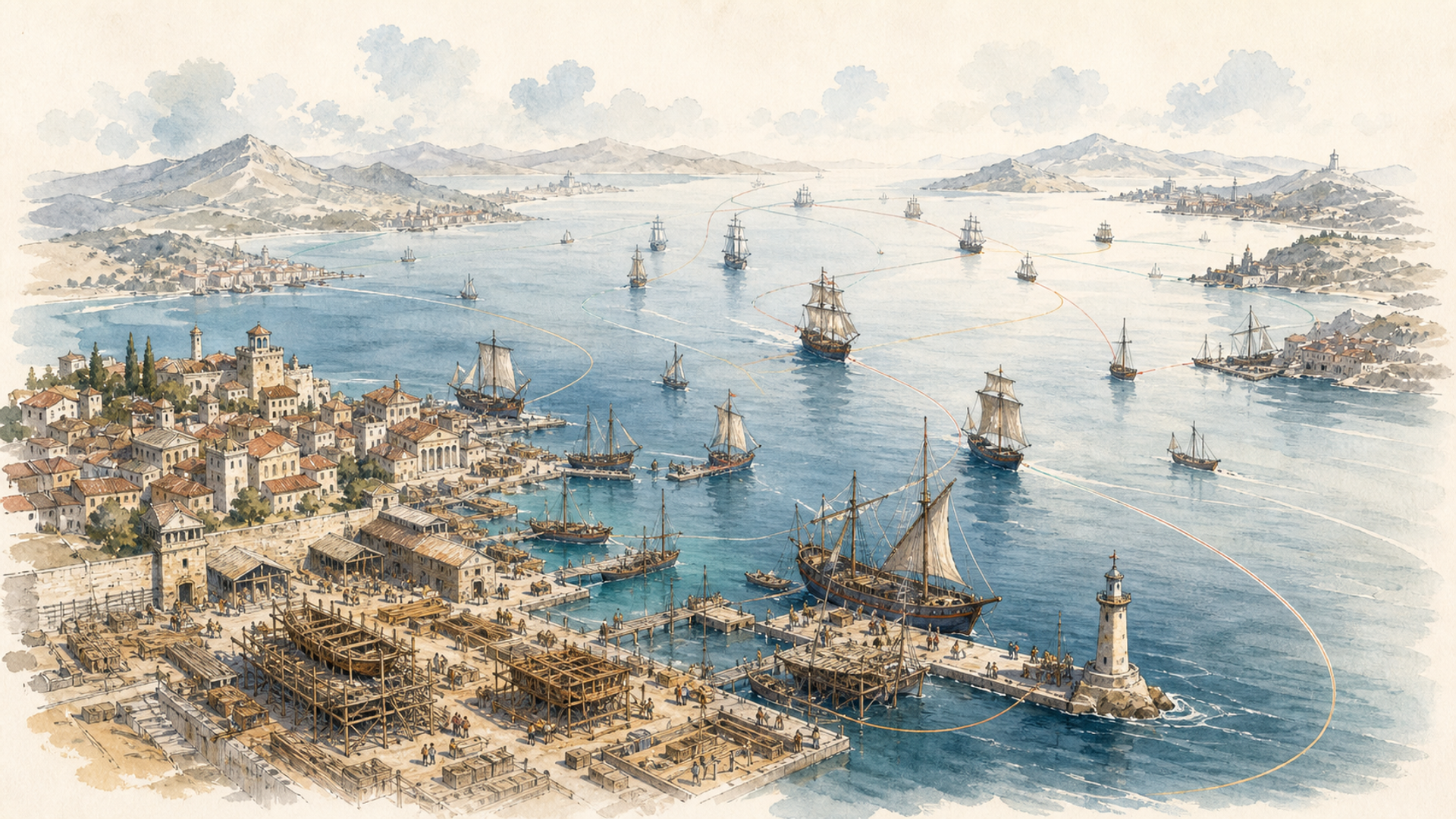
Take Portugal at the beginning of the sixteenth century. It was a small kingdom on Europe’s western edge, with a tiny population beside the great powers of Asia. Yet Portuguese ships appeared along the coasts of Africa, in the Persian Gulf, India, Malacca and beyond. How could such a small state build a system spanning half the planet? The answer is counter-intuitive: it did not have to control everything. If your aim is to dominate particular trade routes, you can concentrate on ports, islands, straits and bases. This is very different from Rome’s land empire, which had to control continuous stretches of countryside, cities and roads. A maritime empire can resemble a necklace: its points lie far apart, but the sea joins them.
Portugal builds a network, not a continent
After Vasco da Gama’s voyage, the Portuguese sought a place in the Indian Ocean trade through a combination of negotiation and force. At different times they built or seized strategic bases including Goa, Malacca and Hormuz, trying to control passages and impose permits and taxes on maritime traffic. They never monopolised all Asian commerce. Local networks were too extensive, the actors too numerous and Portugal too small. They did demonstrate that armed ships and well-placed bases could produce influence wildly out of proportion to their size. It is a model we will meet repeatedly: controlling a node can be cheaper than controlling the whole network.
There were obvious limits. Bases needed supplies, ships needed repairs and crews needed paying. Every distant point depended on a very long logistical chain. When wealthier, better organised European rivals appeared, the Portuguese network became difficult to defend.
In 1602, the Dutch Republic created the Dutch East India Company, the VOC. Imagine a modern multinational whose government grants it not only the right to trade, but powers to sign treaties, maintain armed forces, build fortifications and govern territory. It was much closer to a hybrid of company and state.
The VOC raised capital from investors and organised expeditions on a large scale. Amsterdam became a major financial centre, with markets and institutions able to mobilise money for distant, dangerous ventures. Finance enters geopolitics directly here: fleets are extraordinarily expensive. A state or company that can borrow on better terms can put more ships to sea and sustain longer wars. Seventeenth-century Dutch power therefore depended on more than skilled sailors. It relied on shipyards, credit, insurance, cartography, commerce and institutions.
Britain eventually built a still larger system. The Royal Navy protected routes and interests, but it would be wrong to picture the empire as a project perfectly coordinated from London from the beginning. Private companies, settlers, local administrators, soldiers and merchants often pushed expansion in directions the central government controlled only partially. The British East India Company began as a commercial enterprise and ended up ruling vast Indian territories with its own armies. After the Indian Rebellion of 1857, control passed more directly to the British Crown. The transformation is astonishing: a seventeenth-century trading charter leads, two centuries later, to a territorial empire.
Commerce and conquest could feed one another. A company opens an outpost to protect trade. The outpost needs an army. The army requires local revenue. Securing that revenue leads to tighter political control. Each step makes the next more likely.
Insuring risk
Insurance is among the least spectacular and most important parts of sea power. A ship may sink, be captured or arrive months late. If one merchant risks losing everything on a single voyage, he will invest cautiously. If risk can be spread among many investors or insurers, much larger expeditions become possible. European financial markets developed increasingly sophisticated tools to distribute risk and raise capital. London, Amsterdam and other commercial centres created ecosystems in which ships, public debt, companies and insurance sustained one another.
Geopolitics therefore began to depend on something invisible on a map: the cost of money. If your government can borrow more cheaply than its rival, it can maintain fleets and wars for longer. A naval battle may be won months earlier in an office where somebody agrees to finance a new ship.
Look at Britain’s nineteenth-century network: Gibraltar, Malta and Cyprus in different periods, along with bases and ports on routes to India and Asia. Some territories were tiny, but if they allowed ships to refuel, protected a passage or watched a route, their strategic value dwarfed their area. The opening of the Suez Canal in 1869 made the Mediterranean connection to India even more important. As Britain increased its control over Egypt in the late nineteenth century, Suez became central to imperial logistics. It is the lesson from Chapter 3 on a global scale: the network makes the points important.
A navy does more than fight
A great fleet performs at least three jobs. It can defeat an enemy fleet, protect its own commerce, and prevent the enemy trading freely through blockades and control of routes. Maritime dominance mattered especially to an island such as Britain because the country depended on trade and could project force without maintaining enormous standing armies everywhere. But geography alone is not enough. Other countries are islands and did not build world empires. Britain’s position became power because it combined with financial institutions, industrialisation, naval strength, trade and favourable historical circumstances.
Old school maps often displayed European empires in elegant, uniform colours. The colour concealed what happened on the ground: conquest, taxation, forced labour, slavery in some periods, dispossession, repression and racial hierarchies. Empires also built railways, ports and administrative systems, but those structures were frequently designed first for imperial purposes: moving troops, exporting raw materials, linking ports with production centres. To say that an empire ‘brought infrastructure’ without asking for whom, for what, and at what cost produces a deeply incomplete history.
Colonised societies were not passive. They adapted, resisted, traded and used imperial institutions for purposes of their own. Empires were systems of power, but did not control everything within them.
Until the eighteenth century, European empires could control routes and colonies while the great Asian societies remained economically and politically formidable. The real global asymmetry widened when north-western Europe, and especially Britain, entered the Industrial Revolution. Coal concentrated immense energy. Steam engines turned it into mechanical work. Factories, railways and steamships multiplied production and mobility. Industry allowed more weapons, ships and infrastructure to be built at ever lower relative cost. The old maritime empire now changed character. It no longer merely controlled routes carrying precious goods; it could produce at industrial scale and impose a new kind of military power.
Before we reach that point, however, we need to make a journey that seems distant from geopolitics. We must understand why, in the sixteenth and seventeenth centuries, some Europeans began treating nature as something to be measured systematically, tested and described mathematically. Not because science ‘automatically creates’ empire, but because measuring the world more accurately also means learning to navigate, map, build and—unfortunately—fight within it more effectively.
The company that could wage war
The VOC was founded in 1602. Calling it simply a ‘company’ in the modern sense can mislead. It received powers to conclude treaties, keep armed forces, construct forts and administer territory. It had shareholders while behaving in ways we now associate with a state. The English East India Company, founded in 1600, underwent a still more startling transformation. Established to trade, by the eighteenth century it had become a territorial power in India with an enormous army of its own. Following the Battle of Plassey in 1757 and later conquests and agreements, it acquired fiscal and political power over millions.
Imagine Amazon with an army and the right to collect taxes across whole regions. The comparison is anachronistic, but conveys the strangeness of these hybrid organisations. Ocean voyages were expensive and dangerous. Storms, pirates, wars and disease could destroy a huge investment. Joint-stock companies and insurance spread the risk between investors and voyages, changing the possible scale of expansion. One merchant could be ruined by the loss of his only ship; a well-capitalised company could absorb losses and continue. Sea power depended not only on shipyards and cannon, but on systems able to raise money and finance risk over time. London and Amsterdam became imperial centres partly because they were financial centres. Port and exchange were parts of the same machine.
Between 1756 and 1763, the great European powers fought in Europe, North America, the Caribbean, Africa and Asia. Winston Churchill would much later call the Seven Years’ War the ‘first world war’—an effective phrase, though not its formal historical name. Britain emerged with a stronger position in North America and India, while France lost important colonial possessions. Wars between European powers could now be decided thousands of kilometres from Europe. When an imperial network is global, war becomes global too.
An empire of ports can turn into an empire of land
At first, European powers in the Indian Ocean often sought ports, forts and commercial privileges above all. Yet the line between commerce and politics can move. If you must defend a port, you want control of the surrounding land; if you lend money to a ruler, you may receive rights; if a local war threatens your business, you may intervene; after intervening, you may find yourself responsible for governing. That is how commercial networks can become territorial rule. No single plan written in 1600 led inevitably to nineteenth-century British India. There were successive decisions, each apparently solving an immediate problem, which together produced something much larger.
In the early sixteenth century, Portugal’s population and resources were limited beside the scale of Asia. Directly occupying India, East Africa and South-east Asia as one continuous territory would have been absurd. Its alternative was a network of forts, ports and alliances at strategic points, designed to control part of the trade and impose naval power on the most profitable routes. Goa, Malacca and Hormuz embodied the logic. Together they enabled intervention along corridors between the Indian Ocean, Persian Gulf and South-east Asia. The Portuguese also introduced the cartaz system, permits intended to oblige certain vessels to sail under Portuguese authorisation. They never monopolised the vast, deeply rooted trade of Asia, but showed how an armed network of nodes could project influence far beyond the area directly ruled.
That is one reason imperial maps mislead. Colour only the territory possessed and a maritime empire looks smaller than it was in practice. You must draw the lines between points too: routes, convoys, bases, contracts, loans and information.
The company that was allowed to wage war
The Dutch Republic’s VOC was a joint-stock company with state-granted privileges far beyond those of an ordinary modern business. It could sign treaties, build fortifications, maintain armed forces and administer territories. By our standards, the boundary between company and public power was remarkably blurred. It raised capital from investors and sought to turn commercial and naval superiority into monopoly. It built a major Asian centre at Batavia, today’s Jakarta; in the Moluccas, it used violence to control spices. Yet part of its power also came from intra-Asian trade. It was not simply a ship carrying Indonesian goods to Amsterdam, but a company buying and selling within complex Asian networks.
This introduces something modern: capital can be concentrated in organisations able to sustain risks and projects too large for one merchant. Shares, debt, insurance and financial markets become technologies of power just as surely as cannon and sails. A fleet costs a fortune; mobilise the savings of many investors and you can maintain one for longer.
The growth of the British Empire depended on naval power, industry, colonies, violence, local alliances, political institutions, trading companies and often the exploitation of divisions where it intervened. Finance deserves particular attention because it is less visible than the fleet. A state able to borrow relatively cheaply and collect taxes reliably can sustain longer wars. Ships and soldiers are the immediate instruments; credit determines how long you can pay them.
The Bank of England, founded in 1694, belonged to a broader transformation of British public finance. It did not ‘create the empire’ by itself, and there is no simple formula in which banks equal victory, but it helped a system in which government and financial markets could mobilise large amounts of capital. In eighteenth-century conflicts, that fiscal and credit capacity gave Britain an advantage over some rivals. Distance costs, as we have seen; finance is one way a state pays that cost. Maintaining a base in India, a Mediterranean fleet and soldiers in North America requires a system that can turn future wealth into resources available today.
There is a common error of perspective: imagining a few thousand Europeans ruling millions by themselves through absolute superiority. Colonial empires usually depended heavily on local allies, intermediaries, soldiers, officials and merchants. The East India Company conquered much of the subcontinent with armies in which most soldiers were Indian. It often governed through agreements with local princes and elites. Political rivalries within India mattered just as much as British technology. This does not lessen colonial responsibility; it makes the mechanism clearer. External power works best when it inserts itself into existing structures. Ancient empires taught the same lesson: conquering also means co-opting. When that alliance system breaks, an empire can suddenly become far more fragile.
Controlling flows instead of kilometres
We can now answer the title’s question. A small country can build an enormous empire if it turns advantages in navigation, finance, military power, organisation and position into a network able to control flows far larger than its own population. It need not be strongest everywhere at once; it must be strong enough at the nodes that matter and reliable enough to connect them.
The strategy has a matching vulnerability. Break the network and isolated points lose value. A distant base depends on supplies; a colony on safe routes; a company on credit; a monopoly on others failing to find alternatives. Maritime empires are powerful because they are networks—and fragile for the same reason.