Chapter 05 · Part 02
Why Did We Stop Chasing Food?
Agriculture, surplus and population growth.
Agriculture was not simply progress: it bound communities to land, created surpluses, property and new vulnerabilities. It supplied the material foundation for cities, specialists, taxes and states.
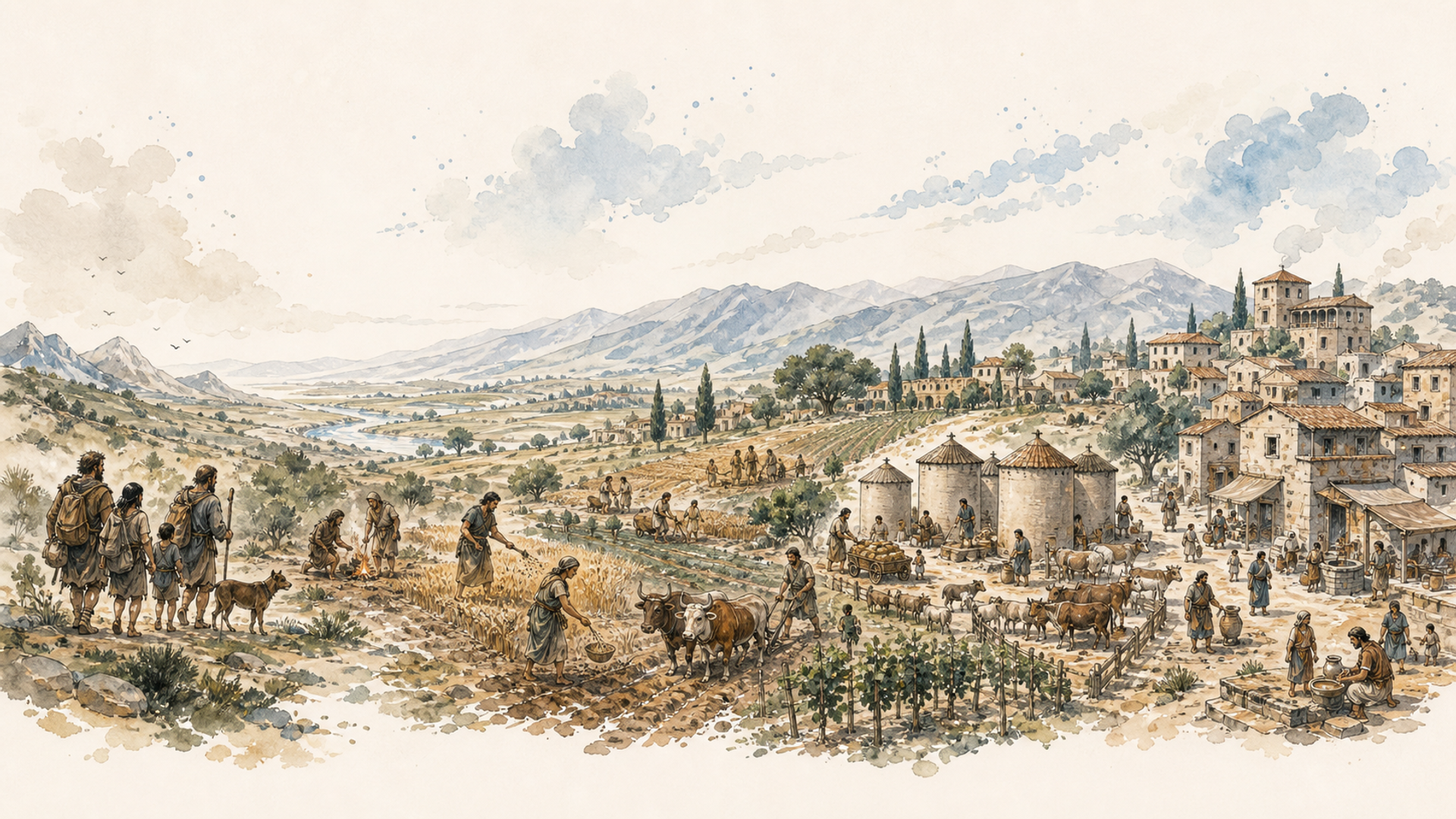
If you could travel back twelve thousand years and ask a community about its plan for the future, nobody would say, “We have decided to invent agriculture and build civilisation.” It did not happen that way. There was no meeting, no master plan and no single morning when humanity stopped hunting and gathering and became farmers.
Agriculture emerged gradually in different places at different times. The Near East saw the domestication of cereals and animals; China of rice and millet; Mesoamerica of maize through a very long process of selection; the Andes of potatoes and other crops. Agricultural systems developed independently in New Guinea too. “The agricultural revolution” is a convenient name for a transformation that took generations and had no single centre. Above all, it was not as obviously advantageous as it can appear to people who assume that producing food must be better than finding it.
Farmers work for the future
Imagine two families. One follows wild plants and animals through the seasons, knows a broad territory and moves as resources change. The other stays beside a field, sows, then waits months to harvest. The farming family may produce much more food from a small area, but becomes tied to that land. It must protect the crop, save seed, repair fences, manage pests and hope rain and temperature cooperate.
Agriculture introduces something psychologically and politically enormous: the future can be stored. A harvest kept in a granary contains months of work turned into food. It can carry people through a bad season, but also creates a new question: who controls the granary? Food dispersed across a landscape is hard to accumulate in one place. Grain produced and stored by hundreds of households can be counted, exchanged, taxed or stolen. Before kings and empires, humanity had already made something power would find intensely interesting.
What helps a population is not always what makes an individual happier. Agriculture can support far more people per unit of land, yet early farming communities also faced restricted diets in some settings, repetitive labour, diseases encouraged by dense settlement and proximity to domestic animals, disputes over property and vulnerability to failed harvests. Hunter-gatherers did not live in paradise; they too faced hunger, accidents, violence and disease. The point is to avoid a fairy tale of linear progress in which each technology immediately improves everyone’s life. Agriculture’s great power lay in enabling higher population densities and more stable communities.
As a village grows, new problems and possibilities appear. In a group of a hundred, nearly everyone may know everyone else. Among a thousand, ten thousand or a hundred thousand, society needs tools to coordinate strangers. If food production is high enough, some people can devote their lives to other work: specialised crafts, construction, trade, ritual, fighting, record-keeping. It does not happen everywhere in the same form or order, but the principle is broad: surplus releases social time.
A mobile group that loses access to a valley may sometimes relocate. An agricultural community with houses, canals, fields and granaries would abandon years of investment. A sown field is not simply “space”; it is accumulated labour. An irrigation canal embodies tools, hours and cooperation. An orchard may take years to mature. The more people invest in a place, the more they care who may use, inherit or defend it.
Property, boundaries and territorial belonging become more pressing. These are not modern national frontiers, which arrive much later. But settled life makes one enduring question harder to avoid: whose land is this? And once something needs defending, people can specialise in defence. Communities build walls, organise warriors and make alliances. Food production did not invent war—humans fought before farming—but it changed the scale of resources worth fighting over and the number of people a conflict could sustain.
The harvest paradox
Agriculture contains an almost cruel paradox: success can increase risk. A village with full granaries is safer from a bad week but more attractive to raiders. A fertile plain supports more inhabitants and for that reason may be more fiercely contested. The more wealth you concentrate, the more organisation you need to protect it.
In Mesopotamia, where irrigated agriculture and cities became highly complex, the open landscape offered fewer natural barriers than a mountain valley. Cities built walls and fought one another. Surplus fed temples and trade, but could also feed armies. The relationship between wealth and vulnerability will return repeatedly. A prosperous port attracts ships and investment, but also pirates and foreign powers. Oil wealth can create immense revenue and intense rivalry. A sophisticated supply chain is efficient and dependent on distant components. Success does not remove risk; it transforms it.
Animal domestication added another layer. Cattle, sheep, goats and other animals supplied meat, milk, hides, wool, manure and, in some places, traction. An ox pulling a plough is a form of energy. A horse changes transport and later warfare. Living close to large animal populations also formed part of the complex history of infectious disease, alongside dense settlement and expanding networks.
We should not reduce epidemics to a single cause, or assume every human disease simply “jumped from animals after farming”. Pathogens have diverse and often complicated origins. But larger, more connected populations created conditions in which some infections circulated more easily and became endemic. Millennia later, when societies long separated met after European ocean voyages, those biological histories had catastrophic consequences. An economic shift in food production changed demography, property, political organisation, war and eventually relations between continents.
Not every farming society built a large city, nor did every complex society depend on cereals in the same way. Different environments, crops, population densities, trading systems and institutions produced different paths. It is equally wrong to place “primitive” hunter-gatherers below “advanced” farmers on a ladder culminating in modern Europe. These are strategies adapted to different conditions. Some hunter-gatherer societies developed complex social structures; some farming populations remained in small villages for centuries.
We can make a more careful claim: agriculture enabled stable concentrations of population and surplus that, in some regions, encouraged cities and states. It was not destiny. It was a new possibility.
From field to city
When that possibility is used, an intriguing problem appears. If thousands live together, who records what enters the granary? Who decides how much water runs through a canal? Who writes down a debt? Who remembers that one household delivered twenty sacks of barley and another ten? What happens when two people claim the same plot? Human memory is no longer enough.
Farming arose independently with different plants and animals. In the Near East, wheat and barley were important; in China, rice and millet; in Mesoamerica, maize, beans and squash; in the Andes, potatoes and other crops. This matters because agriculture was not a gift radiating from a single “cradle of civilisation” to passive peoples. Human communities experimented in different environments. Nor was the transition clean. For millennia, many combined cultivation with hunting, gathering, fishing and herding. “Farmer” and “hunter-gatherer” are useful categories, but life does not always fit textbook boxes.
If you can store grain, someone can count it
A storable harvest has an extraordinary political property: it can be measured and accumulated. An authority can take part as tax; a temple can distribute rations; a household can lend grain and demand repayment; an army can live from granaries. Grain did not “invent the state”, but it made some forms of organisation more practical. Something visible, weighable and storable is easier to tax than scattered resources consumed immediately.
Inequality also acquires new forms. If land and stocks can be controlled, they can be concentrated. Some families accumulate more than others; debt and property matter more; power may become hereditary. Yet agricultural societies still produced very different social systems.
Farming did not eliminate mobile pastoralists. Instead, it created a geopolitical relationship lasting millennia between settled agricultural societies and mobile peoples of steppe and arid lands. Farmers could sustain dense cities and fortifications; pastoralists could use country unsuited to crops and build highly mobile military forces. Many famous frontiers—northern China, for example, or the margins of Middle Eastern empires—did not simply divide “civilisation” from “barbarians”. They separated and connected different economies that traded, fought and depended on one another. The Great Wall of China, in its many historical phases, is not proof that two worlds were completely separate, but that they were close enough to require constant management.
Dense communities offer immense advantages but ease the circulation of pathogens. Add domestic animals, waste, contaminated water and exchange between settlements, and some diseases can persist more readily than among small mobile groups. A disease that kills or immunises its hosts needs enough new hosts nearby to continue. In the long run this created differences in populations’ experience of disease and contributed to the devastation of transoceanic encounters after 1492. An economic choice made millennia earlier—living more closely through farming—had geopolitical effects in a world the first farmers could not imagine.
Nor was that biological history a planned consequence of domestication. No farmer chose settlement in order to create immunity centuries later. Effects accumulated through population size, contact, sanitation, animal husbandry and exchange. This is precisely why the story matters: a change can reshape the world through consequences that none of the people making it could foresee.
Property makes boundaries matter more
If you move with wild herds or seasonal harvests, exclusive control of one field may matter little. If you have spent months sowing, irrigating and waiting, who may use that ground matters very much. Agriculture does not automatically mean private property in the modern sense; common land, collective ownership, family systems and overlapping rights have all existed. But settled life raises the political value of delimitation: this field, canal, pasture and access to water.
A farmer sows today in hope of harvesting months later. Meanwhile the land must remain accessible, water must arrive, animals must be kept away and no one else must seize the crop. Sedentary life makes the future more plannable and more vulnerable. A good year fills stores; drought, flood or a passing army can erase months of labour in days. Warehouses, granaries, walls and redistribution systems become politically important. Surplus is not just wealth, but a promise about the future that someone must protect.
That promise also changes how people experience loss. A mobile community may know a wide territory and possess deep attachments to it, but a farming household has concentrated labour in improvements that cannot travel: cleared soil, terraces, wells, orchards, fences and houses. Leaving is not merely changing location; it can mean abandoning several generations’ accumulated work. This helps explain why access to land and water becomes entangled with inheritance, family status and political membership. The line between “ours” and “theirs” acquires material weight long before it becomes a surveyed state border.
Irrigation can raise production while creating problems. Canals must be dug and maintained; poor management may salinise soil; upstream users may conflict with downstream ones. Geography does not dictate one political answer, but produces problems society must solve somehow.
Nor did agriculture sweep every other livelihood away. Pastoralists, hunter-gatherers, fishers and farmers coexisted, traded and fought for millennia. In many environments, moving with herds was more rational than forcing crops from poor or arid soil. Eurasian steppe societies could project force over immense distances. Agricultural states possessed denser populations and greater tax revenue, while steppe horsemen had mobility that terrified richer empires. These were economic and social systems adapted to different geographies, each producing different forms of power. When they met, the boundary between field and pasture could be as explosive as a modern border.
Nobody woke up one morning and “invented” agriculture
The phrase agricultural revolution suggests a sudden invention. Reality was slower, regional and experimental. Communities independently managed, selected and eventually domesticated plants and animals. The Near East cultivated wheat and barley and herded sheep and goats; China relied heavily on rice and millet; the Americas followed their own paths with maize, beans, squash, potatoes and other crops; New Guinea cultivated plants adapted to a very different tropical environment. There was no single inventor or cradle.
This matters because farming was not an inevitable discovery made once humans became clever enough. Homo sapiens had possessed sophisticated cognitive abilities for tens of thousands of years. Farming economies depended partly on climatic shifts after the last ice age, domesticable species, population density, accumulated knowledge and local choices. For long periods communities mixed cultivation, hunting, fishing and gathering.
Nor did farming automatically improve individual lives. Diets dependent on a few crops might be less varied; fieldwork was repetitive; dense communities increased exposure to disease; harvests failed. Archaeologists find evidence in several settings of nutritional stress and health problems associated with early farming, though experiences differed greatly. For an individual, agriculture does not always look like linear progress. For a population, its effect is vast: the same land can support many more people.
Once a community produces more food than it immediately consumes and stores some of it, the surplus can support craftspeople, soldiers, priests, administrators and builders. It can bridge a bad season, be traded, or be taken as tax and tribute. It is a material foundation for specialisation and urban growth. Yet whoever controls grain, water or redistribution controls part of everyone else’s survival. Farming did not automatically invent inequality or war, but created new things to accumulate, inherit, tax and conquer.
The close relationship between agriculture and states is real without being mechanical. Cereals ripen predictably and can be measured, moved and stored, which makes them particularly legible to administrators. Tubers left underground have historically been less visible to a tax collector. Some scholars argue this distinction favoured particular forms of taxation and control. It is a fascinating lens, not a universal law: states arose in many agricultural settings.
A mobile community can sometimes move away from danger. A farming village is tied to fields, houses, granaries, wells and crops. That makes territory more valuable and the population more predictable. If you want its surplus, you know where to find it; if you wish to control a region, you can occupy its agricultural centres; if you wish to punish an enemy, you can burn crops or destroy irrigation. Settled life enables far greater accumulation and makes escape far more costly.
From this comes a cycle we will follow throughout the book: food production sustains populations; populations sustain armies and public works; armies protect or capture the productive base. It is not inevitable, but it is one route by which villages become cities and groups of villages become large political systems. The pastoralists of the Eurasian steppe prove there was no single path. Horsepower, mobility and steppe knowledge created their own advantages. The Mongols would build history’s largest contiguous land empire from a society that hardly fits the formula “agricultural city equals power”. Geography opens different roads.
When food becomes politics
When the harvest ceases to concern only the family producing it, the history of the state begins. Someone must decide who uses water, how surplus is stored, how a field is measured, how a debt is recorded, who maintains a canal, who receives food in famine and how much grain central authority can take without destroying the community that grows it.
These sound like administrative problems, but within them lie taxes, law, bureaucracy and hierarchy. That is why the next chapter enters a city and asks a surprisingly modern question: how do you govern it? Once thousands of people live together and depend on infrastructure and exchange, memory and goodwill are not enough. They need records, measures, rules and people charged with making them work. After learning to produce surplus, humans had to invent systems for deciding who was entitled to what.