Chapter 13 · Part 03
What Happens When Two Worlds Meet?
The Columbian Exchange, colonial empires, slavery and disease.
Permanent contact between the Americas and Eurasia reshuffles plants, animals, people, metals and pathogens, producing demographic and economic transformations on a planetary scale.
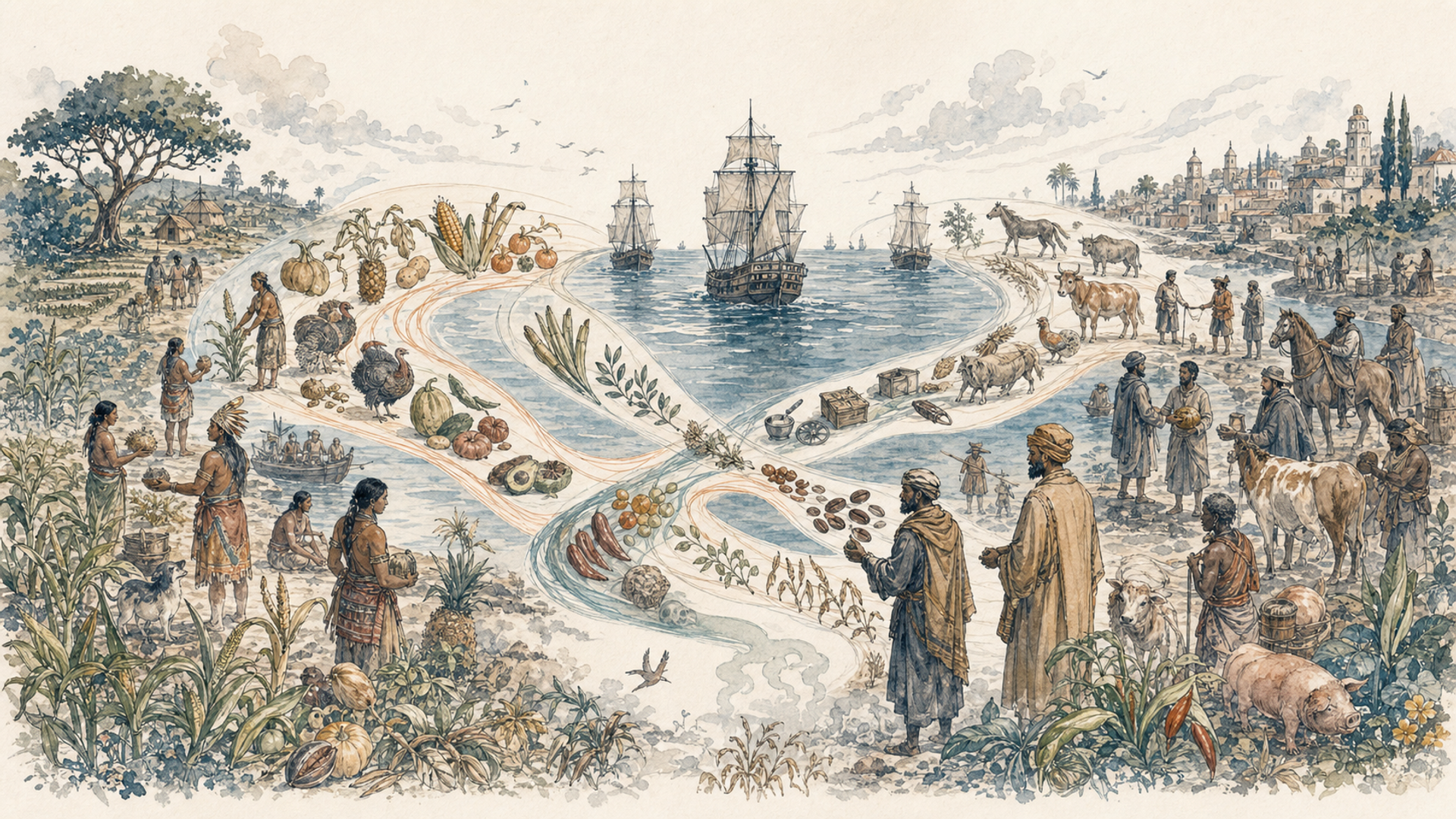
In 1491, nobody in Europe had ever eaten a potato. Nobody in the Americas had seen a European horse at full gallop, or acquired immunity to the same diseases that had circulated for centuries through many Eurasian populations. Tomatoes were not part of Italian cooking; cacao was unknown in Europe; large domesticated animals such as cattle, horses and sheep did not occupy the same place in American economies as they did in the Old World. Then the Atlantic ceased to be a permanent barrier. What followed is called the Columbian Exchange, after Columbus, although ‘exchange’ can sound far too gentle. It was an immense and often brutally violent transfer of plants, animals, pathogens, people, metals and economic systems between continents that had remained largely separate for millennia. Some transfers fed populations. Others destroyed societies.
The invisible conquistador
When the Spanish entered the great American empires, they were few compared with the populations they encountered. European victories cannot be explained by a simple tale of ‘better weapons’. The Spanish built alliances with local groups hostile to dominant powers, exploited political conflicts and possessed certain military advantages. Yet one biological force was devastating: infectious diseases from the Old World. Smallpox, measles and other pathogens struck populations without a long history of exposure to those same diseases. Epidemics caused enormous mortality and social crisis. Scholarly estimates of pre-Columbian populations and deaths vary widely, so we should distrust figures presented with too much confidence. What is not disputed is the catastrophic scale of demographic collapse in many regions.
It is difficult to imagine what such a crisis means politically. It is not merely ‘inhabitants’ who die, but farmers who must grow food, officials who know how to administer, soldiers, craftspeople, religious leaders, parents and keepers of cultural memory. An epidemic does more than reduce a population. It can tear apart the networks that allow a society to function.
There is an evolutionary oddity here. Ancestors of the horse evolved in North America, but horses became extinct there at the end of the Pleistocene. Europeans reintroduced them after 1492. Their impact extended far beyond the conquistadors’ wars. Indigenous peoples of the North American Great Plains adopted horses and profoundly changed mobility, hunting and warfare. Within a few generations, a species brought by invaders had entered Indigenous cultures in ways Europeans had never planned. It is a useful image of the Columbian Exchange: this was no simple transfer from Europe to America. Once moved, plants and animals took on new lives in different societies.
The potato conquers Europe
The journey in the opposite direction was just as important. Potatoes, maize, tomatoes, cacao and other American crops spread through the Old World. The potato had agronomic qualities that made it valuable in several European regions: it could yield many calories from relatively little land and thrive in conditions different from those suited to some grains. Along with many other factors, its spread supported population growth in parts of Europe. Maize became important in areas of Africa, Europe and Asia. Chillies, native to the Americas, entered Asian cuisines so deeply that it is now hard to imagine food from Sichuan or India without them.
This turns our idea of ‘tradition’ upside down. Some ingredients that seem inseparable from ancient cuisines arrived only after the sixteenth century. Tradition is often globalisation that has been around long enough to look local.
The Atlantic connection also produced one of the early modern world’s most brutal systems. Growing sugar in the Americas required enormous amounts of labour. Colonial powers built plantation economies based overwhelmingly on enslaved Africans deported across the Atlantic. Over several centuries, the Atlantic slave trade forcibly transported millions from Africa to the Americas. Conditions aboard ship were horrific, mortality high, and the system destroyed lives, families and communities. It cannot be treated as one more ‘trade flow’ alongside pepper or silver. It was an economic order built on extreme coercion and the conversion of human beings into property.
Slavery existed in many societies before European expansion, including in Africa, but the Atlantic system reached a distinctive scale and developed a particular racial structure. Its demographic, economic and political consequences still run through societies in the Americas, Europe and Africa. This is fundamental to our story: global networks do not distribute benefits evenly by themselves. They can enrich some groups precisely because others are forced to bear the cost.
The silver that travelled around the world
In the Americas, the Spanish found and exploited major deposits of silver, especially at Potosí in present-day Bolivia and in Mexico. American silver entered global commercial networks, and a significant share reached Asia, where demand was high, especially in Ming China during certain periods. For the first time, we can almost trace a planetary circuit: silver mined in the Americas, shipped to Europe or carried across the Pacific on the Manila galleons, then traded in Asia for silk, porcelain and other goods. Spain controlled American territories, but some of the wealth extracted there ultimately fed distant markets.
For centuries, the Manila galleon linked the Spanish Philippines with Mexico. It shows how early the Atlantic and Pacific entered the same system. We no longer have regional networks merely brushing against one another, but a genuinely intercontinental circulation. It is tempting to tell this as the rise of Europe and the decline of the Americas, yet the global reality was more complicated. American crops fed populations in Africa and Asia; American silver interacted with Chinese demand; Asian merchants continued to dominate vast stretches of regional commerce; the Ottoman, Safavid, Mughal and Chinese empires remained immense powers.
Western Europe was not yet master of the world in the sixteenth century. It had, however, secured lasting access to oceans, colonies and flows of metals and merchandise that would help shift the economic and military centre of gravity over the centuries that followed.
The world becomes a single ecological system
Before 1492, the Atlantic separated two great human biological systems relatively sharply. Afterwards, that separation never returned. Plants, animals and diseases circulated with growing intensity. The transformation is so deep that some scholars regard the beginning of the early modern period as a planetary ecological turning point. Not because nature ceased to exist, but because human societies began moving species between continents at a new speed. Today’s lunch may contain ingredients originating on four continents. That is the everyday version of a geopolitical revolution.
Once permanent ocean routes existed, European powers faced a question: how could they protect them and prevent rivals using them more effectively? Portugal created a network of bases and forts along African and Asian coasts. The Dutch built trading companies capable of military force. Britain would eventually develop an even more powerful combination of navy, finance, industry and empire. There was no need to conquer every metre of coastline. Controlling the points that held the network together could be enough.
In 1545, high in the Andes of what is now Bolivia, the Spanish began intensive exploitation of silver from the Cerro Rico at Potosí. The city grew rapidly at more than four thousand metres above sea level and became a symbol of colonial mineral wealth. Mining relied on coercive labour systems, including the colonial mita, which adapted and transformed earlier Andean obligations.
American silver crossed the Atlantic towards Europe, but a substantial portion continued to Asia. Along the Manila galleon route, silver from the Americas could reach the Philippines and finance trade with Chinese merchants eager for the metal. Here one of the first truly planetary economies took shape: a mine in the Andes, a monarchy centred in Madrid, a port in Mexico, a city in the Philippines and Chinese monetary demand could all form part of one circuit. If you want an image for The World, Woven, picture a silver coin travelling halfway around the planet while nobody who touches it understands the whole network. The explanation is not simply that Europeans ‘had better ships’. It is a system of cannon, companies, credit, insurance and ports, with an increasing ability to turn commerce into political power.
In 1492, two empty worlds did not meet: ecosystems separated for millennia did
When Columbus arrived in the Caribbean in 1492, the Americas were home to extraordinarily varied societies: large empires such as the Mexica and Inca, cities, farming villages, trading networks, nomadic communities and countless other political and cultural systems. Eurasia and Africa were equally diverse. The novelty was therefore not an encounter between ‘civilisation’ and ‘nature’, but permanent contact between peoples and biospheres that had developed along separate paths for thousands of years. The historian Alfred Crosby popularised the expression Columbian Exchange for the movement of plants, animals, microorganisms and people across the Atlantic. The list sounds almost harmless: maize, potatoes, tomatoes and cacao to the Old World; horses, cattle, wheat, sugar cane and numerous pathogens to the Americas. The consequences were anything but harmless.
Potatoes from the Andes helped sustain larger European populations in later centuries because of their high caloric yield under certain conditions; maize and cassava spread across Africa and Asia; the horse transformed the economies and cultures of several Indigenous peoples of the North American plains. Sugar cane, already grown elsewhere, expanded enormously on American plantations intimately bound to Atlantic slavery. Smallpox and other infectious diseases devastated many Indigenous American populations that lacked the epidemiological history of Eurasian and African societies exposed to particular pathogens for centuries. Precise estimates of pre-Columbian populations and mortality are difficult, and scholars disagree. There is no dispute, however, that repeated epidemics caused immense demographic collapse in many regions.
Disease does not replace the political and military causes of conquest. Cortés did not bring down the Mexica Empire through smallpox alone: alliances with peoples hostile to Mexica rule, military technology, political choices and internal conflicts were decisive. Pizarro did not conquer the Inca simply because Europeans had ‘better germs’: the empire had emerged from civil war, and the Spanish exploited divisions and captured Atahualpa. Epidemics nevertheless transformed the demographic and social balance. This is precisely the kind of entanglement that gives this work its title: biology, politics, geography and contingency become inseparable.
There is an important moral distinction to make. The early epidemics were not, in most cases, deliberately planned ‘biological weapons’ deployed by sixteenth-century conquistadors; their contemporaries did not possess modern germ theory. That does not make conquest less violent, nor erase later episodes in which colonial actors used or proposed using disease deliberately. It simply distinguishes unintended biological effects from intentional violence, because history becomes more intelligible when the two are not confused.
The silver that circled the planet
Connecting the Americas to the world system involved far more than crops. Silver mines, particularly Potosí in the Andes and mining districts in Mexico, produced enormous amounts of metal for global commercial circuits. Some crossed the Atlantic to Europe; some travelled through the Pacific aboard Manila galleons linking New Spain to the Philippines, where it could be exchanged for Asian goods. Here we can truly begin to see a planetary economy: silver extracted through coerced labour in the Americas could finance silk and porcelain purchases in Asia, pass through a European empire and influence prices and public finances thousands of kilometres away. Atlantic and Pacific routes were no longer separate worlds.
The system was also profoundly violent. Indigenous people were subjected to forced labour in mines, plantations and colonial economies; demand for workers in the Americas helped expand the transatlantic trafficking of enslaved Africans. Millions were forced across the ocean in one of history’s largest coerced migrations. Atlantic economies cannot be described simply as a triumph of trade: part of their wealth was built on coercion.
It is tempting to classify the Columbian Exchange as ‘good’ because it brought potatoes to Europe, or ‘bad’ because it brought smallpox to the Americas. Real history will not fit into such tidy moral columns. The potato could support European population growth, then become a vulnerability where people—most notoriously in nineteenth-century Ireland—depended heavily on a few varieties struck by blight. The horse could serve Spanish conquest and, generations later, be adopted by Indigenous communities that transformed how they lived and fought. A plant could become a staple food far from its own continent; a commercial network could enrich a city while financing slavery.
That may be the true meaning of global connection. When two systems join, neither remains unchanged. It is not only the things people intend to exchange that travel, but consequences—some foreseeable, others not. The modern world would be born from this growing impossibility of separating what happens on one continent from what happens on the others.
A table laid with ingredients that had never met
The simplest way to grasp how deeply the Columbian Exchange entered daily life is to walk into a kitchen. Imagine Italian cooking without tomatoes: no red pizza, no amatriciana as we know it, no bottles of tomato passata in the cupboard. Tomatoes came from the Americas. Potatoes, now associated with Ireland, Germany, eastern Europe and half the continent’s side dishes, came from the Andes. Chillies that seem inseparable from many Asian cuisines came from the Americas too. In the opposite direction travelled wheat, sugar cane, horses, cattle, pigs and many other Eurasian and African species.
This was not merely a matter of adding flavours. Some American crops produced many calories in conditions where traditional cereals yielded less, and over time supported population growth in parts of Europe, Asia and Africa. Maize spread to regions far from Mexico; cassava, native to South America, became vital across parts of tropical Africa. Meanwhile, sugar, tobacco and later cotton plantations in the Americas fed economies built on enslaved labour and European demand. Ecology and economics became so entangled that an agricultural change on one continent could alter population and power on another.
Animals also remade societies. The horse, extinct in the Americas for millennia and reintroduced by Europeans, transformed mobility among several Indigenous peoples of the North American Great Plains, facilitating hunting, trade and war. Yet less visible organisms travelled with the animals and plants. Smallpox, measles and other Eurasian diseases struck American populations without the same history of epidemiological exposure. Mortality was catastrophic, although it varied greatly by place and period and total estimates remain debated. European conquest must not be told as the inevitable triumph of microbes: weapons, local alliances, political divisions, violence and human decisions all mattered. Epidemics nevertheless changed the balance of power dramatically.
The Mexica Empire shows the complexity. Hernán Cortés did not conquer Tenochtitlan with a few hundred Spaniards alone against a continent. He forged alliances with tens of thousands of Indigenous fighters hostile to Mexica rule, especially Tlaxcalans, while a smallpox epidemic devastated the population. ‘Europeans had better weapons’ erases American actors and cannot explain how such a small force operated across such a vast territory. Conquest emerged from technology, disease, local politics and opportunism.
Then came silver. American mines including Potosí fed monetary flows that crossed the Atlantic and continued to Asia. Through Pacific trade between Acapulco and Manila, American silver reached Asian markets where demand—especially in China—was high. It is hard to find a better emblem of the new global world: metal extracted in the Americas through coercive labour, transported by a European empire through an Asian port and absorbed into a Chinese economy. After 1492, oceans did not merely connect continents. They began constructing one system in which ecological and financial transformations could cross the planet.