Chapter 30 · Part 06
Can Geography Lose?
Cables, chips, climate, the Arctic, space and the invisible map.
The internet is physical, chips have a geography, climate changes routes and resources, and space has become infrastructure. Technology continually changes what places mean, but it does not abolish territory.
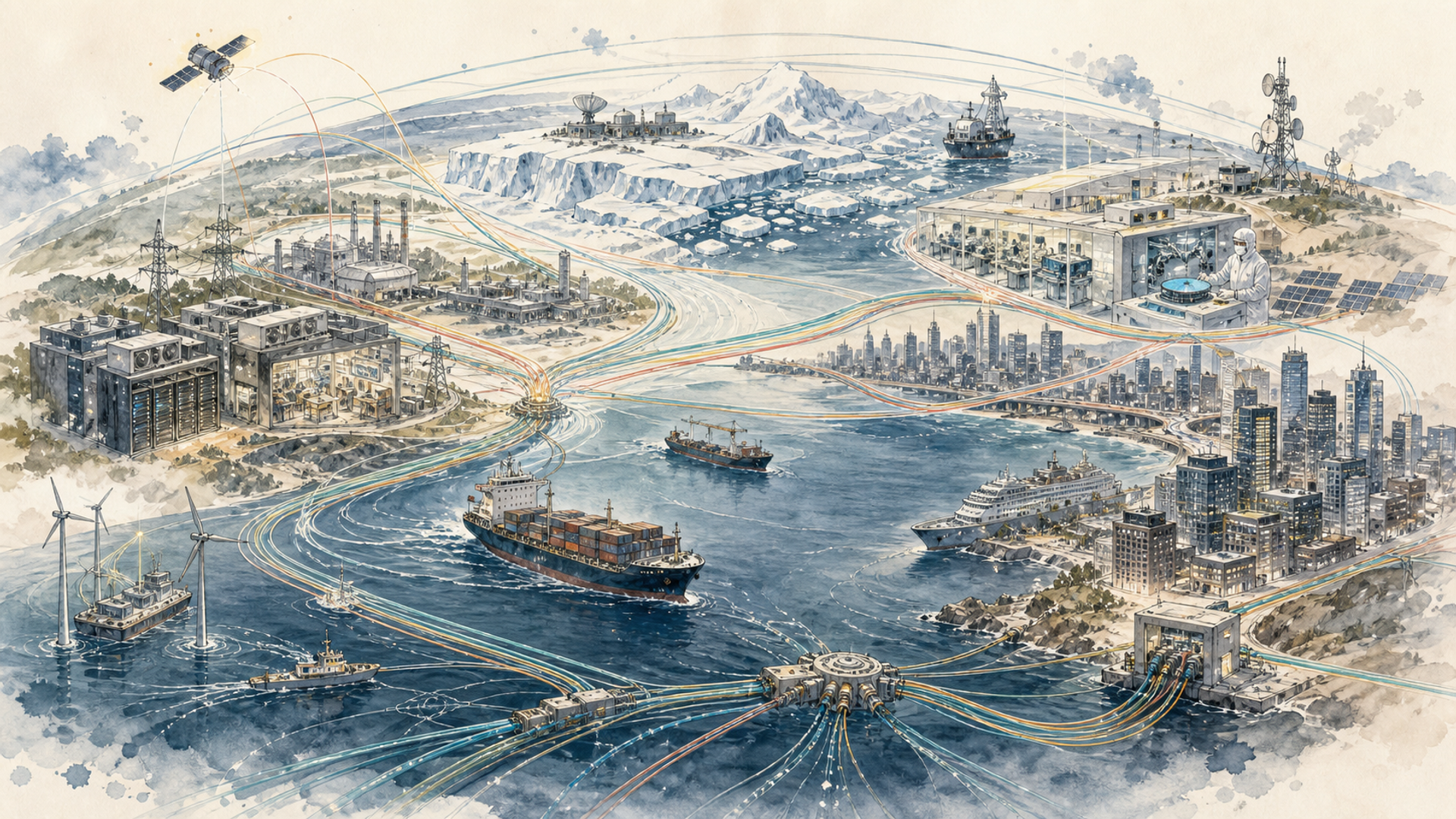
Start a video call with somebody across the Atlantic and a small everyday miracle takes place. Their voice arrives with barely a delay, the image refreshes many times a second and, for a few minutes, distance feels like a detail. Tell this to a fifteenth-century Venetian merchant, who might wait weeks or months for news from a distant port, and he might conclude that we have finally defeated geography.
Then look beneath the ocean.
Most international data traffic does not float magically through satellites in the sky. It runs along fibre-optic cables laid across seabeds. In 2026, the International Telecommunication Union estimated that more than 99 per cent of international data traffic travelled by submarine cable. These are extraordinary, nearly invisible infrastructures: more than a million kilometres of links landing at precise coastal points, entering terrestrial stations, connecting with national networks and ending in data centres.
A message that seems weightless has a very concrete geography. It passes through places, consumes energy, depends on equipment made by someone and remains vulnerable to faults, anchors, fishing, earthquakes and sabotage.
This may be the best image with which to end our journey. Across thirty chapters, we have watched people repeatedly try to overcome the planet’s limits. Ships turned seas from barriers into roads. Railways compressed distance. Telegraphs made information outrun horses. Canals cut continents; aircraft ignored mountains; satellites looked down on the whole globe. Each time, one part of geography appeared defeated. Each time, we later discovered new obligatory passages, dependencies and vulnerabilities. Geography does not lose. It changes jobs.
The internet has a seabed
During the 1990s, people often spoke of cyberspace as something separate from the physical world. It was a perfect word, suggesting a borderless realm where a website was equally reachable from Milan or Singapore. But the internet is no parallel universe. It is a network of objects: cables, routers, aerials, servers, power stations, cooling systems, semiconductor factories and people maintaining them.
You cannot land a submarine cable anywhere. It needs a suitable coast, permits, protection and links to major terrestrial networks. This concentrates infrastructure at particular points. Some island countries depend on only a few cables, so one interruption can hurt far more than it would in a region connected through dozens of alternative routes. Major technology companies now finance many links directly because traffic between their data centres is large enough to justify private infrastructure. The old problem of ports returns in another form: whoever owns or controls a network’s nodes may exert influence far beyond their geographic size.
Data centres have geography too. They consume electricity, generate heat and need dependable connections and often large quantities of water or other cooling. A region with abundant power, a helpful climate, fibre connections and political stability may prove more attractive than another. “The cloud” may be the most misleading name we have invented: behind that weightless word stand enormous buildings packed with heavy machines.
The smallest chip can create an enormous dependence
Semiconductors take the principle farther. Billions of minuscule transistors fit inside one chip, yet manufacturing the most advanced devices requires a planetary industrial chain. Design relies on specialised software. Fabrication plants cost billions. Some of the most sophisticated lithography machines come from only a handful of firms. Ultrapure materials and precision optics arrive from specialised suppliers in several countries.
Specialisation is a triumph of the global economy: no one must reinvent everything. It is also a vulnerability. When one stage is extremely hard to reproduce, the company or country controlling it becomes strategically important. Governments that had left many industrial decisions to markets for decades are investing directly again in semiconductors, batteries, energy technologies and other critical industries—not because every plant must be domestic, but because dependence on one point of failure feels increasingly unsafe.
These are technological chokepoints. Suez concentrates ships; a highly specialised factory concentrates knowledge and production. Hormuz concentrates energy flows; a software standard may concentrate access to an industry. The new bottlenecks do not always appear on classroom maps. You must know what to look for.
Even the sky has useful territory
Looking into space might feel like leaving geography behind. Space still contains more and less useful positions, indispensable terrestrial infrastructure and systems that need protection. Weather satellites observe storms and fires; communications satellites connect remote regions; navigation constellations supply location and an extraordinarily precise time reference used not just by phones, but by electricity grids, telecommunications and financial systems.
GPS is so ordinary as to be invisible, but began as a US military system. Others built their own: the European Union’s Galileo, Russia’s GLONASS and China’s BeiDou. The motive is not simply technological pride. Complete dependence on another power’s navigation and timing system can become dangerous in crisis. Space produces sovereignty, dependence and redundancy too.
Satellites need ground stations, control centres, rockets, launch sites and industries. A spaceport’s location brings advantages and disadvantages; orbital access obeys physics; radio frequencies require coordination. We have not taken geopolitics off the planet. We have added another layer above the map.
Climate change adds a different transformation. So far we have seen people change the meaning of geography through politics and technology. Climate change alters physical conditions to which societies must adapt. Global mean sea level has already risen and will continue rising for decades and centuries. Effects will not be uniform, because coastlines differ in elevation, subsidence, tides and infrastructure. A change that looks small on a world map may matter enormously to a low-lying city, densely populated delta or small island.
The Arctic is another example. Declining summer sea ice makes some activities and routes more accessible and increases interest in resources, infrastructure and military presence at high latitudes. Yet we should resist the sensational headline that “the Arctic is the new Suez”. Arctic navigation remains difficult, seasonal and expensive, requiring suitable ships, rescue services, ports, insurance and dependable weather information. A possibility becoming greater does not guarantee it will replace existing routes.
Climate affects water, farming, heatwaves, fire, infrastructure and population movement. It would be a mistake, on the final page, to return to determinism and say that “climate will cause wars”. Climate may intensify existing pressure, make compromise harder, damage economies or contribute to migration. Whether pressure produces cooperation, conflict or adaptation depends on institutions, technology, wealth, policy and choices. Our rule does not change because the temperature rises.
Artificial intelligence needs power stations
Few technologies feel less material than artificial intelligence. You type a question and an answer appears; no factory, ship or mine is visible. Behind that gesture stand specialised chips, data centres, electricity grids, cooling systems and vast capital. Training and using large models requires computing capacity concentrated in physical infrastructure.
Competition in AI is therefore also competition for advanced semiconductors, reliable energy, data, expertise and the ability to construct computing centres quickly. This creates surprising geographies. Regions with plentiful, stable and reasonably priced electricity attract data centres; a congested grid may become a more important constraint than land prices. Governments and companies debate renewables, nuclear plants and transmission lines not only to power homes and traditional factories, but to feed digital computation. The “race for intelligence” ends inside an ancient question: where is the energy, and what does it cost to bring it where you need it?
Minerals return to the centre too. Batteries, turbines, power networks and electronics use lithium, copper, nickel, graphite, rare earths and many other materials. Calling them “critical” does not necessarily mean they are geologically rare. The difficulty is often concentrated extraction and, especially, processing and refining. A country may possess deposits without the industry needed to turn them into material of the required quality.
The energy transition does not end resource geopolitics. It changes the list of strategic resources and creates new chains of dependence. Moving from fossil fuel to renewables will not automatically make energy local and apolitical. Sun and wind are more widely distributed than giant oilfields, but panels, turbines, batteries, grids and control systems must be manufactured. Technology can reduce one dependence and create another. The useful question is not “Does this abolish geopolitics?” but “What geography replaces the previous one?”
Sovereignty no longer ends at the border
A country can control every metre of its territory while depending on something outside it: imported gas, fertiliser, medicines, cloud services, chips, cables, satellites or financial markets. This does not make the nation-state obsolete. Recent decades have shown how important governments remain when closing borders during a pandemic, imposing sanctions, financing strategic industries, protecting infrastructure or deciding trading relationships.
What it means to be secure has changed. A well-defended military frontier is insufficient if a power station depends on software nobody can repair, if a factory stops for want of one distant supplier’s component or if most international communication uses two cables landing on the same coast.
That is why resilience entered the vocabulary of geopolitics. It means sometimes accepting inefficiency in exchange for alternatives: more suppliers, more routes, stockpiles, redundant production and dependable allies. For two centuries, modernity celebrated removing friction—moving faster, holding less inventory, connecting everything and lowering cost. Now we discover that a frictionless system may be fragile because it has no margin. An engineer does not design a bridge to carry exactly the average load. Societies are learning the same lesson about energy, technology and trade.
The map of people moves too
One geography changes without any continent moving: population. Several European and East Asian societies are ageing rapidly and in some cases have begun to shrink; many parts of sub-Saharan Africa are far younger and still growing quickly. These trends affect labour markets, pensions, housing, potential military manpower, consumption and migration. The numbers still do not contain the future.
A young population can become a tremendous advantage when education, health and employment allow millions to develop their capabilities; without opportunity it may contribute to frustration and instability. An older population can pressure welfare systems, while automation, immigration, productivity and greater labour participation can alter the outcome.
Migration makes the question more political. It can fill labour shortages and bring skills to an economy; for migrants, it may be a family strategy for survival or improvement; for receiving societies, it can create innovation alongside disputes over identity, integration and resources. Climate, war and economic disparities may change flows, but no model turns pressure automatically into a precise number of migrants. People respond to family networks, law, borders, opportunity and danger.
In the first chapters we asked why humans lived in particular places. The mirror question at the end is where future generations will choose—or be forced—to live. Environment and technology will shape the answer, but so will policies not already written on the map.
Return to the map, but look differently this time
Repeat the experiment from Chapter 1. Erase every border. Mountains, rivers, plains, coasts and deserts remain. Thirty chapters would be wasted if the only lesson were “geography is important”. You knew that. What matters is seeing the layers accumulated on the physical Earth.
On a fertile valley, imagine agriculture and surplus. A city rises by the river, administration around the city, empire beyond the boundary. Ships, merchants, faiths and diseases cross the sea. A compass changes what a fleet can do. Coal changes what society can produce. Railways change distance; telegraphs change time. Nationalism turns millions of strangers into a political “we”. Two world wars destroy empires and create institutions. Containers join distant factories. Chips make invisible industrial expertise strategic. Cables on the seabed create a new kind of strait.
The world is woven because none of these layers completely erases another. Technology can reduce the weight of a mountain, but must build a tunnel through it. Globalisation can bring food from across the world, but the ship still passes through a port. The internet moves information at light speed, but that light travels through glass manufactured, laid and repaired by people. History is not a march in which each invention replaces what existed before. It is an accumulation of threads.
When news tells you two states are disputing an island, ask what passes nearby and what history gave the position value. When somebody says a war is “inevitable”, look for the political choices hidden inside that word. When you hear of a chip crisis, follow the chain to the plants and machines that make chips possible. When a power appears invincible, ask which supplies, alliances and institutions allow its strength to function. And when an explanation feels astonishingly simple, add at least one more thread.
Perhaps that is the most useful gift a book like this can offer. Not a ready-made answer to every future crisis—that would be a ridiculous promise—but a habit of mind. Look at the map and ask why. Look at history and ask what remains. Look at technology and ask which new dependence it created. Look at political decisions and remember that no mountain signs a treaty and no ocean declares war.
Geography has not lost. Nor will it win. History always begins in a world we did not choose, and continues with what we decide to make of it.